
Fluid Power Engineering Mastery
How to Calculate Hydraulic Cylinder Force: The Definitive Guide
An authoritative and comprehensive technical analysis exploring fluid dynamics, push and pull mechanical calculations, differential area mathematics, and real world mechanical efficiency in fluid power linear actuators.

The Mathematical Foundation of Mechanical Muscle
In the highly complex disciplines of mechanical engineering, heavy machinery design, and industrial automation, fluid power remains the absolute pinnacle of force generation. Hydraulic systems are uniquely capable of transmitting immense, meticulously controlled kinetic energy across vast distances using relatively compact components. The final execution point of this energy transfer is the hydraulic cylinder. Whether you are engineering a colossal mining excavator, designing a precision aerospace testing rig, or maintaining a manufacturing stamping press, understanding exactly how to calculate hydraulic cylinder force is an absolutely non negotiable skill. A miscalculation in this domain does not merely result in inefficiency; it leads to catastrophic structural failures, severe safety hazards, and massive financial losses.
The process of calculating hydraulic cylinder force is rooted in the fundamental laws of fluid mechanics, specifically Pascal Law. This principle states that a pressure change occurring anywhere in a confined incompressible fluid is transmitted throughout the fluid such that the same change occurs everywhere. In practical terms, this means the pressure generated by your hydraulic pump is applied equally to every square inch of the internal surfaces of your cylinder. By manipulating the physical dimensions of the cylinder specifically the internal bore and the piston rod engineers can harness this uniform pressure to generate staggering amounts of pushing and pulling force.
From a rigorous engineering perspective, determining the output of a linear actuator requires more than simply multiplying two numbers together. You must account for the difference between the extension stroke and the retraction stroke, understand the critical concept of the annular area, navigate the complexities of Imperial versus Metric measurement systems, and factor in real world mechanical inefficiencies such as seal friction. This highly detailed, authoritative guide will comprehensively break down the mathematics, the physics, and the practical application formulas required to master hydraulic cylinder force calculation.
The Core Equation: Pascal Law in Action
At the very center of all fluid power mathematics is a single, elegantly simple equation. To determine the mechanical output of any fluid power actuator, you must understand the relationship between Force, Pressure, and Area.
Force = Pressure x Area
This equation is the undeniable bedrock of fluid dynamics. To increase the output force of a machine, an engineer has only two options: increase the hydraulic pressure generated by the pump, or increase the physical surface area inside the cylinder that the fluid pushes against.
Force (F)
This is the total mechanical push or pull generated by the cylinder rod. In the Imperial system used widely in North America, Force is measured in Pounds (lbs). In the Metric system, it is measured in Newtons (N) or Kilonewtons (kN). This is the final target number engineers need to ensure the machine can lift its designated payload.
Pressure (P)
Pressure represents the intensity of the hydraulic fluid driven by the system pump. It is the energy potential within the hoses and valves. In the Imperial system, Pressure is measured in Pounds per Square Inch (PSI). In the Metric system, it is typically measured in Bar or Megapascals (MPa). Higher pressure means more potential energy.
Area (A)
This is the physical, internal surface area of the piston that the pressurized hydraulic fluid acts upon. In the Imperial system, Area is measured in Square Inches. In the Metric system, it is measured in Square Millimeters or Square Centimeters. Calculating this precise area is the most critical step in determining the output power of the actuator.

Calculating Hydraulic Cylinder Extension Force (Pushing)
The extension stroke, also known as the push stroke, is when the hydraulic cylinder rod extends outward from the barrel. This is the movement used by an excavator to dig into the earth or a hydraulic press to crush metal. Because the fluid enters the blind end of the cylinder also known as the cap end it has the entire, uninterrupted circular surface of the piston to push against. Consequently, a hydraulic cylinder will always generate its absolute maximum force during the extension stroke.
To calculate the push force, you must first determine the full Bore Area. The bore is the internal diameter of the cylinder barrel. Because the piston is a perfect circle, we use the standard mathematical formula for the area of a circle.
Step 1: Calculate the Bore Area
The formula for the area of a circle is: Area = Pi x Radius squared. The radius is exactly half of the bore diameter.
For example, if you have a cylinder with a 4 inch internal bore diameter:
- –Radius = 4 inches / 2 = 2 inches.
- –Radius squared = 2 x 2 = 4.
- –Area = 3.14159 x 4 = 12.56 square inches.
Step 2: Calculate the Total Extension Force
Now that we have the Bore Area, we simply multiply it by the system Pressure (PSI).
If your hydraulic pump operates at 3,000 PSI:
Push Force = 3,000 PSI x 12.56 square inches = 37,680 pounds of force.

Calculating Hydraulic Cylinder Retraction Force (Pulling)
The retraction stroke, or pull stroke, occurs when the hydraulic cylinder rod is pulled back into the barrel. This calculation introduces a highly critical engineering variable: the physical volume occupied by the steel piston rod itself.
Understanding the Annular Area
During retraction, pressurized fluid enters the rod end of the cylinder. However, the steel piston rod passes directly through this chamber. Therefore, the fluid cannot push against the entire circular face of the piston. The fluid can only push against the donut shaped ring of exposed piston surface surrounding the rod. This specific geometry is known in fluid power engineering as the Annular Area. Because the Annular Area is always smaller than the full Bore Area, a double acting hydraulic cylinder will always generate less force when pulling than when pushing, assuming pump pressure remains constant.
The Retraction Formula
To find the Annular Area, you must calculate the total Bore Area and subtract the physical area occupied by the Rod.
Annular Area = Full Bore Area minus Rod Area.
Once you have determined the Annular Area, you multiply it by your system pressure to find your total pulling power.
Pull Force = Pressure x Annular Area.
Practical Retraction Example
Let us use the same 4 inch bore cylinder from the previous example, which has a Bore Area of 12.56 square inches. Now, assume this cylinder has a 2 inch diameter steel piston rod.
- –Rod Radius = 2 inches / 2 = 1 inch.
- –Rod Area = 3.14159 x (1 x 1) = 3.14 square inches.
- –Annular Area = 12.56 (Bore Area) – 3.14 (Rod Area) = 9.42 square inches.
Pull Force = 3,000 PSI x 9.42 square inches = 28,260 pounds of pulling force.
Notice the massive difference: This exact same cylinder pushes with 37,680 pounds of force, but only pulls with 28,260 pounds of force. Ignoring this differential is a critical error in mechanical design.
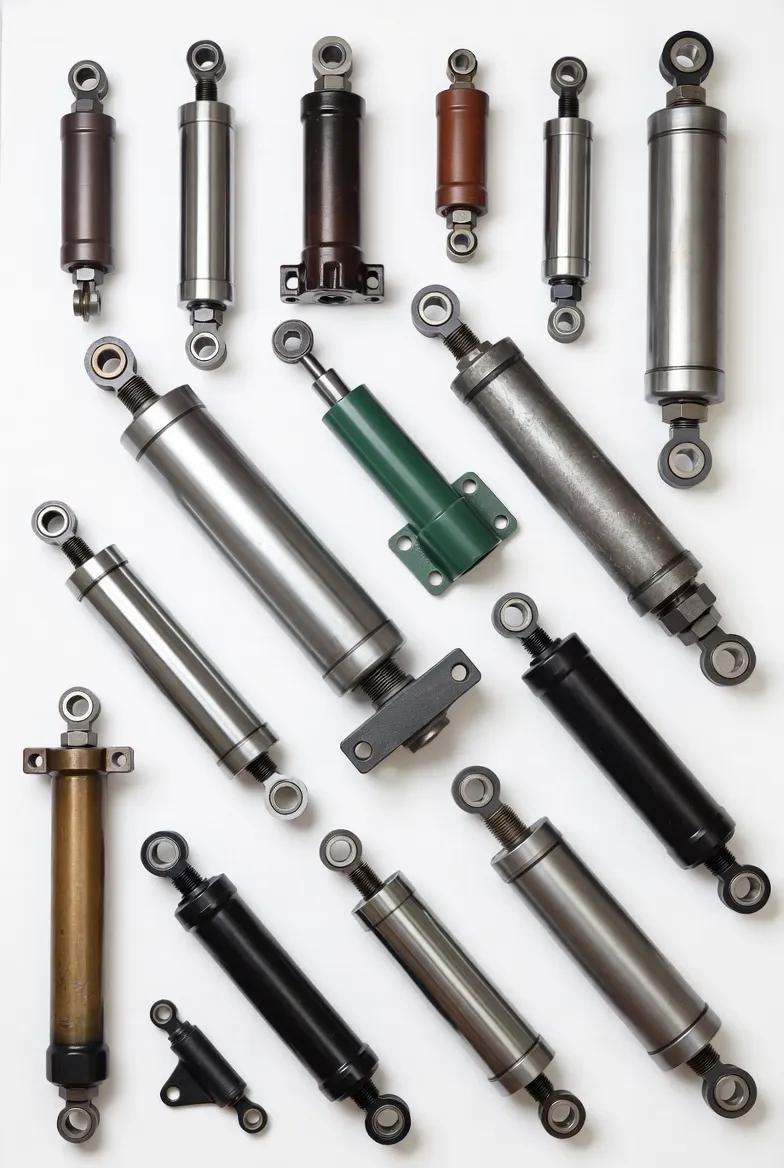
Metric System Calculations
While the United States primarily utilizes the Imperial measurement system (PSI and inches), the vast majority of international engineering, heavy manufacturing, and European mobile equipment utilize the Metric system. Fluid power engineers must be equally fluent in calculating force using Bar and millimeters to operate on a global scale. The core physics equation remains identical (Force = Pressure x Area), but the units require careful management to ensure accurate outcomes.
- ✔️
Metric Pressure Units: In European and Asian fluid power design, hydraulic pressure is almost universally stated in Bar. To convert Bar into the standard scientific unit of force, it must be converted to Newtons per square millimeter. Remember that 1 Bar is equal to 0.1 Newtons per square millimeter (N/mm²).
- ✔️
Metric Area Units: Cylinder bore and rod diameters are typically designated in millimeters (mm). Therefore, the resulting Area calculation will be in square millimeters (mm²). This keeps the mathematical formulas clean and prevents decimal errors.
- ✔️
The Metric Calculation Example: Assume a cylinder has a bore diameter of 100 mm and operates at a pressure of 200 Bar. First, find the radius (50 mm). Calculate the Area: 3.14159 x (50 x 50) = 7,854 mm². Next, convert the pressure: 200 Bar equals 20 N/mm². Finally, calculate the Force: 20 N/mm² x 7,854 mm² = 157,080 Newtons. To make this number more manageable, engineers typically divide by 1,000 to express the final output as 157.08 Kilonewtons (kN).

Real World Variables: Friction and Mechanical Efficiency
The formulas discussed above provide the Theoretical Force. In a perfect, frictionless vacuum, these numbers would be absolute. However, fluid power systems operate in the real, imperfect physical world. When designing machinery, engineers must bridge the gap between theoretical mathematics and physical reality by applying a Mechanical Efficiency Factor to their calculations.
Inside every hydraulic cylinder, tight elastomeric seals are squeezed fiercely against the piston and the rod to prevent high pressure fluid from leaking. While these seals are vital for pressure containment, they create immense physical drag. Furthermore, as fluid rushes through hoses, elbows, and directional control valves, it encounters flow resistance, causing a slight drop in overall system pressure by the time the oil actually reaches the cylinder ports. To account for these inevitable frictional and pressure losses, standard engineering practice dictates multiplying the Theoretical Force by an efficiency coefficient, which typically ranges from 0.85 to 0.95. For a standard, well maintained industrial cylinder, multiplying the calculated theoretical force by 0.90 provides a highly accurate, safe estimate of the Actual Force the machine will deliver on the factory floor.

Conclusion: The Imperative of Mathematical Accuracy
Calculating hydraulic cylinder force is not merely an academic exercise; it is the absolute critical first step in all fluid power system design. Whether you are attempting to calculate hydraulic cylinder push force calculation for an industrial forging press, or determining the hydraulic cylinder pull force required to retract a heavy excavator boom, precision is paramount. By mastering the core physics of Pascal Law, understanding the critical difference between the full bore area and the annular rod area, fluent conversion between Metric and Imperial units, and acknowledging real world mechanical seal friction, engineers can specify equipment with absolute confidence. Utilizing a reliable hydraulic pressure to force calculator combined with deep theoretical knowledge ensures operational safety, maximizes industrial efficiency, and guarantees the long term structural reliability of the world’s most powerful heavy machinery.