
Advanced Kinematics & Structural Engineering
Understanding Hydraulic Cylinder Mounting Styles: A Comprehensive Engineering Guide
An authoritative technical blueprint detailing the physics of rigid flanges, articulating clevises, heavy-duty trunnions, and the definitive kinematic protocols required to eliminate lateral side-loading and prevent catastrophic structural failure.

The Crucial Link Between Fluid Power and Physical Motion
In the highly intensive disciplines of commercial earthmoving, deep underground mining, automated industrial manufacturing, and marine logistics, hydraulic linear actuators are the undisputed muscles that drive extreme mechanical force. They convert the intense hydrostatic pressure of synthetic fluid into unrelenting, perfectly controlled linear kinetic energy. However, the ability of a hydraulic cylinder to successfully move a massive payload relies entirely on a single, highly stressed mechanical variable: how the cylinder is physically anchored to the machine chassis. Understanding the diverse array of hydraulic cylinder mounting styles is not merely a matter of mechanical convenience; it is the absolute foundation of kinematic engineering and structural survival. To explore the absolute highest industry standards for precision-engineered fluid power components and custom mounts, visiting our premium hydraulic cylinders platform is an essential first step.
Specifying the incorrect mounting architecture guarantees catastrophic mechanical failure. If a rigid flange mount is deployed on an articulated machine arm that experiences lateral sway, the immense twisting forces will instantly snap the high-tensile steel piston rod or shatter the cast-iron mounting bracket. Conversely, utilizing an articulating pivot mount on a precision industrial press will result in unacceptable payload deflection and loss of micron-level accuracy. The mount dictates the path of the force. It must seamlessly transfer the extreme linear thrust while simultaneously isolating the delicate internal polyurethane seals and brass bearing guides from destructive, non-linear side loads.
From an authoritative engineering perspective evaluated against international ISO fluid power manufacturing criteria, selecting the correct mounting style requires a rigorous mathematical analysis of the machine’s operational geometry, the stroke length of the actuator, and the absolute trajectory of the driven payload. This comprehensive technical guide will meticulously dissect the physics of fixed and pivot mounting architectures, explore the advanced load-bearing capabilities of trunnion and spherical bearings, and provide the definitive engineering matrix required to ensure your heavy machinery performs flawlessly under extreme stress.
Category 1: Fixed Mounting Styles (Rigid Force)
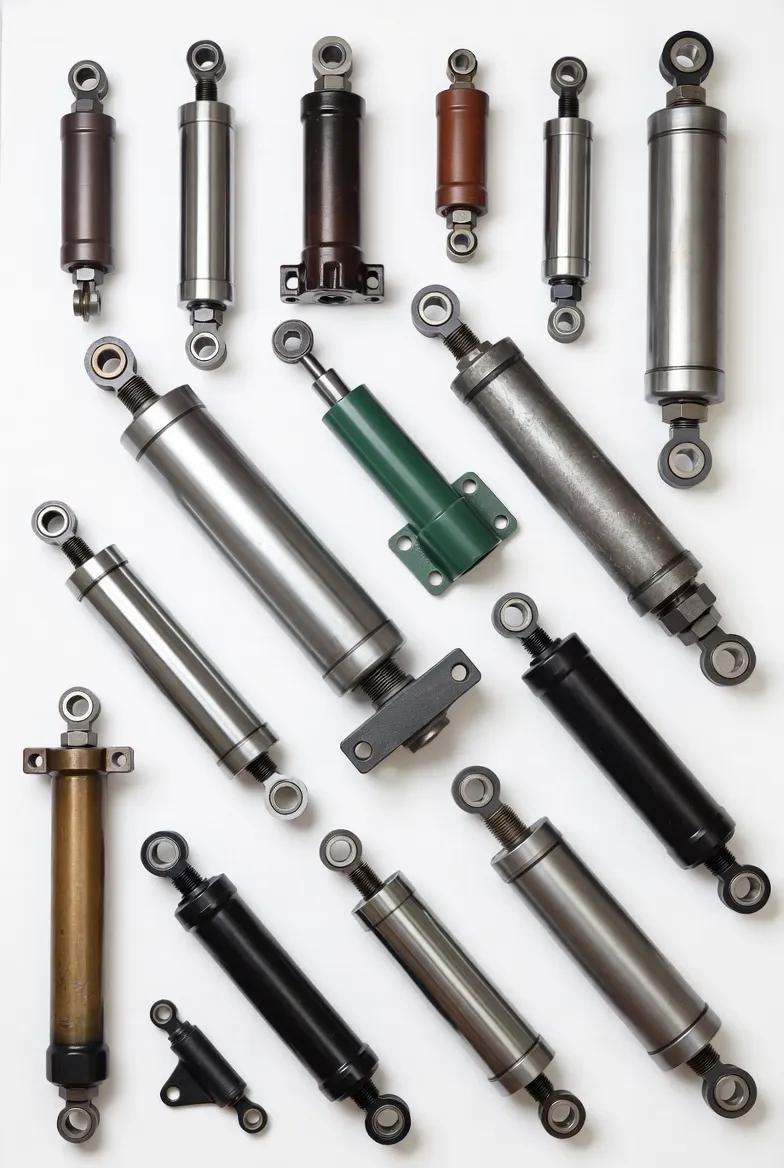
Fixed mounts are engineered to absorb force in a perfectly straight line. They do not allow the cylinder body to articulate, swing, or pivot. They are the absolute standard for stationary industrial machinery.
?
Flange Mounts (Head and Cap)
Flange mounts consist of a thick steel plate projecting from the cylinder, bolted flush against the machine chassis. They can be located at the head (where the rod extends) or the cap (the rear base). A head rectangular flange is exceptionally strong when the cylinder is performing a pulling or tension operation, as the force naturally presses the flange deeper into the machine framework. Conversely, a cap flange is optimal for massive pushing operations, as the entire cylinder barrel is structurally supported from behind. Because they cannot pivot, the payload’s travel path must be flawlessly aligned with the cylinder’s centerline. These are widely utilized in factory press applications.
?
Foot Mounts and Lug Mounts
Foot mounts bolt the side of the cylinder barrel directly to a flat horizontal surface. While highly convenient for installation, they introduce a distinct engineering challenge: the thrust force is offset from the mounting bolts. This creates a severe overturning moment or bending stress on the cylinder body. To mitigate this, engineers must often install heavy-duty thrust keys or shear pins into the machine base to absorb the sheer force, rather than relying entirely on the tensile strength of the mounting bolts. This style is frequently seen in stationary automated logistics equipment like Forklift Hydraulic Cylinders operating mast shift mechanisms.

Category 2: Pivot Mounting Styles (Absorbing the Arc)
When a machine utilizes an articulated arm, a swinging boom, or a tilting bed, the payload does not travel in a straight line; it moves in a radial arc. Fixed mounts would instantly break under these conditions. Pivot mounts are designed to swing along with the payload, ensuring the force remains perfectly axially aligned with the cylinder rod.
The Clevis Mount
The clevis mount is the absolute workhorse of the mobile fluid power industry. It consists of a U-shaped bracket attached to the rear cap of the cylinder, secured to the machine frame by a massive steel pivot pin. This allows the entire cylinder body to swing back and forth in a single plane of motion as the rod extends and pushes a hinged lever. Because the cylinder can articulate, the internal seals are completely protected from bending forces, provided the load remains strictly within the intended arc. Clevis mounts are universally utilized in Agricultural Hydraulic Cylinders to raise and lower heavy implements like plows and planters over uneven terrain.
Spherical Bearings: Conquering Lateral Deflection
A standard clevis mount can only pivot up and down. However, heavy mobile machinery often experiences violent lateral side-to-side twisting as it drives over rocks and trenches. To combat this, advanced actuators utilize spherical bearing mounts (sometimes called swivel eyes). Instead of a rigid pin, the connection point features a hardened steel ball encased within a spherical race. This allows the cylinder to not only pivot up and down but also to twist and rotate freely in multiple directions, completely isolating the actuator from the devastating torsional stress of the chassis. For massive earthmoving equipment, such as Excavator Hydraulic Cylinders, spherical bearings are absolutely mandatory to prevent the chrome rod from bending and destroying the internal seals during asymmetric digging operations.

Category 3: The Heavy-Duty Trunnion Mount
When exceptional stroke length is combined with massive payloads, standard pivot mounts at the base of the cylinder become insufficient due to extreme bending moments. The trunnion mount provides the ultimate center-of-gravity solution.
⚖️
Intermediate (Center) Trunnion
A trunnion mount consists of two massive steel cylindrical pins welded or bolted directly to the sides of the cylinder barrel. When these pins are located in the dead center of the cylinder, it creates an intermediate trunnion. This is a brilliant engineering design because it effectively balances the weight of the massive actuator, allowing it to pivot freely with minimal bearing friction. More importantly, placing the pivot point in the center effectively halves the unsupported length of the extending rod, exponentially increasing the cylinder’s resistance to Euler column buckling under extreme compressive loads.
?️
Telescopic and High-Lift Applications
Head or cap trunnions provide similar pivoting benefits but are anchored at the extreme ends of the barrel. Trunnion mounts are heavily favored in massive, multi-stage telescopic applications. For example, Dump Truck Hydraulic Cylinders frequently utilize extremely robust external trunnions. As the massive cargo bed is elevated to a sixty-degree angle, the trunnion pins absorb the entire weight of the shifting payload while allowing the multi-stage cylinder body to swing freely beneath the truck chassis without binding.
Diagnostic Symptoms of Improper Mounting
When a machine designer specifies the wrong mounting architecture, or when a mount becomes structurally compromised due to fatigue, the hydraulic cylinder will exhibit severe, rapidly accelerating symptoms of destruction.
- ✔️
One-Sided Rod Scoring: If you observe deep, longitudinal scratches on only one side of the chrome piston rod, the cylinder is suffering from severe lateral side-loading. The rigid mount is fighting the natural arc of the machine, forcing the rod to aggressively bend and grind against the internal brass bearing guide. This asymmetrical friction will obliterate the external wiper seal and allow massive environmental contamination into the fluid stream.
- ✔️
Shattered Cast End Caps: When a foot-mounted cylinder lacks proper shear pins or thrust keys, the immense linear force transfers directly into the mounting bolts. As the bolts fatigue and stretch, the cast iron end cap flexes and shatters catastrophically. This indicates a profound miscalculation of the required mounting strength.
- ✔️
Seal Extrusion and Blowout: Bending moments caused by restricted pivot mounts force the internal piston out of perfect concentricity with the barrel. This pinches the polyurethane seals on one side while opening a massive clearance gap on the other, leading to instantaneous high-pressure blowout. In safety-critical applications like Aerial Work Vehicle Hydraulic Cylinders, flawless pin alignment and spherical bearings are non-negotiable to prevent lethal fluid loss and platform free-fall.


Conclusion: Architecting Flawless Force Transmission
Understanding hydraulic cylinder mounting styles is not a trivial design afterthought; it is the absolute foundation of successful fluid power engineering. A massive steel pressure vessel generating hundreds of tons of force is entirely useless—and incredibly dangerous—if that energy is not flawlessly transferred to the machine chassis. By abandoning rigid flange mounts in mobile applications and adopting articulating clevises, integrating heavy-duty trunnions to combat long-stroke column buckling, and deploying advanced spherical bearings to eradicate destructive lateral twisting, design engineers can guarantee unparalleled mechanical reliability. Correctly anchoring your hydraulic actuators eliminates asymmetric wear, protects critical elastomeric boundaries, and ensures your heavy machinery performs with safe, unrelenting kinetic force. If your organization is suffering from repetitive structural fatigue, broken rods, or frequent seal blowouts, our specialized engineering team stands ready to re-architect your mounting protocols and provide world-class custom fluid power solutions.