
Fluid Power Engineering Masterclass
The Ultimate Guide to Hydraulic Cylinders: How They Work and Key Components
An authoritative technical blueprint exploring the metallurgical architecture, fluid dynamic principles, critical internal components, and advanced industrial applications of modern fluid power actuators.

The Mechanical Muscles of the Industrial World
In the highly rigorous and mathematically precise disciplines of heavy equipment manufacturing, automated industrial fabrication, marine engineering, and commercial agriculture, fluid power systems represent the undisputed pinnacle of controlled kinetic force. If you observe any major construction site, shipping port, or modern manufacturing facility, you will witness immense mechanical feats: excavators tearing through solid bedrock, massive injection molding machines clamping shut with thousands of tons of force, and specialized aerial lifts raising heavy payloads effortlessly into the sky. The hidden driving force behind all of this monumental mechanical power is the linear actuator. To explore the industry standard in fluid power, you can visit our premium hydraulic cylinders platform. These robust devices convert the hydrostatic energy of pressurized fluid into unrelenting linear motion. Understanding the ultimate guide to hydraulic cylinders, specifically how they work and their key components, is absolutely essential knowledge for any fluid power engineer, system designer, or equipment maintenance professional.
Unlike electrical motors that rely on magnetic fields or pneumatic systems that use highly compressible air, hydraulic systems utilize the fundamental laws of fluid dynamics to achieve their incredible power output. Because liquids are practically incompressible, hydraulic cylinders provide an exceptionally rigid, smooth, and highly controlled application of force. They can hold massive loads perfectly suspended in mid-air for hours without requiring continuously applied energy, and they can deliver instant, maximum breakout torque from a dead stop. A hydraulic cylinder operates under a unique set of punishing conditions. It must contain extreme internal hydrostatic pressures that routinely exceed three thousand to five thousand pounds per square inch, while simultaneously defending itself against hostile external environments filled with abrasive dust, corrosive chemicals, and violent physical shock loads.
From a highly authoritative engineering perspective evaluated against international fluid power manufacturing standards, a hydraulic cylinder is a masterpiece of metallurgical science and polymer chemistry. It is not a single piece of metal, but rather a highly complex, synchronized assembly of precision machined components working in perfect unison. This comprehensive, highly detailed technical engineering manual will meticulously dissect the fundamental physics of hydrostatic force, break down every critical internal component, explore various structural configurations, and detail the advanced maintenance protocols required to ensure flawless operational reliability in the modern industrial landscape.
The Core Principle: How Hydraulic Cylinders Work
Before examining the physical hardware, it is vital to understand the foundational fluid physics that allow a relatively compact steel tube to generate hundreds of tons of linear force. The entire science of fluid power rests upon a singular law of physics.
Pascal Principle and Force Multiplication
Discovered by the French mathematician Blaise Pascal, this fundamental law states that pressure applied to a confined, incompressible fluid is transmitted equally and undiminished in all directions throughout the fluid. In practical engineering terms, Force equals Pressure multiplied by Area. When a hydraulic pump forces pressurized oil into the cylinder barrel, that fluid seeks a path to expand. It pushes against the circular face of the internal piston. Because the piston has a large surface area, even a moderate fluid pressure translates into a massive mechanical pushing force. By increasing either the bore size area or the system pressure, engineers can exponentially multiply the output tonnage of the actuator.
Differential Velocity Dynamics
While force is dictated by pressure and area, the speed at which the cylinder extends is dictated by the pump flow rate in gallons per minute and the internal volume of the cylinder. A critical kinematic reality of standard double acting cylinders is differential volume. During extension, fluid fills the entire rear chamber. During retraction, fluid fills the front chamber, but a large portion of that physical space is already occupied by the steel piston rod. Because there is less empty volume to fill on the rod end, a constant pump flow will cause the cylinder to retract significantly faster than it extends. Engineers must carefully calculate these velocity differentials when designing automated machinery.

Anatomical Breakdown: The Key Components of a Hydraulic Cylinder
A fluid power linear actuator is constructed from several highly specialized subcomponents. The failure of any single part will instantly compromise the entire pressure vessel and lead to debilitating machine downtime.
1. The Cylinder Barrel (The Tube)
The barrel is the primary exterior body of the actuator. It functions as the ultimate pressure containment vessel. Manufactured from high yield strength, seamless cold drawn carbon steel, the barrel must endure massive outward hydrostatic forces without ballooning or rupturing. The interior wall of the barrel undergoes a highly sophisticated micro honing process. This creates a mirror smooth finish with a microscopic cross hatch pattern, which is absolutely critical for retaining a thin film of lubricating hydraulic oil to prevent the internal seals from experiencing dry friction.
2. The Piston and Dynamic Seals
The piston is the solid steel dividing wall that moves linearly within the barrel. It separates the high pressure extension chamber from the low pressure return chamber. Wrapped around the outer circumference of the piston are the primary dynamic seals typically energized PTFE rings or heavy duty polyurethane U-cups. These seals bridge the microscopic clearance gap between the piston and the barrel wall. If these seals degrade or extrude due to fluid contamination or extreme pressure spikes, the high pressure fluid will bypass the piston, resulting in severe heat generation and a total loss of lifting power.
3. The Piston Rod (The Ram)
The piston rod is the physical bridge that transmits the internal kinetic force to the external machinery. Because it acts as a slender column under compression, it must possess immense core yield strength to prevent Euler buckling. Standard rods are manufactured from medium carbon steel, while extreme heavy duty applications utilize chromoly alloy steel. To protect the rod from severe environmental abrasion and chemical corrosion, the exterior is coated with a diamond hard layer of electroplated chromium, and frequently induction hardened to prevent rock strikes from denting the underlying steel.
4. The Head Gland and Base Cap
The ends of the barrel are sealed by the base cap (the blind end) and the head gland (the rod end). The base cap is a solid steel block that anchors the cylinder to the machine and houses the primary fluid entry port. The head gland is significantly more complex. It is a highly machined block that the piston rod slides through. It contains internal brass or composite bearing bands to guide the rod and absorb lateral side loading forces. Crucially, the head gland houses the primary rod seal to contain the internal pressure, and an aggressive external wiper seal designed to scrape abrasive dirt and ice off the retracting rod.

Structural Classifications: Tie-Rod vs. Welded Body
The industrial applications of a hydraulic cylinder are largely dictated by its external structural architecture. Engineers must choose between two highly distinct manufacturing paradigms based on environmental hostility and spatial constraints.
Tie-Rod Hydraulic Cylinders
Tie rod cylinders dominate indoor factory automation, plastic injection molding, and machine tool operations. They are characterized by square end caps and high strength external threaded rods that physically clamp the assembly together. Because they adhere to strict dimensional standards, they are incredibly easy to replace. Furthermore, a technician can rapidly dismantle a tie rod cylinder right on the assembly line using standard hand tools to replace degraded seals, minimizing critical manufacturing downtime. However, their bulky footprint and susceptibility to tensile rod stretching under severe shock loads make them less suitable for mobile construction environments.
Welded Body Hydraulic Cylinders
Welded body cylinders are the absolute standard for heavy mobile equipment, including earthmovers, bulldozers, and agricultural harvesters. The base cap and mounting clevises are permanently welded directly to the seamless steel barrel, creating a monolithic, incredibly rigid pressure vessel. Without the protruding tie rods, these cylinders present a sleek, narrow profile that fits easily into confined machine linkages. In highly abusive environments, equipment like Excavator Hydraulic Cylinders rely entirely on this robust welded design to survive violent rock strikes and heavy side loading without suffering structural blowouts.
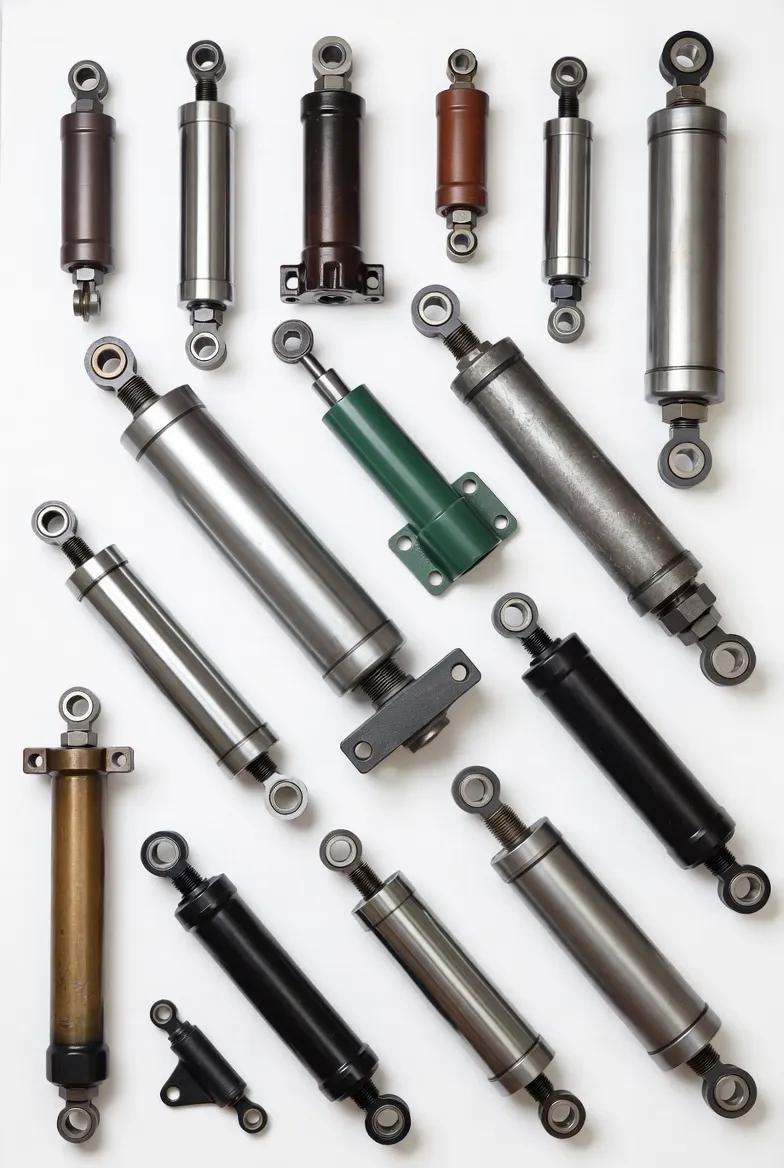
Application Specific Designs: Telescopic and Specialized Actuators
Standard rod style hydraulic cylinders face an inescapable geometric limitation: their extended stroke can never exceed roughly twice their collapsed length. This is highly problematic for mobile equipment which requires an incredibly long extended reach but has very little installation space beneath the chassis.
- ✔️
Multi-Stage Nested Architecture: Telescopic cylinders solve this spatial dilemma by utilizing a nested structure. They consist of a main outer barrel and several descending diameter hollow tubes known as stages or sleeves. The fluid pressure forces the largest stage to extend first, providing massive breakout tonnage. This brilliant kinematics allows a telescopic cylinder to achieve an extended length up to six times greater than its compact retracted footprint. They are heavily utilized as Dump Truck Hydraulic Cylinders for immense vertical lifting capabilities on tipping trailers and heavy haulers.
- ✔️
Precision Material Handling: When lifting delicate or massive payloads in a distribution warehouse, Forklift Hydraulic Cylinders employ specialized valving and internal cushioning to prevent sudden drops and ensure millimeter perfect load placement. Similarly, Agricultural Hydraulic Cylinders are engineered with robust seals to withstand constant exposure to abrasive fertilizers, mud, and extreme weather conditions.

Predictive Maintenance and The Future of Fluid Power
A hydraulic cylinder is only as reliable as the preventative maintenance protocols protecting it. The absolute deadliest enemies of fluid power are abrasive particulate contamination and lateral side loading. If dirt bypasses the external wiper seal, it embeds in the internal polymers, transforming the seals into liquid sandpaper that destroys the honed barrel. Furthermore, if machine mounting brackets become worn, the cylinder is subjected to severe lateral bending moments that will permanently warp the hardened chrome rod.
The future of fluid power lies in the integration of predictive maintenance. Modern high end cylinders can be equipped with embedded linear position sensors, extreme resolution pressure transducers, and vibration monitors. This advanced digital diagnostic telemetry allows fleet managers to execute predictive maintenance—detecting microscopic internal seal bypass or impending structural fatigue and replacing the components during planned factory downtime. This entirely eliminates the devastating financial costs of sudden, catastrophic machine failures on the production floor.

Conclusion: Mastering the Science of Force
The ultimate guide to hydraulic cylinders reveals that these machines are a masterful synthesis of metallurgical strength, polymer durability, and profound thermodynamic physics. From understanding the core fluid dynamic principles of Pascal Law to breaking down the key components like the piston, barrel, and high-strength rod, it is clear why these actuators drive modern industry. By understanding the critical differences between welded and tie rod architectures, respecting the devastating consequences of side loading, and embracing rigorous predictive maintenance, engineering professionals can harness fluid power safely and efficiently. Selecting the correct hydraulic cylinder ensures that whether automating a pristine aerospace assembly line or digging the foundations of modern infrastructure, the machinery will perform with absolute, unyielding, and flawless mechanical reliability. For specialized high reach tasks, Aerial Work Vehicle Hydraulic Cylinders exemplify the precise engineering required to ensure absolute safety and stability at extreme heights.