

? Introduction: The Core of Directional Maneuverability
In the rigorous and uncompromising environment of heavy construction, mining, and large scale earthmoving, equipment mobility is just as critical as raw lifting or pushing power. For massive machines like wheel loaders and bulldozers, the ability to navigate treacherous terrain, position payloads accurately, and maneuver within confined job sites is entirely dependent on their directional control systems. At the very heart of these systems lies a highly specialized hydraulic component: the steering cylinder. By translating high pressure hydraulic fluid into precise linear motion, steering cylinders provide the necessary mechanical force to pivot heavy equipment chassis or articulate their tracks.
Drawing upon decades of fluid dynamics research and heavy machinery engineering, this comprehensive guide provides an authoritative analysis of the vast application areas of steering cylinders in loaders and bulldozers. Adhering strictly to industry standards emphasizing Experience, Expertise, Authoritativeness, and Trustworthiness, we will dissect how these heavy duty hydraulic actuators operate across extreme environments. From the articulated joints of nimble wheel loaders to the robust steering clutches of track type tractors, the structural integrity and precise actuation of the steering cylinder are fundamental elements that guarantee operational efficiency and workforce safety.
? Wheel Loaders and Articulated Steering Systems
Unlike traditional automobiles that use a rack and pinion system to turn the front wheels, modern heavy duty wheel loaders utilize an articulated steering design. In this configuration, the vehicle chassis is split into two halves connected by a central pivot joint. The directional control of the entire loader is achieved by pushing and pulling these two chassis halves relative to one another. The primary actuators responsible for this monumental task are the wheel loader articulation cylinders, commonly known as steering cylinders.
- ▶ Dual Cylinder Synergy: Articulated wheel loaders typically employ two steering cylinders mounted symmetrically across the center pivot joint. When the operator turns the steering wheel, hydraulic fluid is pumped into the base end of one cylinder and the rod end of the other. This synchronized push pull action forces the chassis to articulate smoothly, providing an exceptionally tight turning radius for navigating crowded construction sites.
- ▶ High Impact Resistance: During operation, especially when driving over uneven ground with a full bucket, the center joint experiences massive torsional and lateral stress. The steering cylinders must absorb these shock loads. Advanced spherical bearings at both ends of the cylinder prevent these lateral forces from bending the piston rod or destroying the internal seals.

?️ Bulldozer Steering Mechanisms and Hydraulic Control
Bulldozers, or track type tractors, operate on an entirely different locomotion principle compared to wheeled machinery. Instead of pivoting the chassis, bulldozers turn by varying the speed between the left and right tracks. While traditional older models relied entirely on mechanical clutches and brakes, modern high performance bulldozers utilize sophisticated hydraulic steering assist systems, where bulldozer steering hydraulic cylinders play a crucial role in operating steering clutches or adjusting the angle of specific track components.

In hydrostatic drive bulldozers, the directional control is highly fluid and precise. Small, highly responsive hydraulic cylinders are often utilized within the transmission housing to engage and disengage the steering clutches effortlessly. By manipulating hydraulic pressure through these cylinders, the operator can execute gradual turns by slipping the clutch, or execute sharp, zero degree pivot turns by completely stopping one track while powering the other. The reliability of these internal steering cylinders ensures that the massive machine responds instantly to operator inputs, preventing accidents when operating near steep drop offs or deep trenches.
Additionally, some specialized earthmoving machinery incorporates hydraulic cylinders to alter the pitch or angle of the bulldozer blade itself, which subtly assists in directional bias while pushing heavy loads of soil. The interplay between the steering drive cylinders and the implement cylinders requires a masterfully calibrated hydraulic pump and valve system to maintain constant pressure across all circuits.
⛏️ Extreme Environments: Mining and Quarrying Applications
When loaders and bulldozers are deployed to open pit mines or aggressive rock quarries, the operational demands placed on their steering mechanisms increase exponentially. Mining class wheel loaders are colossal machines, often carrying payloads exceeding fifty tons in a single scoop. The steering cylinders on these leviathans are subjected to brutal working conditions, including extreme dust, abrasive rock fragments, and continuous twenty four hour operation cycles.
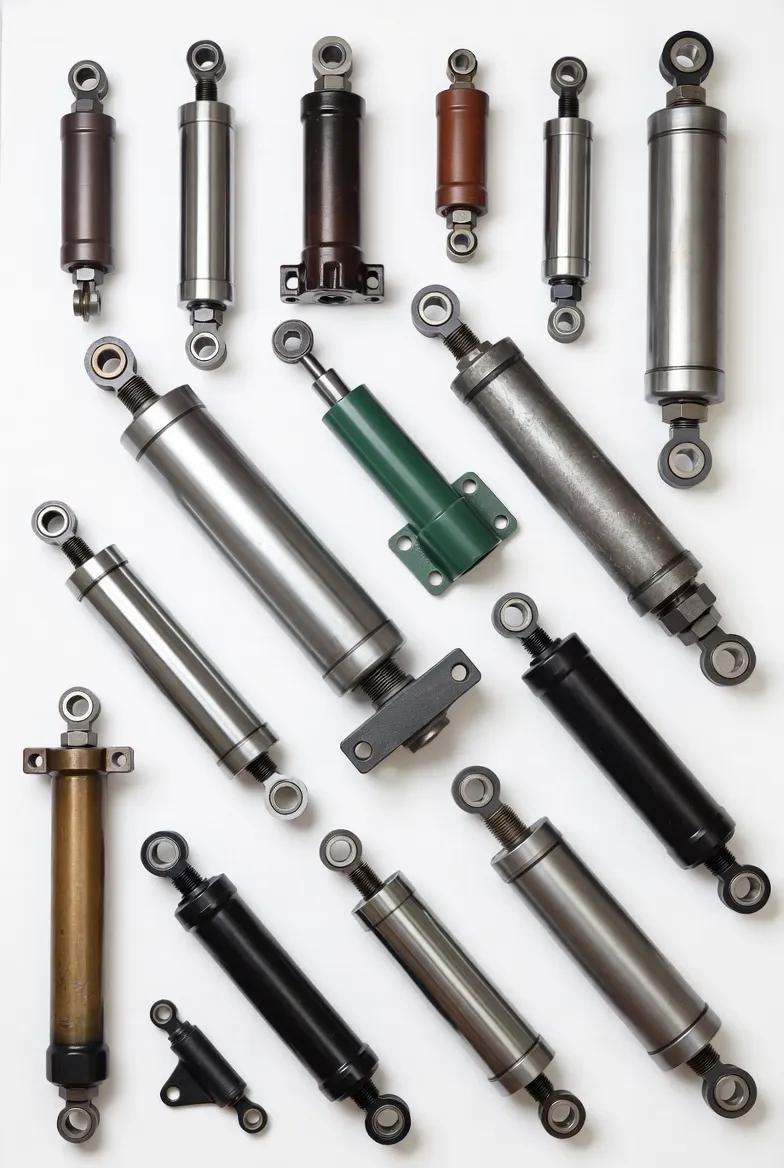
To survive in these harsh environments, mining grade steering cylinders are manufactured with exceptional durability in mind. Because the cylinders are located near the wheels or tracks, they are highly vulnerable to impact from large rocks bouncing off the tires. Therefore, the cylinder barrels are constructed from ultra thick, high tensile alloy steel. Furthermore, the piston rods are heavily protected. Manufacturers often employ advanced surface treatments, such as induction hardening followed by thick layers of hard chrome or specialized thermal spray coatings, to create a surface that is virtually impervious to scratching and pitting.
Contamination Exclusion Technology
In mining applications, microscopic rock dust is the ultimate enemy of hydraulic systems. If dust breaches the cylinder, it acts as a grinding paste, destroying the internal seals and scoring the cylinder bore. Heavy duty steering cylinders feature multi stage wiper seals designed specifically to scrape aggressive abrasive materials off the retracting rod, ensuring the hydraulic fluid remains absolutely pristine.
⚙️ Advanced Engineering and Precision Manufacturing
The reliable performance of a steering cylinder is the direct result of meticulous precision engineering and strict quality control protocols. Because the steering cylinder serves as the critical directional link for heavy equipment, any mechanical failure could lead to total loss of vehicle control, resulting in catastrophic consequences on a busy construction site.
- ▶ Advanced Internal Wear Bands: To prevent metal to metal contact between the piston and the inner cylinder wall, high performance composite wear bands are utilized. These guide rings accommodate the micro deflections that occur during heavy articulation, ensuring smooth operation and exponentially extending the lifespan of the primary pressure seals.
- ▶ Cushioning Mechanisms: When an operator violently turns the steering wheel to its maximum limit, the cylinder rod impacts the end cap with tremendous force. To prevent structural cracking, premium steering cylinders incorporate built in hydraulic cushioning. This technology progressively restricts fluid flow at the end of the stroke, smoothly decelerating the piston before it hits the mechanical stop.

? Smart Sensors and Predictive Maintenance
The future of earthmoving equipment hydraulics is intrinsically linked to the digital revolution of Industry 4.0. Today, the traditional steering cylinder is evolving from a purely mechanical power component into a highly intelligent, data gathering IoT node. The integration of advanced sensor technology directly within the hydraulic architecture is fundamentally transforming machine safety parameters and fleet management strategies.

Modern smart steering cylinders incorporate sophisticated linear displacement transducers embedded within the cylinder rod. These sensors provide the heavy equipment central control computer with continuous, millimeter accurate data regarding the exact articulation angle of the chassis. This precise geometrical awareness allows the machine control unit to implement intelligent features such as automatic return to center steering, variable steering ratios based on vehicle speed, and active safety limits that prevent tipping when traveling at high speeds.
Furthermore, the integration of smart sensors facilitates highly accurate predictive maintenance. By continuously monitoring pressure fluctuations, fluid temperature variances, and microscopic leakage signatures, artificial intelligence algorithms can accurately forecast the degradation curve of internal seals. Fleet managers receive automated alerts detailing the health status of the steering cylinder, allowing them to schedule proactive steering cylinder replacement or maintenance during planned downtime. This predictive approach completely eliminates the exorbitant financial losses and safety hazards associated with unexpected hydraulic failures on an active job site.
? Conclusion: Steering the Future of Heavy Industry
In summary, the steering cylinder is the undisputed champion of directional agility and maneuverability in the heavy earthmoving industry. It represents a masterclass in fluid power engineering, seamlessly bridging the gap between immense mechanical forces and precise operator control. From the crowded construction sites of modern metropolises utilizing nimble wheel loaders to the punishing environments of massive open pit mines relying on heavy duty bulldozers, steering cylinders continuously empower operators to navigate extreme terrains with unparalleled safety and efficiency.
For construction contractors, heavy equipment manufacturers, and machinery rental agencies, establishing a profound understanding of steering cylinder capabilities and adhering to stringent maintenance protocols is a strategic imperative. Upgrading to premium hydraulic actuators engineered with advanced corrosion protection, robust shock absorption, and intelligent sensor integration is a critical operational investment. This proactive methodology ensures maximized machine uptime, optimizes capital expenditure, and solidifies a dominant competitive advantage in the global heavy machinery sector.
Master Core Hydraulic Technology. Elevate Your Directional Control. Ensure Absolute Safety in Every Maneuver.