
Fluid Power System Engineering
How to Calculate Hydraulic Cylinder Flow Rate Requirements?
A comprehensive technical methodology for determining volumetric flow demands of linear actuators, covering piston area relationships, velocity targets, and pump sizing for optimal fluid power system performance.

The Critical Role of Flow Rate in Hydraulic Cylinder Performance
In the precise and demanding domain of fluid power system design, understanding how to calculate hydraulic cylinder flow rate requirements is absolutely fundamental to achieving desired actuator performance, selecting appropriately sized pumps and valves, and ensuring overall system efficiency. The volumetric flow rate of hydraulic fluid supplied to a cylinder directly governs the velocity at which the piston extends and retracts, which in turn determines machine cycle times, production throughput, and operational responsiveness. An incorrectly calculated flow requirement can lead to sluggish cylinder movement that fails to meet productivity targets, or conversely, to the specification of an oversized and unnecessarily expensive hydraulic power unit that wastes energy and generates excessive heat.
The relationship between hydraulic cylinder flow rate and piston velocity is elegantly straightforward yet profoundly consequential. For any given cylinder, the piston speed is directly proportional to the flow rate entering the cylinder and inversely proportional to the effective piston area upon which that flow acts. This fundamental relationship means that calculating flow requirements is essentially an exercise in determining how much fluid volume per unit time must be delivered to move a piston of known area at a specified velocity. However, the practical application of this principle demands careful consideration of differential cylinder areas during extension versus retraction, the effects of rod diameter on annular flow requirements, and the volumetric losses that occur due to internal leakage and fluid compressibility under varying pressure and temperature conditions.
This exhaustive technical guide provides a complete methodology for calculating hydraulic cylinder flow rate requirements across a wide range of applications. We will explore the fundamental equations governing flow and velocity, develop step by step calculation procedures for both extension and retraction strokes, examine the impact of cylinder configuration including single rod and double rod designs, and address advanced considerations such as the influence of fluid compressibility, temperature effects on viscosity and leakage, and the sizing of pumps and directional control valves to meet calculated flow demands. By mastering these flow calculation techniques, fluid power engineers and system designers can ensure that hydraulic cylinders deliver the precise speed and responsiveness required for optimal machine performance.
Fundamental Flow Rate Equations for Hydraulic Cylinders
The foundation of hydraulic cylinder flow rate calculation rests upon the precise mathematical relationship between volumetric flow, effective piston area, and resulting piston velocity.
The Basic Flow Velocity Equation
The fundamental equation for calculating hydraulic cylinder flow rate requirements is expressed as Flow Rate equals Piston Velocity multiplied by Effective Piston Area. In consistent units, if velocity is expressed in inches per minute and area in square inches, the resulting flow rate will be in cubic inches per minute. To convert to the more common industrial unit of gallons per minute, the result must be divided by 231, the number of cubic inches in one US gallon. This basic relationship can be rearranged to solve for any of the three variables depending upon which parameters are known and which is being sought. When calculating flow rate requirements, the target piston velocity is typically derived from cycle time specifications and stroke length, while the effective area is determined by the cylinder bore diameter for extension strokes or the annular area for retraction strokes.
Effective Area Calculations for Extension and Retraction
Accurate hydraulic cylinder flow rate calculation demands precise determination of the effective piston area for each direction of motion. For the extension stroke, the full piston area is applicable and is calculated as Area equals pi multiplied by the square of the bore diameter divided by four. For the retraction stroke of a single rod cylinder, the effective area is the annular area on the rod side of the piston, calculated as the full piston area minus the cross sectional area of the piston rod. The cross sectional area of the rod is similarly calculated using the rod diameter. Because the annular area is always smaller than the full piston area, a given flow rate will produce a faster retraction velocity than extension velocity. This characteristic must be carefully considered when calculating flow requirements for applications where both extension and retraction speeds are critical to overall cycle time performance.

Step by Step Methodology for Calculating Cylinder Flow Requirements
A systematic approach to hydraulic cylinder flow rate calculation ensures that all relevant factors are properly considered and that the resulting flow specification will meet application performance requirements.
1️⃣Determine Required Piston Velocities
The first step in calculating hydraulic cylinder flow rate requirements is to establish the target piston velocities for both extension and retraction strokes. These velocities are derived from the required cycle time and the cylinder stroke length. For a simple reciprocating application where the cylinder must extend a distance of twenty four inches and retract the same distance within a total cycle time of six seconds, with equal time allocated to extension and retraction, each stroke must be completed in three seconds. The average velocity is then eight inches per second, or four hundred eighty inches per minute. It is important to note that actual cylinder velocity profiles are not perfectly constant due to acceleration and deceleration phases, so average velocity calculations provide a reasonable basis for initial flow requirement estimation. For more precise calculations, the maximum velocity achieved during the constant velocity portion of the stroke should be used, as this represents the peak flow demand on the hydraulic system.
2️⃣Calculate Effective Areas for the Selected Cylinder
With the target velocities established, the next step is to calculate the effective piston areas based on the selected cylinder bore and rod diameters. For a cylinder with a four inch bore, the full piston area is pi times four squared divided by four, yielding approximately twelve point five seven square inches. If this cylinder is equipped with a two inch diameter piston rod, the rod cross sectional area is three point one four square inches. The annular area on the rod side, which governs retraction flow requirements, is twelve point five seven minus three point one four, equaling nine point four three square inches. These area values are fundamental constants for the selected cylinder configuration and will be used in all subsequent flow rate calculations for this actuator.

Advanced Considerations in Flow Rate Calculation
Beyond the basic flow velocity relationship, several advanced factors influence the actual flow rate required to achieve desired hydraulic cylinder performance.
Internal Leakage and Volumetric Efficiency
All hydraulic cylinders experience some degree of internal leakage across the piston seal, particularly as components wear over time or when operating at elevated temperatures that reduce fluid viscosity. This internal leakage represents flow that bypasses the piston without contributing to useful mechanical motion, effectively reducing the volumetric efficiency of the actuator. When calculating hydraulic cylinder flow rate requirements for precise applications or for systems expected to operate over long maintenance intervals, it is prudent to apply a volumetric efficiency factor to account for anticipated leakage. A typical volumetric efficiency for a new, well manufactured cylinder might range from ninety seven to ninety nine percent, but this can degrade to below ninety percent in worn cylinders or high temperature service. The theoretical flow requirement should be divided by the volumetric efficiency to determine the actual flow that must be supplied to achieve the target velocity.
Fluid Compressibility and Bulk Modulus Effects
Although hydraulic fluid is often treated as incompressible in basic calculations, all fluids exhibit some degree of compressibility characterized by their bulk modulus. Under the high pressures typical of hydraulic systems, the volume reduction due to compression can become significant, particularly in systems with long fluid columns or large fluid volumes. This compressibility effect means that the pump must deliver additional flow to compress the fluid to operating pressure before any piston motion occurs, and to maintain that pressure as the load moves. In high performance or high precision applications, this additional flow requirement should be accounted for in the overall flow rate calculation. The effective bulk modulus of the hydraulic system is reduced by the presence of entrained air and the compliance of hoses and tubing, further increasing the required flow to achieve a given velocity profile.
Regenerative Circuit Flow Considerations
In regenerative hydraulic circuits, fluid discharged from the rod side of the cylinder is routed back to the piston side during extension, supplementing the flow from the pump. This configuration allows a smaller pump to achieve higher extension velocities than would otherwise be possible, but it fundamentally alters the flow rate calculation methodology. The effective flow into the piston side becomes the sum of the pump flow plus the regenerative flow from the rod side. The regenerative flow rate is determined by the rod side annular area and the extension velocity. Calculating the required pump flow for a regenerative circuit requires solving simultaneous equations that account for this flow recirculation. The ratio of bore area to rod area determines the degree of regeneration and the resulting speed enhancement factor, making rod diameter selection a critical parameter in regenerative circuit design.
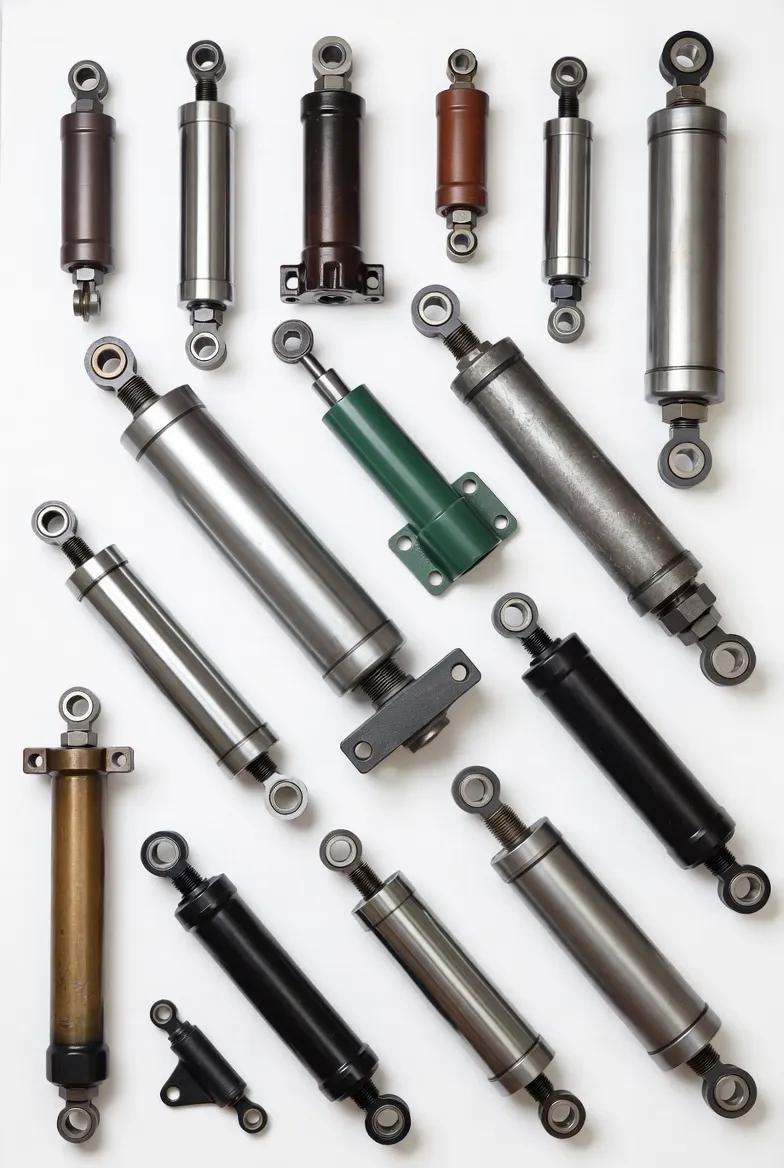
Practical Flow Calculation Examples and Pump Sizing
Applying the hydraulic cylinder flow rate calculation methodology to real world scenarios illustrates the practical importance of accurate flow determination for proper pump and system component sizing.
- ?
Example Calculation: Single Cylinder Industrial Press Application: Consider a hydraulic press utilizing a six inch bore cylinder with a three inch diameter rod, requiring an extension stroke of thirty inches to be completed in four seconds. The average extension velocity is four hundred fifty inches per minute. The full piston area is approximately twenty eight point two seven square inches. The theoretical flow requirement is four hundred fifty inches per minute multiplied by twenty eight point two seven square inches, yielding twelve thousand seven hundred twenty one cubic inches per minute. Converting to gallons per minute by dividing by two hundred thirty one gives approximately fifty five gallons per minute. Accounting for a volumetric efficiency of ninety five percent, the required pump flow increases to approximately fifty eight gallons per minute. This flow demand, combined with the system operating pressure required to generate pressing force, determines the hydraulic power requirement for pump motor sizing.
- ?
Multiple Cylinder Flow Aggregation: In hydraulic systems with multiple cylinders operating simultaneously, the total flow requirement is the sum of the individual cylinder flow demands during concurrent operation. If a machine incorporates three identical cylinders that must extend together, the total pump flow must be three times the single cylinder requirement. However, if the cylinders operate sequentially rather than simultaneously, the pump can be sized based on the largest individual flow requirement, potentially reducing system cost and energy consumption. Careful analysis of the machine cycle and cylinder actuation sequence can reveal opportunities for flow optimization and pump downsizing that yield significant capital and operating cost savings.
- ?
Valve Sizing Based on Calculated Flow Requirements: The calculated hydraulic cylinder flow rate directly informs the selection of directional control valves, flow control valves, and other circuit components. Valves must be sized with sufficient flow capacity to pass the required flow without excessive pressure drop, which would waste energy and generate heat. A common guideline is to select valves with a rated flow capacity at least ten to twenty percent greater than the calculated maximum system flow. Additionally, the pressure drop characteristics of the selected valve at the calculated flow rate should be evaluated to ensure that the resulting pressure loss does not compromise the available force at the cylinder or necessitate an increase in system operating pressure.

Optimizing Flow Requirements Through System Design
Beyond simply calculating the flow rate required for a given cylinder and velocity, experienced fluid power engineers employ various strategies to optimize flow demands and reduce overall system cost and energy consumption.
Differential Cylinder Sizing Strategies
Since the annular area on the rod side is smaller than the full piston area, the retraction stroke inherently requires less flow than the extension stroke for a given velocity. This characteristic can be exploited by designing the machine cycle such that the retraction stroke is the high speed portion of the cycle, reducing the maximum flow demand on the pump. In some applications, the bore diameter may be selected primarily based on force requirements, while the rod diameter is chosen to achieve a specific annular area that optimizes flow balance between extension and retraction. Larger rod diameters reduce the annular area and further decrease retraction flow requirements, which can be beneficial when retraction speed is the primary driver of cycle time.
Double Rod Cylinders for Balanced Flow
Double rod hydraulic cylinders, which feature a piston rod extending from both ends of the cylinder, provide equal effective areas on both sides of the piston. This configuration eliminates the flow imbalance between extension and retraction, simplifying flow calculations and allowing the use of a smaller pump when bidirectional speed symmetry is required. Double rod cylinders also eliminate the differential volume that must be accommodated by the reservoir as fluid levels change with cylinder position. The primary trade off is increased overall length and the need to provide clearance for the second rod, but in applications where balanced flow characteristics are paramount, double rod cylinders offer distinct advantages for hydraulic cylinder flow rate optimization.
Accumulator Assisted Flow Augmentation
In applications characterized by intermittent high speed cylinder movements with substantial dwell periods between cycles, hydraulic accumulators can be employed to reduce the required pump size. The accumulator stores pressurized fluid during idle periods and releases it during high demand portions of the cycle, effectively supplementing pump flow. This approach allows the use of a smaller, more energy efficient pump sized for average flow requirements rather than peak instantaneous demand. When calculating hydraulic cylinder flow rate requirements for accumulator assisted systems, the pump must be sized to deliver the average flow over the complete duty cycle, while the accumulator capacity is determined by the volume of fluid required during the peak flow period minus the volume supplied by the pump during that same interval.
Mastering how to calculate hydraulic cylinder flow rate requirements is an indispensable skill for fluid power system designers and application engineers. Accurate flow calculations ensure that pumps, valves, and conductors are properly sized to deliver the required actuator performance while avoiding the inefficiencies and costs associated with oversized components.

Conclusion: Precision in Hydraulic Cylinder Flow Calculation
The ability to accurately calculate hydraulic cylinder flow rate requirements is a cornerstone competency in fluid power engineering that directly influences system performance, capital cost, and operational efficiency. The fundamental relationship between flow rate, effective area, and piston velocity provides a straightforward basis for initial calculations, but achieving optimal results demands consideration of numerous additional factors including differential cylinder areas, volumetric efficiency losses due to internal leakage, the effects of fluid compressibility under pressure, and the flow augmentation possibilities offered by regenerative circuits and accumulator supplementation. By applying the systematic calculation methodologies and optimization strategies detailed in this guide, engineers can confidently determine the precise flow requirements for any hydraulic cylinder application, enabling the selection of appropriately sized pumps, valves, and associated components. This disciplined approach to flow calculation ensures that hydraulic systems deliver the intended speed and responsiveness while minimizing energy consumption, heat generation, and total lifecycle cost.