

Vérin de bras pour pelle hydraulique Case CX300B
En tant que fabricant, fournisseur et exportateur de produits mécaniques, nous proposons des vérins hydrauliques et de nombreux autres produits.
N'hésitez pas à nous contacter pour plus de détails.
Courrier :sales@hydraulic-cylinders.net
Fabricant fournisseur exportateur de vérins hydrauliques.
Vérin de bras pour pelle hydraulique Case CX300B
Introduction
The Arm Cylinder for Case Large Excavator CX300B is a specialized hydraulic cylinder designed to provide linear motion and power to the arm of various machinery, such as excavators, cranes, and robotic arms. The arm cylinder plays a crucial role in hydraulic systems, enabling efficient movement and control of additional tools or attachments. These cylinders not only ensure smooth motion but also withstand heavy loads, ensuring high operational efficiency and reliability of the machinery in various working conditions.
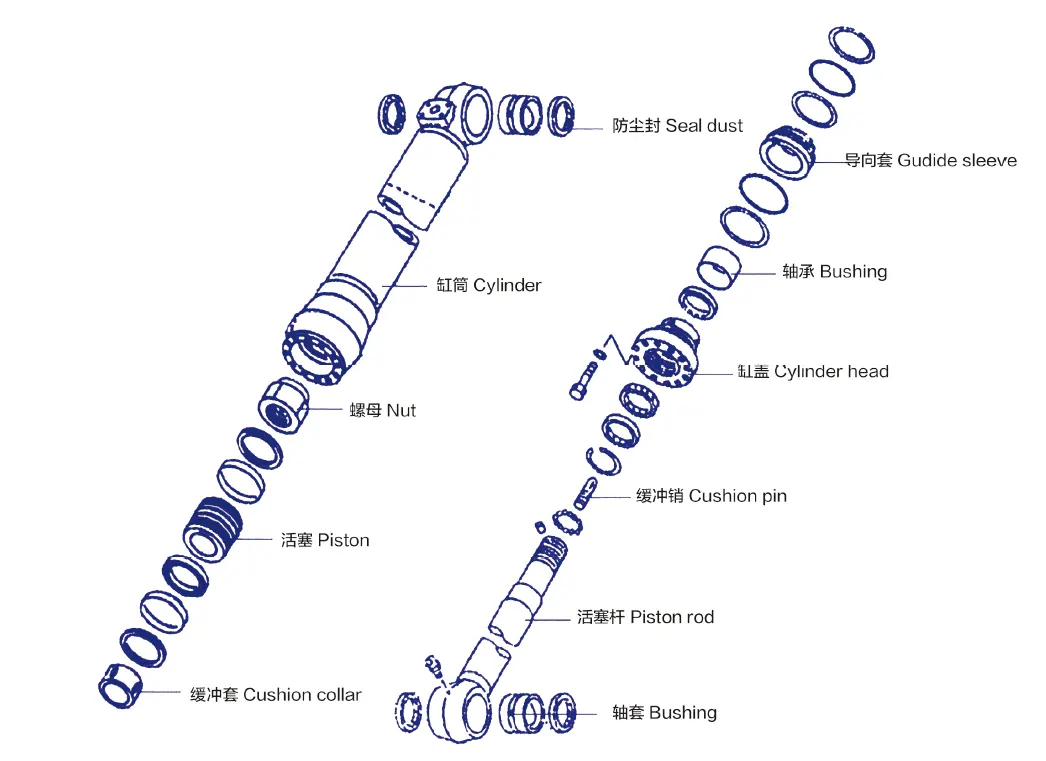
Caractéristiques
- Transmission à haut rendement : The arm cylinder provides powerful linear motion and force, ensuring high-performance capabilities of the machinery during various operations.
- Contrôle précis : Grâce à des systèmes hydrauliques, le vérin du bras permet un contrôle précis du mouvement, rendant le fonctionnement des outils fixés plus flexible et précis.
- Durabilité: Les vérins de bras sont généralement fabriqués à partir de matériaux à haute résistance, offrant une excellente résistance à l'usure et à la corrosion, ce qui les rend adaptés à une utilisation à long terme dans des environnements difficiles.
- Adaptabilité multifonctionnelle : These cylinders find wide applications in various types of machinery, such as excavators, cranes, and robotic arms, adapting to different working requirements.
- Entretien facile : Designed with ease of maintenance and replacement in mind, the arm cylinders facilitate convenient periodic inspections and upkeep, minimizing equipment downtime.

Applications
Le vérin à bras trouve des applications dans diverses industries :
1. Ingénierie de la construction
In excavators and cranes, the arm cylinder controls the movement of the bucket or boom for tasks like earthmoving, material handling, and structural installation.
2. Fabrication
Dans les lignes de production automatisées, le vérin de bras facilite le mouvement des bras robotisés pour les processus d'assemblage, de soudage et de manutention des matériaux, améliorant ainsi l'efficacité et la précision de la production.
3. Machines agricoles
In agricultural equipment such as harvesters and seeders, the arm cylinder controls the movement of operation arms for tasks like seeding, fertilizing, and harvesting.
4. Exploitation minière
Dans les équipements miniers, le vérin de bras est utilisé pour contrôler le mouvement du bras des machines minières pour l'extraction et le transport du minerai.
5. Logistique et transport
Dans les chariots élévateurs et les robots de manutention, le vérin du bras contrôle le levage et le mouvement des fourches, permettant la manutention et l'empilage des matériaux.

Considérations de conception et critères de sélection
When considering the design and selection of arm cylinders, the following factors are vital:
1. Capacité de charge
Arm cylinders must be able to withstand the maximum loads encountered during operation to ensure safe and reliable performance.
2. Scellement
Various seals, such as piston seals and rod seals, are used to prevent leakage and ensure efficient operation. Seals made of wear-resistant materials like polyurethane and nitrile rubber are commonly employed.
3. Durabilité
Arm cylinders are manufactured with high-quality materials and undergo precision surface treatment to enhance wear resistance, ensuring long-lasting performance in demanding environments.
4. Sécurité
Safety features, such as pressure relief valves and overload protection mechanisms, should be incorporated to safeguard against potential hazards during operation.
5. Maintenabilité
Easy access for maintenance, including regular lubrication and replacement of worn parts, should be considered during the design phase to minimize downtime and ensure optimal performance.

Étanchéité et lubrification
Arm cylinders utilize various sealing elements, such as piston seals and rod seals, made from wear-resistant materials like polyurethane and nitrile rubber. The cylinder body and threaded end surfaces undergo meticulous treatment to improve wear resistance. Regular lubrication with appropriate hydraulic fluid is necessary to ensure smooth operation and longevity.
Mesures d'inspection régulière et de maintenance préventive
Pour garantir des performances et une longévité optimales, les mesures suivantes doivent être prises :
- Inspectez régulièrement le cylindre du bras pour détecter tout signe d'usure, de dommage ou de fuite.
- Clean the cylinder and its components to remove dirt and debris.
- Check and adjust the cylinder’s mounting and alignment, ensuring proper installation.
- Surveiller les niveaux et la qualité du fluide hydraulique, et procéder à l'appoint ou au remplacement si nécessaire.
- Follow the manufacturer’s guidelines for maintenance and lubrication.
Guide d'installation du produit
Suivez ces étapes pour installer correctement le cylindre du bras :
- Ensure the machinery is turned off and all pressure is released from the hydraulic system.
- Fixez solidement le cylindre du bras aux points de montage désignés à l'aide des fixations appropriées.
- Connect the hydraulic hoses to the cylinder’s inlet and outlet ports, ensuring proper sealing.
- Inspect the installation for any leaks or misalignment.
- Test the functionality of the arm cylinder by performing a controlled operation.

Considérations de sécurité et facteurs environnementaux
When using arm cylinders, it is essential to prioritize safety measures to prevent accidents and ensure personnel protection. Safety precautions include proper training, following operating instructions, and using appropriate personal protective equipment. Environmental factors, such as temperature and exposure to chemicals, should also be considered to select suitable materials and ensure proper cylinder performance.
Dépannage et problèmes courants
Certains problèmes courants qui peuvent survenir avec les vérins de bras incluent :
- Fuite des joints ou des connexions
- Rough or jerky motion during operation
- Inadequate force or movement
- Bruit ou vibrations excessifs
To address these problems, consider the following troubleshooting steps:
- Inspectez et remplacez les joints ou les connexions usés ou endommagés.
- Check hydraulic fluid levels and quality, replenishing or replacing as needed.
- Assurez-vous du bon alignement et du montage du vérin de bras.
- Inspect other hydraulic components for potential issues.
Implementing preventive measures, such as regular maintenance and inspection, can minimize potential problems and improve the overall performance of the arm cylinder.
À propos de notre entreprise
We are a professional manufacturer of replacement hydraulic cylinders, offering a wide range of products. We have become one of the leading manufacturers and wholesale distributors in the domestic and international markets. Our commitment to excellence drives us to continuously improve our technological capabilities and production efficiency through industry-standard manufacturing practices and the use of advanced digital manufacturing equipment and professional testing systems. We strive to provide high-quality and customized solutions to meet the diverse needs of our customers.
Aspects clés de notre entreprise :
- Professionalism and expertise in hydraulic cylinder production
- Certifications internationales garantissant la qualité des produits
- Customization services tailored to specific requirements
- Équipements de production de pointe
Vérin hydraulique Application :

 FR
FR  EN
EN  PT
PT  ES
ES  DE
DE  IT
IT  AR
AR  ZH
ZH  RU
RU  KO
KO  KA
KA  BG
BG  CS
CS  DA
DA  EL
EL  ET
ET  FI
FI  HU
HU  ID
ID  LT
LT  LV
LV  NB
NB  NL
NL  PL
PL  RO
RO  SK
SK  SL
SL  SV
SV  TR
TR  UK
UK