
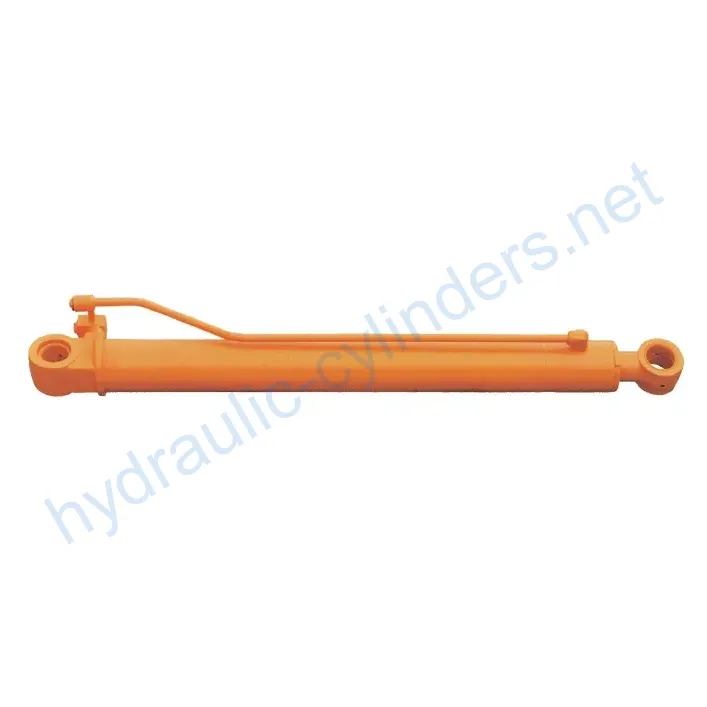
Vérin de bras pour mini-pelle Kato HD1023
En tant que fabricant, fournisseur et exportateur de produits mécaniques, nous proposons des vérins hydrauliques et de nombreux autres produits.
N'hésitez pas à nous contacter pour plus de détails.
Courrier :sales@hydraulic-cylinders.net
Fabricant fournisseur exportateur de vérins hydrauliques.
Vérin de bras pour mini-pelle Kato HD1023
Introduction
The Arm Cylinder for Kato Small Excavator HD1023 is a specialized hydraulic cylinder designed to provide linear motion and power to the arm of various types of machinery such as excavators, cranes, and mechanical arms. The arm cylinder plays a crucial role in hydraulic systems, enabling the smooth movement and control of additional tools or attachments. These cylinders not only ensure smooth motion but also withstand heavy loads, ensuring efficient operation and reliability of machinery in various working conditions.
Caractéristiques
- Transmission à haut rendement : Le vérin du bras assure un mouvement linéaire et une force puissants, garantissant des performances élevées au bras mécanique dans diverses opérations.
- Contrôle de précision : Grâce au système hydraulique, le vérin du bras permet un contrôle précis du mouvement, rendant le fonctionnement des outils fixés plus flexible et précis.
- Durabilité: Les vérins de bras sont généralement fabriqués à partir de matériaux à haute résistance, offrant une excellente résistance à l'usure et à la corrosion, ce qui les rend adaptés à une utilisation à long terme dans des environnements difficiles.
- Adaptabilité polyvalente : These cylinders can be widely applied in various machinery equipment such as excavators, cranes, and mechanical arms, adapting to different job requirements.
- Entretien facile : The design considerations for ease of maintenance and replacement make regular inspections and maintenance convenient, reducing equipment downtime.

Applications
The arm cylinder for Kato Small Excavator HD1023 finds its applications in various industries:
- Génie civil : Dans les excavatrices et les grues, le vérin de bras est utilisé pour contrôler le mouvement des godets ou des flèches pour les travaux de terrassement, la manutention des matériaux et l'installation structurelle.
- Fabrication: In automated production lines, the arm cylinder enables the movement of mechanical arms for processes such as assembly, welding, and material handling, enhancing production efficiency and precision.
- Machines agricoles : Dans les machines agricoles telles que les moissonneuses-batteuses et les semoirs, le vérin du bras contrôle le mouvement des bras de travail pour des tâches comme le semis, la fertilisation et la récolte.
- Exploitation minière: Dans les équipements miniers, le vérin de bras est utilisé pour contrôler le mouvement du bras des machines minières pour l'extraction et le transport du minerai.
- Logistique et transport : Dans les chariots élévateurs et les robots de manutention, le vérin du bras contrôle le levage et le mouvement des fourches, permettant ainsi le transport et l'empilage des matériaux.
Considérations de conception et critères de sélection
When considering the design of the arm cylinder, several factors are crucial:
- Capacité de charge : The arm cylinder should be capable of withstanding the expected loads to ensure safe and efficient operation.
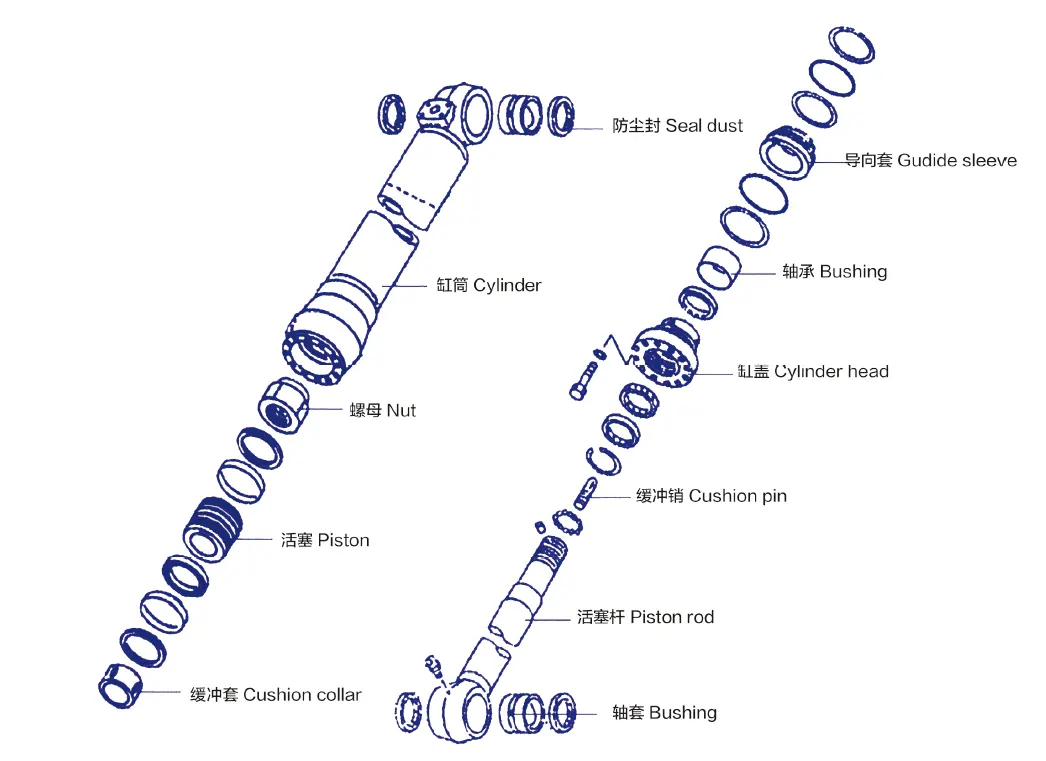
- Scellage: Various sealing components, such as piston seals and rod seals, should be used. These seals are made from wear-resistant materials like polyurethane and nitrile rubber. The cylinder body and threaded ends undergo meticulous processing to enhance wear resistance.
- Durabilité: The arm cylinder should be durable and able to withstand the demands of its application, including resistance to wear, corrosion, and potential impact.
- Sécurité: Safety considerations should be incorporated into the design to prevent accidents and ensure the protection of operators and surrounding equipment.
- Maintenabilité : The design should facilitate easy maintenance and repair, reducing downtime and overall maintenance costs.

Étanchéité et lubrification
For optimal performance, the arm cylinder utilizes various sealing components, such as piston seals and rod seals. These seals are made from wear-resistant materials like polyurethane and nitrile rubber. The cylinder body and threaded ends undergo meticulous processing to enhance wear resistance. Regular lubrication with the appropriate hydraulic oil is essential.
Mesures d'inspection régulière et de maintenance préventive
- Perform regular inspections to check for any signs of wear, leaks, or damage to the arm cylinder.
- Assurez-vous de la bonne lubrification du cylindre et remplacez l'huile hydraulique conformément aux recommandations du fabricant.
- Check and tighten all connections to avoid potential leaks or malfunctions.
- Inspectez et remplacez, si nécessaire, les joints et autres composants usés ou endommagés.
- Follow the manufacturer’s guidelines for preventive maintenance, including recommended service intervals and procedures.
Instructions d'installation du produit
Une installation correcte du vérin de bras est essentielle pour un fonctionnement optimal et une sécurité maximale. Suivez ces instructions :
- Ensure the equipment is powered off and in a safe state before installation.
- Alignez soigneusement le vérin du bras avec les points de fixation sur la machine.
- Securely fasten all connections, following the manufacturer’s torque specifications.
- Check for proper alignment and smooth operation of the arm cylinder.
- Inspect all connections for leaks and make any necessary adjustments.

Considérations de sécurité et facteurs environnementaux
When using the arm cylinder, it is essential to prioritize safety measures due to the involvement of heavy machinery and hydraulic systems. Adhering to safety protocols and proper training is crucial to prevent accidents and ensure the well-being of operators and bystanders. Additionally, environmental factors such as proper waste disposal and adherence to environmental regulations should be considered to minimize any negative impact.
Dépannage et problèmes courants
Voici quelques problèmes courants pouvant survenir avec le cylindre du bras :
- Fuite de fluide hydraulique
- Loss of power or inefficient operation
- Bruit ou vibrations excessifs
- Mouvements irréguliers ou saccadés
- Seal wear or failure
Pour remédier à ces problèmes :
- Inspect the cylinder for any signs of leaks and repair or replace seals as necessary.
- Check the hydraulic system for proper fluid levels and pressure.
- Ensure all connections are secure and tightened to prevent vibrations.
- Inspect the mechanical arm for any misalignment or obstructions.
- Follow recommended maintenance procedures to prevent seal wear and failure.

Remember to organize the article logically, using subheadings for easy navigation. Incorporate relevant images or charts to enhance understanding, and ensure that the content is clear, concise, and suitable for readers with varying levels of technical knowledge.
À propos de notre entreprise
We are a professional manufacturer of replacement hydraulic cylinders, offering a wide range of products. We have become one of the leading manufacturers and wholesale distributors of hydraulic cylinders in domestic and international markets. We adhere to the principles of excellence and rely on industrialized production management strategies in our refined manufacturing workshop to constantly improve our technical capabilities and production efficiency. By introducing high-end digital manufacturing equipment and professional testing systems, we optimize our manufacturing platform, refine our product quality control processes, and possess strong innovation capabilities. Our goal is to meet the diverse needs of our customers with efficiency, accuracy, and high-quality products.
Notre entreprise se distingue par :
- Professionnalisme et expertise dans la fabrication de vérins hydrauliques
- Certifications internationales garantissant la qualité des produits
- Coutume
Vérin hydraulique Application :

 FR
FR  EN
EN  PT
PT  ES
ES  DE
DE  IT
IT  AR
AR  ZH
ZH  RU
RU  KO
KO  KA
KA  BG
BG  CS
CS  DA
DA  EL
EL  ET
ET  FI
FI  HU
HU  ID
ID  LT
LT  LV
LV  NB
NB  NL
NL  PL
PL  RO
RO  SK
SK  SL
SL  SV
SV  TR
TR  UK
UK