

Vérin de bras pour mini-pelle Kato HD820R820V
En tant que fabricant, fournisseur et exportateur de produits mécaniques, nous proposons des vérins hydrauliques et de nombreux autres produits.
N'hésitez pas à nous contacter pour plus de détails.
Courrier :sales@hydraulic-cylinders.net
Fabricant fournisseur exportateur de vérins hydrauliques.
Vérin de bras pour mini-pelle Kato HD820R820V
Définition et explication
The arm cylinder is a specially designed hydraulic cylinder that provides linear motion and power to the arm of various types of machinery, such as excavators, cranes, and mechanical arms. The arm cylinder plays a critical role in the hydraulic system, enabling additional tools or attachments to move and be controlled effectively. These cylinders not only provide smooth motion but also withstand heavy loads, ensuring efficient operation and reliability of the machinery under various working conditions.
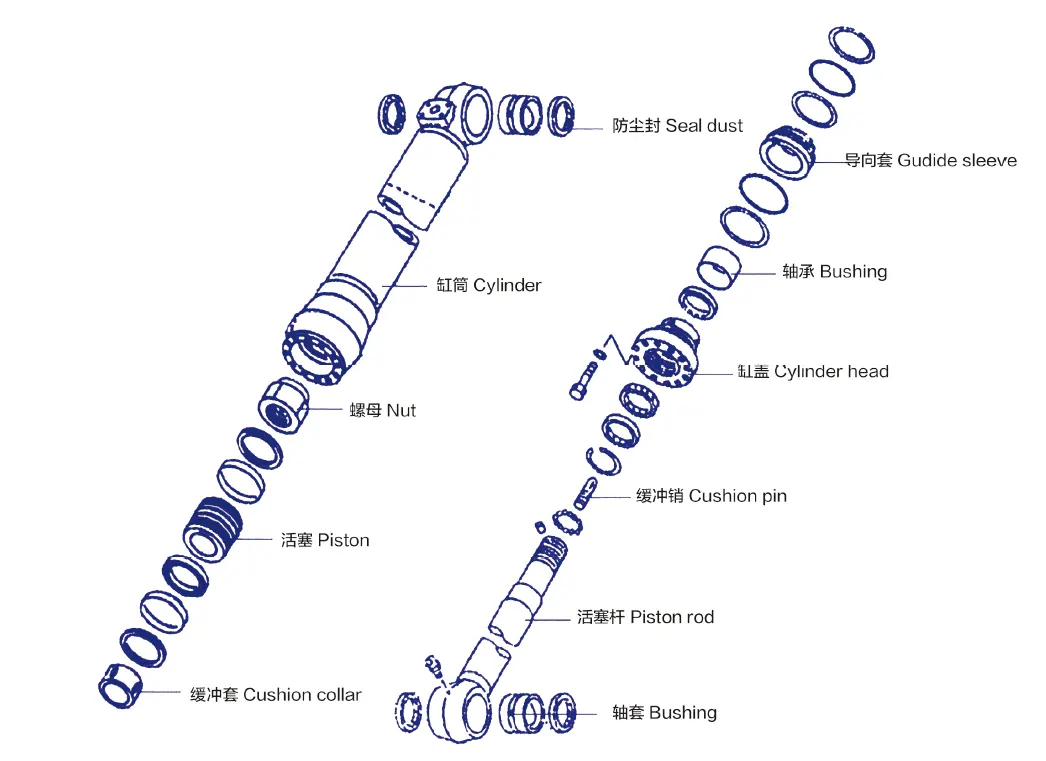
Caractéristiques du produit
- Transmission à haut rendement : The arm cylinder can provide powerful linear motion and force, ensuring high efficiency performance in various operations.
- Contrôle précis : Grâce au système hydraulique, le vérin du bras permet un contrôle précis du mouvement, rendant l'utilisation des outils supplémentaires plus flexible et précise.
- Grande durabilité : Le cylindre du bras est généralement fabriqué à partir de matériaux à haute résistance, offrant une bonne résistance à l'usure et à la corrosion, et adapté à une utilisation à long terme dans des environnements difficiles.
- Adaptabilité multifonctionnelle : Ces cylindres peuvent être largement utilisés dans divers équipements mécaniques, tels que les excavatrices, les grues et les bras mécaniques, pour répondre à différentes exigences de travail.
- Entretien facile : La conception prend en compte la facilité d'entretien et de remplacement, ce qui rend l'inspection et l'entretien réguliers plus pratiques et réduit les temps d'arrêt de l'équipement.
Notre produit peut parfaitement remplacer ces vérins hydrauliques.

Applications
The arm cylinder can be used in various industries and equipment:
- Génie civil : Dans les excavatrices et les grues, le vérin de bras sert à contrôler le mouvement du godet ou de la flèche pour les travaux de terrassement, la manutention de matériaux et l'installation de structures.
- Fabrication: In automated production lines, the arm cylinder is used for the motion of mechanical arms, such as assembly, welding, and handling, to improve production efficiency and precision.
- Machines agricoles : Dans les machines agricoles telles que les moissonneuses-batteuses et les semoirs, le vérin du bras contrôle le mouvement du bras opérateur pour effectuer des tâches telles que le semis, la fertilisation et la récolte.
- Exploitation minière: Dans les équipements miniers, le vérin de bras sert à contrôler le mouvement du bras des engins d'extraction et de manutention du minerai.
- Logistique et transport : In forklifts and handling robots, the arm cylinder is used to control the lifting and movement of cargo, realizing material handling and stacking.
Considérations de conception et normes de sélection
The arm cylinder needs to meet the following design and selection standards:
- Capacité portante : The arm cylinder needs to have sufficient bearing capacity for the load it carries.
- Scellage: The arm cylinder needs to use various sealing components, such as piston seals and rod seals, made of wear-resistant materials, such as polyurethane and nitrile rubber, to ensure sealing performance.
- Durabilité: The arm cylinder needs to use high-strength materials with good wear resistance and corrosion resistance to ensure long-term use under harsh conditions.
- Sécurité: The arm cylinder needs to be designed with safety features, such as overload protection and emergency stop, to ensure safe operation.
- Entretien: The arm cylinder needs to be designed for easy maintenance and replacement, such as easy access to maintenance points and standard components.

Étanchéité et lubrification
The arm cylinder needs to use various sealing components, such as piston seals and rod seals, made of wear-resistant materials, such as polyurethane and nitrile rubber, to ensure sealing performance. The cylinder body and thread end surface undergo fine processing to improve wear resistance. The arm cylinder needs to be lubricated regularly with a suitable amount of hydraulic oil to ensure smooth operation.

Maintenance préventive
The arm cylinder needs regular inspection and preventive maintenance to ensure its performance and extend its service life.
- Propreté: Keep the arm cylinder and hydraulic system clean to prevent contamination.
- Wear Inspection: Regularly inspect the arm cylinder for wear, deformation, and damage, and replace it if necessary.
- Lubrification: Regularly lubricate the arm cylinder with a suitable amount of hydraulic oil to ensure smooth operation.
- Leakage Inspection: Regularly inspect the arm cylinder for leakage and repair it if necessary.
Guide d'installation
Follow these steps to install the arm cylinder correctly:
- Check the compatibility of the arm cylinder with the machinery and the hydraulic system.
- Clean the installation area and the hydraulic system connections.
- Install the arm cylinder and tighten the connection bolts to the specified torque.
- Connect the hydraulic hoses and fittings to the arm cylinder.
- Test the arm cylinder for proper operation and leakage.

Considérations de sécurité et facteurs environnementaux
When using the arm cylinder, it is important to follow safety regulations and guidelines to prevent accidents and injuries. Environmental factors, such as temperature and humidity, can affect the performance and lifespan of the arm cylinder, and it is necessary to consider these factors in the selection and use of the arm cylinder.
Dépannage et problèmes courants
Common issues with the arm cylinder include leakage, wear, and damage. To diagnose and solve these problems, follow these steps:
- Identify the symptoms and causes of the problem.
- Inspect the arm cylinder and hydraulic system for wear, deformation, and damage.
- Repair or replace the damaged components.
- Test the arm cylinder for proper operation and leakage.
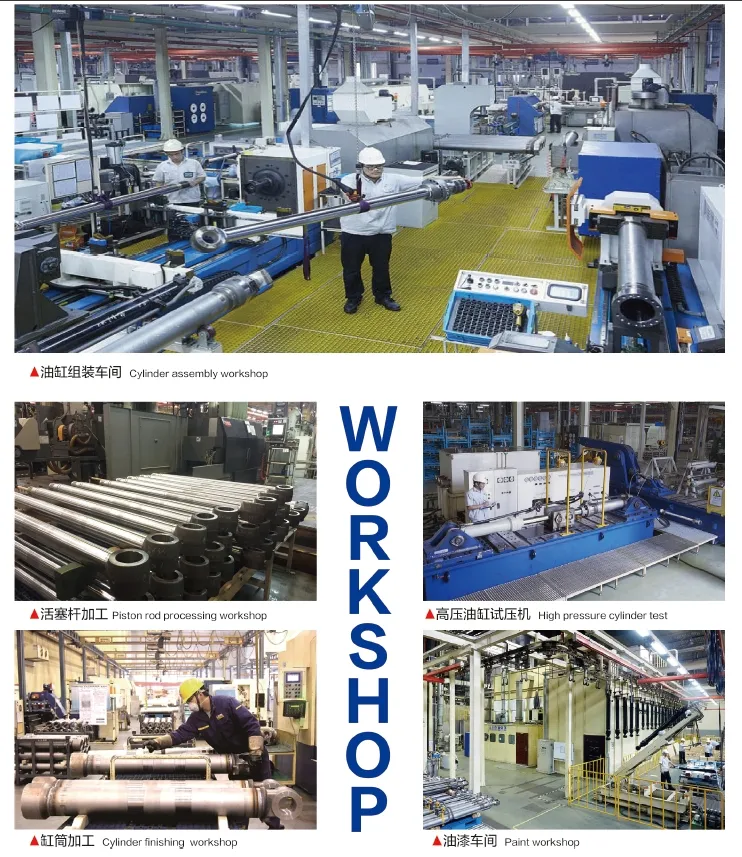
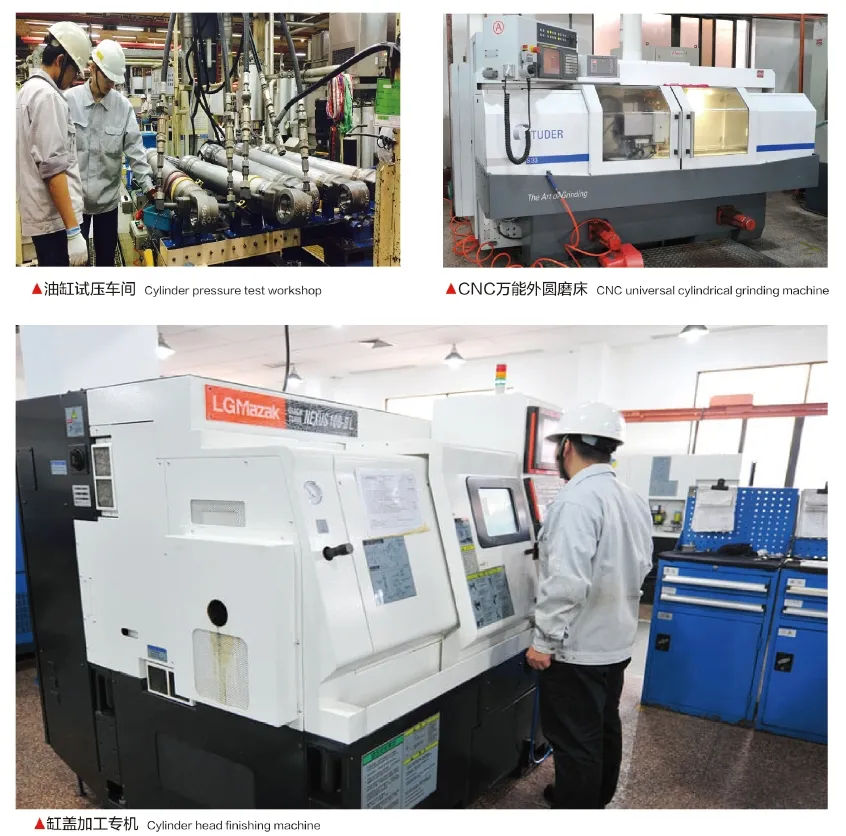
We are a professional manufacturer of replacement hydraulic cylinders, with a wide range of products. We have become one of the leading hydraulic cylinder manufacturers and wholesale distributors in the domestic and international markets. We always adhere to the principle of excellent quality, rely on the industrialized production management strategy of fine manufacturing workshops, continuously improve our technical level and production efficiency. By introducing high-end digital manufacturing equipment and professional inspection systems, we continuously optimize our manufacturing platform, improve product quality control processes and have strong innovation capabilities. Our goal is to meet customer’s diversified needs with principles of high efficiency, accuracy, and high-quality.
À propos de notre entreprise
Notre entreprise présente les avantages suivants :
- Professionnalisme: Our company has a professional team with rich experience in hydraulic cylinder design, manufacturing, and sales.
- Certification internationale : Our products have obtained international quality and safety certifications, such as ISO9001, CE, and SGS.
- Services de personnalisation : Our company provides customized hydraulic cylinder services according to customer’s specific requirements.
- Équipement de production : Our company has advanced digital production equipment, such as CNC machines and testing systems, to ensure product quality and efficiency.
- Services après-vente : Our company has a professional after-sales service team to provide timely technical support and maintenance services.
Auteur : lyl.
Vérin hydraulique Application :

 FR
FR  EN
EN  PT
PT  ES
ES  DE
DE  IT
IT  AR
AR  ZH
ZH  RU
RU  KO
KO  KA
KA  BG
BG  CS
CS  DA
DA  EL
EL  ET
ET  FI
FI  HU
HU  ID
ID  LT
LT  LV
LV  NB
NB  NL
NL  PL
PL  RO
RO  SK
SK  SL
SL  SV
SV  TR
TR  UK
UK