
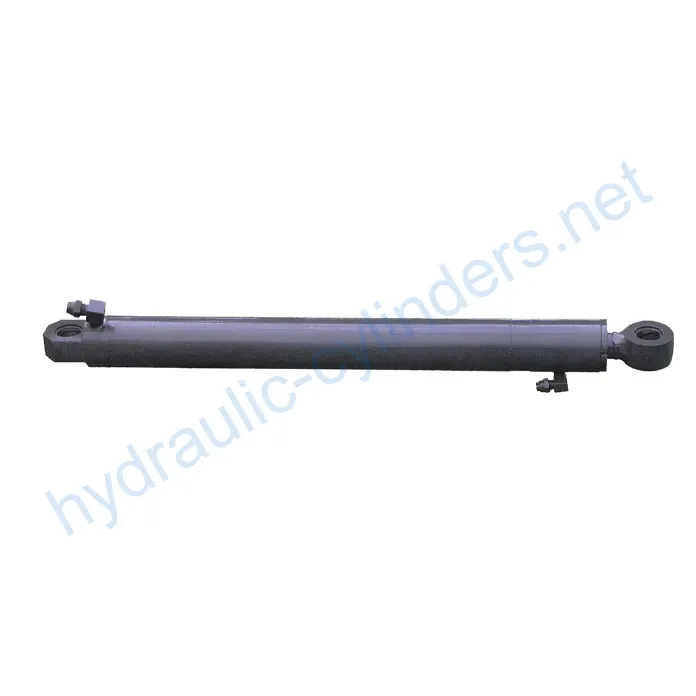
Cylindre de bras pour KYM KY85
En tant que fabricant, fournisseur et exportateur de produits mécaniques, nous proposons des vérins hydrauliques et de nombreux autres produits.
N'hésitez pas à nous contacter pour plus de détails.
Courrier :sales@hydraulic-cylinders.net
Fabricant fournisseur exportateur de vérins hydrauliques.
Cylindre de bras pour KYM KY85
Introduction
Definition and Explanation of Arm Cylinder
An arm cylinder is a specially designed hydraulic cylinder that is mainly used to provide linear motion and power to the arms of various types of machinery such as excavators, cranes, and robotic arms. The arm cylinder plays a critical role in hydraulic systems, enabling attachments or accessories to move and be controlled effectively. These cylinders not only enable smooth movement but also withstand heavy loads, ensuring efficient operation and reliability of the machinery under various operating conditions.
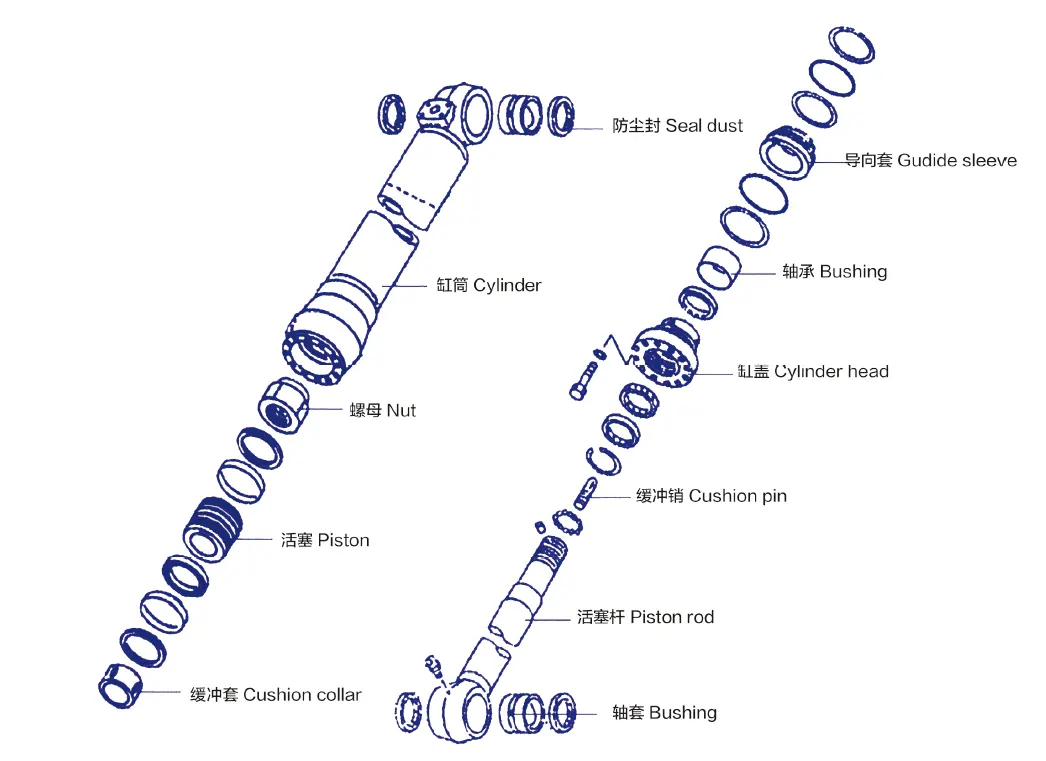
Caractéristiques
1. Transmission à haut rendement
Le vérin du bras permet un mouvement linéaire et une force puissants, garantissant ainsi une performance élevée du bras robotique dans diverses opérations.
2. Contrôle précis
Grâce au système hydraulique, le vérin du bras permet un contrôle précis du mouvement, rendant le fonctionnement des accessoires plus flexible et précis.
3. Grande durabilité
The arm cylinder is usually made of high-strength materials and has good wear resistance and corrosion resistance, making it suitable for long-term use in harsh environments.
4. Adaptabilité polyvalente
These cylinders can be widely used in various types of machinery such as excavators, cranes, and robotic arms, adapting to different job requirements.
5. Entretien facile
La conception prend en compte la facilité d'entretien et de remplacement, ce qui rend l'inspection et la maintenance régulières plus pratiques et réduit les temps d'arrêt des équipements.

Applications
Le vérin à bras est largement utilisé dans diverses industries, notamment :
1. Ingénierie de la construction
Dans les excavatrices et les grues, le vérin du bras sert à contrôler le mouvement du godet ou de la flèche, permettant ainsi d'effectuer des travaux de terrassement, de manutention de matériaux et d'installation de structures.
2. Industrie manufacturière
In automated production lines, the arm cylinder is used for the motion of robotic arms, performing assembly, welding, and handling processes, improving production efficiency and accuracy.
3. Machines agricoles
In agricultural machinery such as harvesters and seeders, the arm cylinder controls the movement of the operation arm, performing tasks such as planting, fertilizing, and harvesting.
4. Exploitation minière
In mining equipment, the arm cylinder is used to control the movement of the mining equipment’s arm, performing ore mining and handling.
5. Logistique et transport
Dans les chariots élévateurs et les robots de manutention, le vérin du bras sert à contrôler le levage et le mouvement de la fourche, permettant ainsi la manutention et l'empilage des matériaux.
Considérations de conception et normes de sélection
1. Capacité de charge
The arm cylinder’s load capacity is a critical factor to consider when selecting. The cylinder must be capable of withstanding the load it will be subjected to under various operating conditions.
2. Scellement
The sealing of the arm cylinder is of utmost importance. The cylinder must be sealed tightly to prevent hydraulic fluid leakage, which can cause damage to the machinery and the environment.
3. Durabilité
The arm cylinder must be durable and able to withstand the harsh operating environment it will be subjected to. Materials with high wear resistance and corrosion resistance should be selected to ensure long-term use.
4. Sécurité
When designing the arm cylinder, safety should be considered. Measures should be taken to prevent accidents caused by cylinder failure or malfunction.
5. Maintenabilité
The arm cylinder should be designed with maintenance in mind. It should be easy to disassemble and repair. Regular maintenance should be carried out to ensure the cylinder’s optimal performance.

Joints et lubrification
Various seals such as piston seals and rod seals are used to ensure the arm cylinder’s sealing performance. Materials with high wear resistance and good sealing performance, such as polyurethane and nitrile rubber, are commonly used. The cylinder body and thread end surface are finely processed to improve wear resistance. Regular lubrication with hydraulic oil is required to ensure the cylinder’s optimal performance.
Maintenance et mesures de précaution
Regular inspection and preventive maintenance should be carried out on the arm cylinder to ensure its optimal performance. The following measures should be taken:
1. Inspection régulière
The arm cylinder should be inspected regularly to ensure its optimal performance and detect any potential problems early.
2. Schedule Maintenance
Scheduled maintenance should be carried out to ensure the arm cylinder’s sealing performance, lubrication, and other functions.
3. Replacement of Worn Parts
Worn parts should be replaced promptly to ensure the cylinder’s optimal performance and prevent accidents caused by failure or malfunction of the cylinder.
4. Cleaning and Lubrication
The cylinder should be cleaned and lubricated regularly to ensure its optimal performance.
5. Safety Precautions
When handling the arm cylinder, safety precautions should be taken to prevent accidents caused by cylinder failure or malfunction.

Guide d'installation
The following steps should be taken when installing the arm cylinder:
1. Positionnement
The cylinder should be positioned correctly, and the mounting surface should be flat.
2. Tightening
The bolts should be tightened to the specified torque to ensure the cylinder’s optimal performance.
3. Testing
The cylinder should be tested after installation to ensure its optimal performance.
Considérations relatives à la sécurité des produits et à l'environnement
When using the arm cylinder, safety measures should be taken to prevent accidents caused by cylinder failure or malfunction. The environmental impact should also be considered.
Dépannage et problèmes courants
The following are some common issues that may arise when using the arm cylinder:
1. Sealing Failure
Hydraulic fluid leakage may occur due to seal failure, causing damage to the machinery and the environment.
2. Abnormal Noise
Abnormal noise may occur due to cylinder failure or malfunction.
3. Slow Movement
The cylinder’s movement may be slow due to a lack of lubrication or other reasons.
If any of the above issues occur, the following measures should be taken:
1. Inspection
The cylinder should be inspected to determine the cause of the issue.
2. Replacement of Worn Parts
Worn parts should be replaced promptly to restore the cylinder’s optimal performance.
3. Lubrication
The cylinder should be lubricated regularly to ensure its optimal performance.

À propos de nous
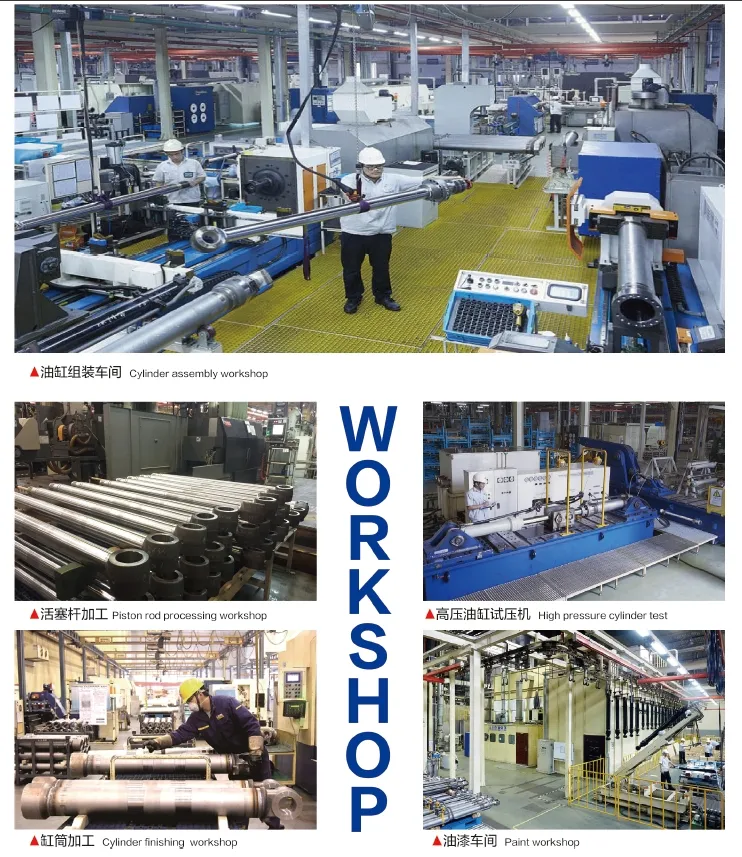
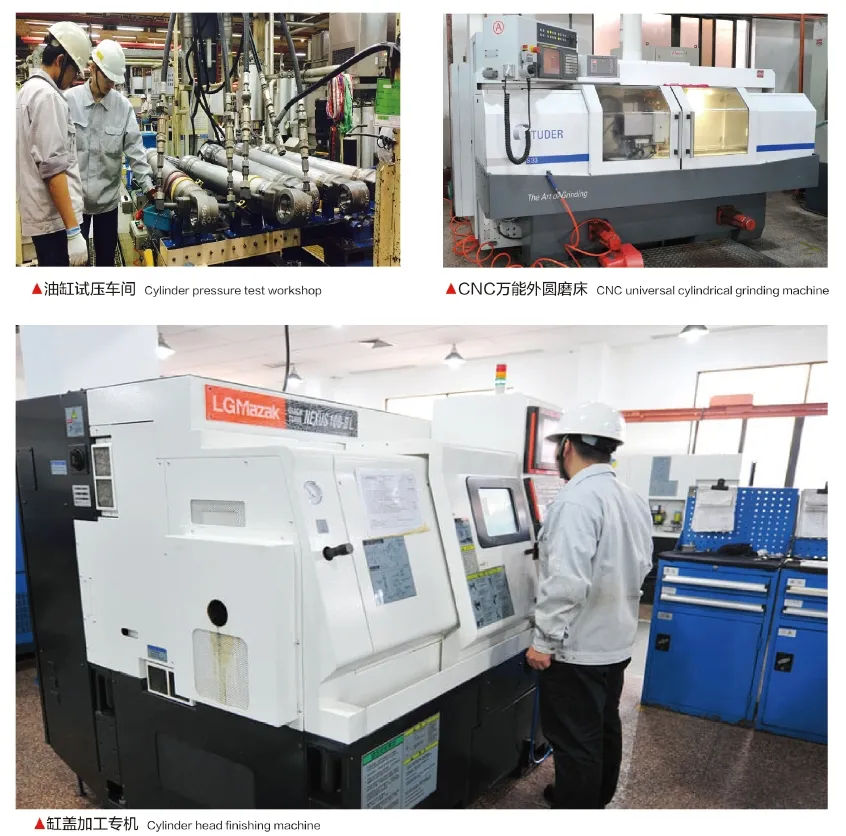
We are a professional manufacturer of replacement hydraulic cylinders with a wide range of products. We have become one of the leading hydraulic cylinder manufacturers and wholesale distributors in domestic and foreign markets. We have always adhered to the principle of excellent quality and relied on the industrial production management strategy of the fine manufacturing workshop to continuously improve our technical level and production efficiency. By introducing high-end digital manufacturing equipment and professional testing systems, we continuously optimize the manufacturing platform, improve the product quality control process, and have strong innovation capabilities. Our goal is to meet the diverse needs of our customers with high efficiency, precision, and high quality.
We offer professional services, international certification, custom services, production equipment, and after-sales services to our customers.
Auteur : lyl
Vérin hydraulique Application :

 FR
FR  EN
EN  PT
PT  ES
ES  DE
DE  IT
IT  AR
AR  ZH
ZH  RU
RU  KO
KO  KA
KA  BG
BG  CS
CS  DA
DA  EL
EL  ET
ET  FI
FI  HU
HU  ID
ID  LT
LT  LV
LV  NB
NB  NL
NL  PL
PL  RO
RO  SK
SK  SL
SL  SV
SV  TR
TR  UK
UK