
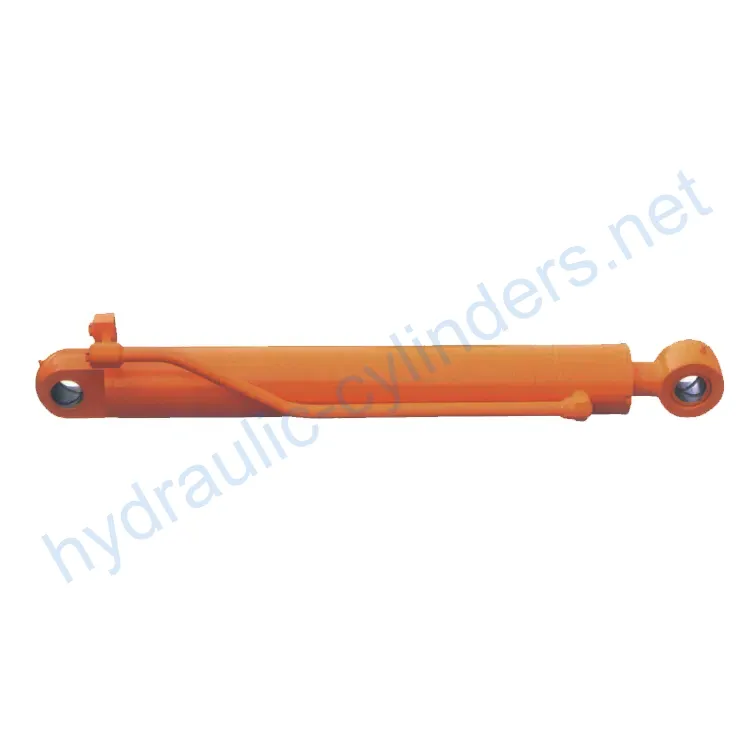
Vérin de bras pour pelle hydraulique Sunward Middle SWE210
En tant que fabricant, fournisseur et exportateur de produits mécaniques, nous proposons des vérins hydrauliques et de nombreux autres produits.
N'hésitez pas à nous contacter pour plus de détails.
Courrier :sales@hydraulic-cylinders.net
Fabricant fournisseur exportateur de vérins hydrauliques.
Vérin de bras pour pelle hydraulique Sunward Middle SWE210
Introduction
The arm cylinder is a specially designed hydraulic cylinder that provides linear motion and power to the arm of various machinery, such as excavators, cranes, and robotic arms. It plays a crucial role in hydraulic systems, enabling the efficient movement and control of additional tools or attachments. These cylinders not only ensure smooth motion but also withstand heavy loads, ensuring high operational efficiency and reliability in various working conditions.
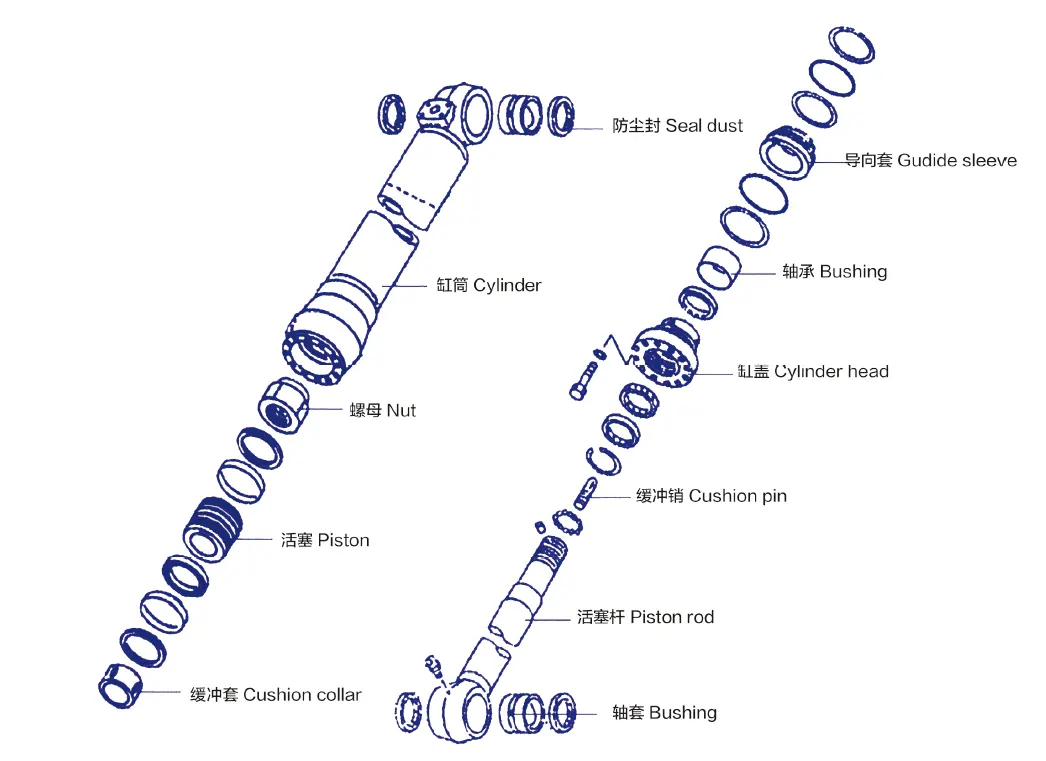
Caractéristiques
- Transmission à haut rendement : Le vérin du bras assure un mouvement linéaire et une force puissants, garantissant des performances élevées au bras mécanique dans diverses opérations.
- Contrôle précis : Grâce au système hydraulique, le vérin du bras permet un contrôle précis du mouvement, rendant le fonctionnement des outils fixés plus flexible et précis.
- Durabilité: Les vérins de bras sont généralement fabriqués à partir de matériaux à haute résistance, offrant une excellente résistance à l'usure et à la corrosion, adaptés à une utilisation à long terme dans des environnements difficiles.
- Adaptabilité multifonctionnelle : These cylinders are widely applicable to various machinery such as excavators, cranes, and robotic arms, adapting to different working requirements.
- Entretien facile : Designed for ease of maintenance and replacement, arm cylinders facilitate regular inspections and maintenance, reducing equipment downtime.

Applications
Les vérins à bras trouvent des applications dans diverses industries :
- Génie civil : Utilisés dans les excavatrices et les grues, les vérins de bras contrôlent le mouvement des godets ou des flèches pour les travaux de terrassement, la manutention de matériaux et les installations structurelles.
- Industrie manufacturière : Arm cylinders are utilized in automated production lines for the movement of robotic arms, facilitating assembly, welding, and material handling processes, thereby improving production efficiency and precision.
- Machines agricoles : Arm cylinders control the motion of operating arms in agricultural machinery such as harvesters and seeders, performing tasks like seeding, fertilizing, and harvesting.
- Exploitation minière: In mining equipment, arm cylinders control the arm movement for mining and transportation of ores.
- Logistique et transport : Forklifts and handling robots employ arm cylinders to control the lifting and movement of forks, enabling material handling and stacking.
Considérations de conception et critères de sélection
When designing and selecting arm cylinders, several factors must be considered:
- Capacité de charge : The cylinder should be able to handle the required load to ensure optimal performance and safety.
- Scellage: Various sealing components, such as piston seals and rod seals made from wear-resistant materials like polyurethane and nitrile rubber, are used to ensure effective sealing.
- Durabilité: The cylinder body and threaded ends undergo meticulous treatment to enhance their wear resistance, ensuring long-lasting performance.
- Sécurité: Safety measures should be implemented to prevent accidents and ensure operator protection during operation.
- Maintenabilité : Regular lubrication with suitable hydraulic oil and periodic maintenance help extend the service life of the arm cylinder.

Étanchéité et lubrification
The arm cylinder utilizes various sealing components, such as piston seals and rod seals made from materials like polyurethane and nitrile rubber, to ensure effective sealing. The cylinder body and threaded ends are finely treated to improve wear resistance. Regular lubrication with an appropriate amount of hydraulic oil is necessary to ensure proper lubrication of moving parts.
Inspection régulière et maintenance préventive
To maintain optimal performance and prevent unexpected failures, regular inspections and preventive maintenance are essential. The following measures should be taken:
- Inspectez le cylindre pour détecter tout signe de fuite, de dommage ou d'usure.
- Vérifiez l'état des composants d'étanchéité et remplacez-les si nécessaire.
- Assurer une lubrification adéquate de toutes les pièces mobiles.
- Tighten all connections and fasteners as needed.
- Monitor the cylinder’s performance and address any abnormal behavior promptly.
Guide d'installation du produit
Une installation correcte du cylindre de bras est essentielle à son bon fonctionnement et à sa longévité. Suivez ces étapes :
- Assurez-vous que l'équipement est hors tension et que le système hydraulique est dépressurisé.
- Align the cylinder in the desired position and insert the rod end into the mounting bracket or connection point.
- Secure the cylinder in place using suitable mounting bolts or pins.
- Raccordez les flexibles hydrauliques au vérin en veillant à un bon alignement et à des connexions étanches.
- If necessary, adjust the cylinder stroke length or mounting position to meet the equipment’s requirements.
- Once the installation is complete, thoroughly inspect all connections and perform a functional test.

Considérations de sécurité et facteurs environnementaux
When working with arm cylinders, safety precautions are vital to prevent accidents and ensure operator well-being. Adhering to safety measures during operation and maintenance is essential for a safe working environment.
Dépannage et problèmes courants
Arm cylinders may encounter certain problems. Here are some common issues and their potential solutions:
- Fuite: Inspect the cylinder for damaged seals or connections and replace them if necessary. Tighten loose connections.
- Mouvements lents ou erratiques : Check the hydraulic fluid level and quality. Ensure the system is properly pressurized. Inspect for any blockages or damaged components.
- Bruit ou vibrations excessifs : Inspect the cylinder for loose or damaged parts. Check for misalignment or bent rods. Lubricate moving parts.
En suivant ces conseils de dépannage et ces mesures préventives, les lecteurs peuvent diagnostiquer et résoudre efficacement les problèmes tout en minimisant les risques de dysfonctionnements.

About Us – lyl
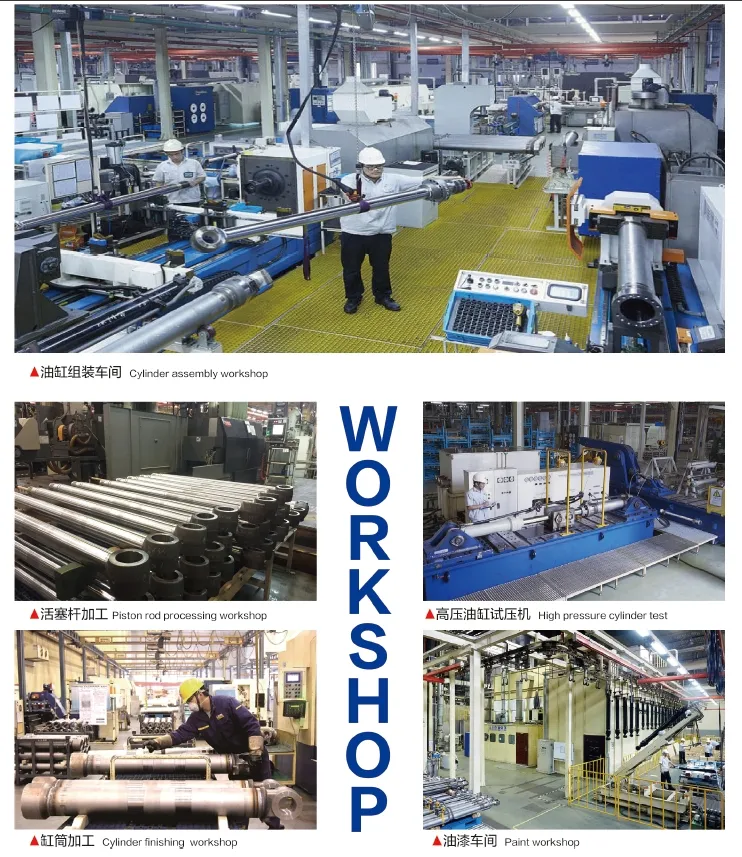
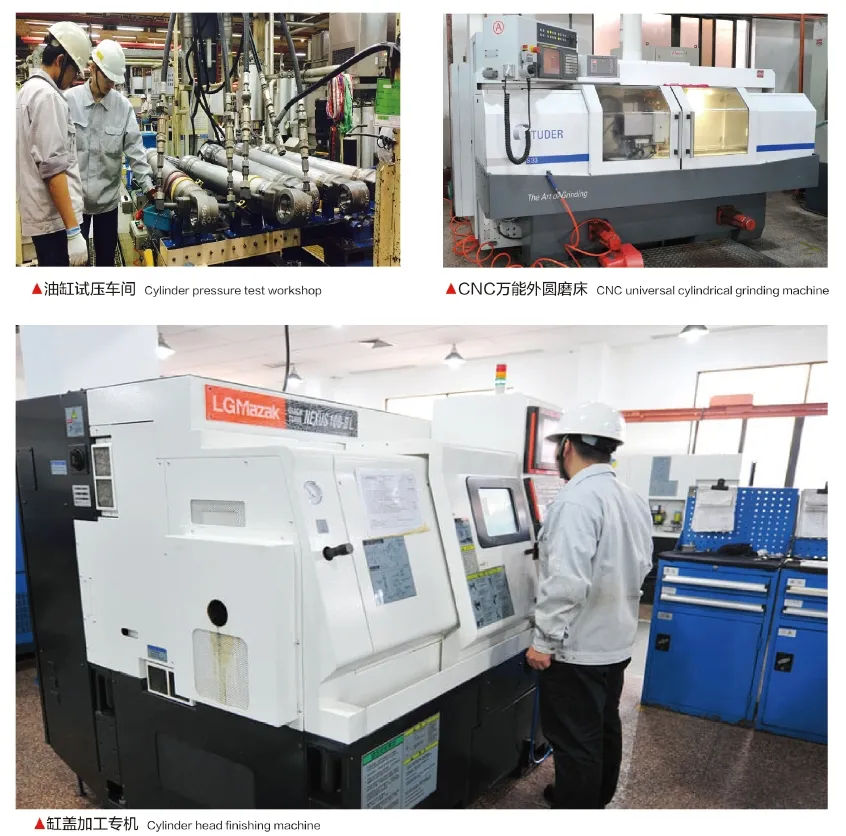
We are a professional manufacturer of replacement hydraulic cylinders, offering a wide range of products. We have become one of the leading manufacturers and wholesale distributors of hydraulic cylinders in domestic and international markets. With our commitment to excellent quality, we continuously enhance our technological capabilities and production efficiency through the implementation of advanced manufacturing strategies in our finely-tuned production workshop. By introducing high-end digital manufacturing equipment and professional testing systems, we optimize our manufacturing platform and improve our product quality control processes, ensuring strong innovation capabilities. Our goal is to meet the diverse needs of customers with principles of efficiency, precision, and high quality.
Vérin hydraulique Application :

 FR
FR  EN
EN  PT
PT  ES
ES  DE
DE  IT
IT  AR
AR  ZH
ZH  RU
RU  KO
KO  KA
KA  BG
BG  CS
CS  DA
DA  EL
EL  ET
ET  FI
FI  HU
HU  ID
ID  LT
LT  LV
LV  NB
NB  NL
NL  PL
PL  RO
RO  SK
SK  SL
SL  SV
SV  TR
TR  UK
UK