
Fluid Power Mechanical Engineering
What Is the Difference Between Mechanical and Hydraulic Advantage in Cylinders?
A comprehensive engineering analysis comparing force multiplication principles, linkage geometry, and fluid power physics in linear actuator systems for industrial and mobile applications.

Understanding the Two Distinct Forms of Force Multiplication in Actuator Systems
In the sophisticated realm of fluid power and mechanical system design, the concept of advantage refers to the multiplication or transformation of input force into a more useful output force or motion characteristic. However, the terms mechanical advantage and hydraulic advantage represent fundamentally distinct physical phenomena, each governed by different principles of physics and employed for different engineering purposes. Understanding the difference between mechanical and hydraulic advantage in cylinders is essential for engineers and system designers seeking to optimize actuator performance, maximize efficiency, and achieve specific force and motion profiles in industrial machinery and mobile equipment applications.
Mechanical advantage, in the context of hydraulic cylinder applications, refers to the force multiplication achieved through the geometric arrangement of linkages, levers, and pivoting mechanisms that connect the cylinder to the driven load. By positioning the cylinder attachment points at specific distances from pivot centers or by employing toggle linkages and scissor mechanisms, the linear force output of the cylinder can be transformed into substantially larger forces at the working point, albeit with a corresponding reduction in velocity and displacement. This form of advantage is purely kinematic and structural, relying on the conservation of energy principle wherein the product of force and distance remains constant, neglecting frictional losses.
Hydraulic advantage, in stark contrast, derives from the fundamental pressure area relationship inherent to fluid power systems. Within the cylinder itself, the force generated is the product of the hydraulic fluid pressure and the effective piston area. By selecting a larger bore diameter or operating at higher system pressures, the cylinder produces greater output force for a given input pressure. Furthermore, in hydraulic circuits employing multiple cylinders or intensifiers, hydraulic advantage can be achieved through the differential areas of master and slave cylinders, enabling tremendous force multiplication that is limited only by the structural integrity of the components and the available hydraulic power. This comprehensive technical guide will thoroughly explore both forms of advantage, providing detailed mathematical analysis, practical application examples, and guidance for optimizing system design through the judicious application of mechanical and hydraulic advantage principles.
Mechanical Advantage: Geometric Force Multiplication Through Linkage Design
Mechanical advantage in cylinder applications is achieved through the strategic arrangement of pivots, lever arms, and attachment points that amplify or redirect the linear force output of the actuator.
Lever Arm Principles and Moment Balance
The most fundamental form of mechanical advantage in cylinder applications arises from the classic lever principle. When a hydraulic cylinder is attached to a pivoting arm at some distance from the pivot point, the force exerted at the working end of the arm is amplified by the ratio of the cylinder moment arm to the load moment arm. The mechanical advantage achieved is equal to the distance from the pivot to the cylinder attachment point divided by the distance from the pivot to the load application point. This simple yet powerful principle is employed extensively in excavator booms, lift tables, dump truck bodies, and countless other applications where the cylinder force must be multiplied to lift heavy payloads. The trade off for this force multiplication is a proportional reduction in the velocity of the load compared to the cylinder piston velocity, consistent with the conservation of energy principle.
Toggle Linkages and Variable Mechanical Advantage
More sophisticated mechanical advantage systems employ toggle linkages that provide varying mechanical advantage throughout the stroke. A toggle mechanism consists of two or more links arranged such that as the cylinder extends and the links approach a straight line configuration, the mechanical advantage approaches infinity theoretically, although practical limits are imposed by link stiffness and bearing capacities. Toggle linkages are extensively used in clamping fixtures, injection molding machine platens, and mechanical presses where extremely high forces are required near the end of the stroke for clamping or forming operations. The variable nature of toggle mechanical advantage allows the use of relatively small bore cylinders to generate immense clamping forces during the critical final portion of the stroke when the links are nearly aligned.

Hydraulic Advantage: Pressure Area Force Multiplication in Fluid Power Systems
Hydraulic advantage represents the fundamental force multiplication principle inherent to all fluid power systems, arising from the relationship between pressure and effective piston area.
?Pascal’s Law and Bore Diameter Selection
Hydraulic advantage within a single cylinder is governed by Pascal’s Law, which states that pressure applied to a confined fluid is transmitted undiminished throughout the fluid. The force output of a hydraulic cylinder is simply the product of the system pressure and the effective piston area. By selecting a cylinder with a larger bore diameter, the effective area increases, and a given hydraulic pressure generates proportionally greater force. For example, a four inch bore cylinder operating at 2500 PSI generates approximately 31400 pounds of force, while a six inch bore cylinder at the same pressure produces over 70600 pounds of force. This form of hydraulic advantage is independent of mechanical linkages and represents the direct conversion of fluid power to linear mechanical force. The selection of bore diameter to achieve the required hydraulic advantage is one of the most fundamental decisions in fluid power system design.
⚡Hydraulic Intensifiers and Master Slave Cylinder Systems
A more advanced form of hydraulic advantage is achieved through the use of hydraulic intensifiers or master slave cylinder configurations. In a master slave system, a relatively small diameter master cylinder is driven by a modest input force, generating hydraulic pressure that is transmitted to a larger diameter slave cylinder. The hydraulic advantage achieved is equal to the ratio of the slave cylinder piston area to the master cylinder piston area. For instance, a master cylinder with a one inch bore driving a slave cylinder with a four inch bore yields a hydraulic advantage of sixteen to one, meaning that one pound of force applied to the master cylinder generates sixteen pounds of force at the slave cylinder output, neglecting frictional and flow losses. This principle is extensively employed in hydraulic jacks, vehicle braking systems, and high force clamping applications where immense force multiplication is required from a manageable input effort.

Comparative Analysis: Mechanical vs Hydraulic Advantage in Cylinder Systems
While both mechanical and hydraulic advantage serve to multiply force, they operate on fundamentally different principles and exhibit distinct characteristics that influence their suitability for various applications.
Force Displacement Trade off Characteristics
Mechanical Advantage: Governed by the conservation of energy, any increase in force achieved through lever arms or linkages is accompanied by a proportional decrease in displacement and velocity. The product of force and distance remains constant minus frictional losses. This characteristic is advantageous in applications where high force is required over a relatively short distance, such as clamping or pressing operations.
Hydraulic Advantage: Force multiplication through bore diameter selection does not inherently reduce stroke length or velocity. A larger bore cylinder generates more force at a given pressure, but its stroke length is independent of bore size. However, the increased flow requirement to achieve a given velocity with a larger bore cylinder represents a different form of trade off, impacting pump sizing and system efficiency.
Efficiency and Frictional Losses
Mechanical Advantage: Linkage based mechanical advantage systems incur frictional losses at each pivot joint and bearing surface. The overall mechanical efficiency is the product of the individual joint efficiencies and typically ranges from 85 to 95 percent for well lubricated, properly maintained linkages. Bushing wear and inadequate lubrication can significantly degrade mechanical efficiency over time.
Hydraulic Advantage: Fluid power systems experience losses due to fluid friction in conductors, pressure drops across valves, and internal leakage across seals. The volumetric and mechanical hydraulic efficiency of a well designed system typically ranges from 85 to 92 percent. Fluid viscosity changes with temperature significantly impact hydraulic efficiency, particularly during cold start conditions.
Spatial Constraints and Design Flexibility
Mechanical Advantage: Achieving significant mechanical advantage through linkages requires physical space for lever arms and pivoting mechanisms. The geometry of the linkage often dictates the overall machine envelope and can impose constraints on cylinder placement and access for maintenance. However, linkages can redirect force vectors, enabling cylinder placement in locations that are convenient for hydraulic routing while still applying force in the required direction at the work point.
Hydraulic Advantage: Force multiplication through increased bore diameter or higher system pressure typically requires less physical space than equivalent mechanical advantage linkages. A larger bore cylinder occupies only marginally more space than a smaller bore cylinder while delivering substantially greater force. This compactness is particularly valuable in mobile equipment applications where space is at a premium and multiple functions must be densely packaged.
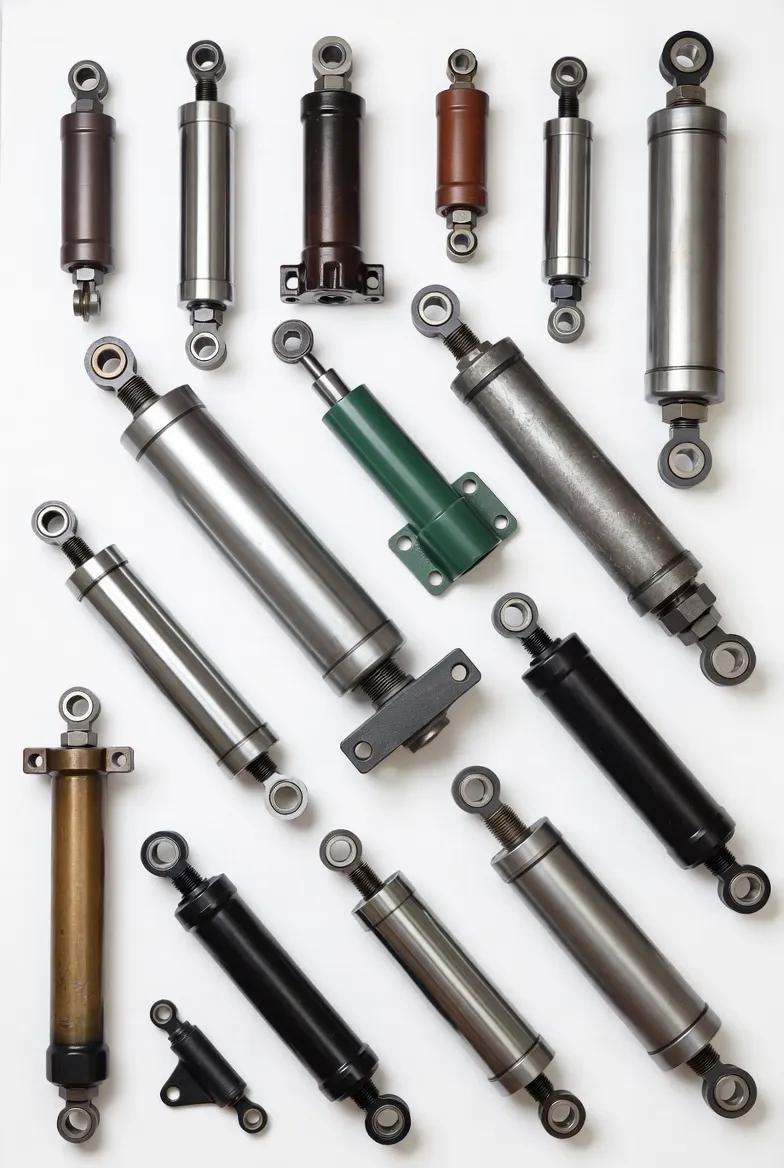
Practical Applications Combining Mechanical and Hydraulic Advantage
In many sophisticated machine designs, mechanical and hydraulic advantage are employed synergistically to achieve performance objectives that would be difficult or impossible using either approach in isolation.
- ?️
Excavator and Backhoe Linkages: Construction excavators exemplify the combined application of mechanical and hydraulic advantage. The hydraulic cylinders themselves provide substantial hydraulic advantage through their bore diameter and operating pressure. Simultaneously, the articulated boom, arm, and bucket linkages create variable mechanical advantage throughout the working range. The overall force multiplication at the bucket teeth is the product of the hydraulic advantage of the cylinder and the instantaneous mechanical advantage of the linkage geometry. This combined approach enables compact cylinders to generate the tremendous digging forces required for excavation while maintaining the reach and maneuverability essential to machine productivity.
- ?
Hydraulic Presses with Mechanical Toggle: Many high tonnage hydraulic presses employ a two stage force generation strategy. The main hydraulic cylinder provides substantial hydraulic advantage and moves the press platen through the majority of its stroke at relatively low force and high speed. As the tooling approaches the workpiece, a mechanical toggle linkage engages, providing additional mechanical advantage that multiplies the cylinder force to achieve the final pressing or forming tonnage. This combination optimizes cycle time by using high speed hydraulic motion for the non working portion of the stroke and leveraging mechanical advantage for the high force working portion, allowing the use of a smaller hydraulic power unit than would otherwise be required.
- ✈️
Aircraft Flight Control Actuation: Modern aircraft employ sophisticated combinations of hydraulic and mechanical advantage in flight control surface actuation systems. Hydraulic actuators provide the primary force generation, with bore sizes and operating pressures selected to meet the maximum hinge moment requirements. Mechanical linkages and bellcranks provide additional mechanical advantage while also summing inputs from multiple actuators and providing the correct kinematic relationship between actuator stroke and control surface deflection. The integration of mechanical and hydraulic advantage ensures precise, responsive, and redundant control surface positioning essential for flight safety.

Engineering Calculations for Mechanical and Hydraulic Advantage
Precise calculation of mechanical and hydraulic advantage is essential for proper system design and component selection.
Calculating Mechanical Advantage
For a simple lever system, the mechanical advantage is the ratio of the effort arm length to the load arm length. For a cylinder attached to a pivoting arm, the effective moment arm varies with the angle between the cylinder axis and the arm. The instantaneous mechanical advantage is calculated as the perpendicular distance from the pivot to the line of action of the cylinder force, divided by the perpendicular distance from the pivot to the line of action of the load. For complex linkages, graphical or analytical kinematic analysis using vector mathematics is required to determine mechanical advantage throughout the range of motion.
Calculating Hydraulic Advantage
The hydraulic advantage of a single cylinder is simply the effective piston area. For extension, this is the full bore area calculated as pi times the square of the bore diameter divided by four. For retraction, the annular area is the bore area minus the rod cross sectional area. In a master slave cylinder system, the hydraulic advantage is the ratio of the slave cylinder effective area to the master cylinder effective area. The total force output of a combined mechanical and hydraulic system is the product of the cylinder force output and the instantaneous mechanical advantage of the linkage.
Combined Advantage Optimization
The optimal combination of mechanical and hydraulic advantage for a given application balances multiple factors including spatial constraints, cost, efficiency, and controllability. Parametric studies varying cylinder bore diameter, operating pressure, and linkage geometry can identify the most cost effective configuration that meets all performance requirements. Modern computer aided engineering tools including multibody dynamics simulation and finite element analysis enable rapid evaluation of design alternatives and prediction of system performance before physical prototyping.
A thorough understanding of the difference between mechanical and hydraulic advantage in cylinders equips engineers with the analytical framework necessary to design efficient, reliable, and cost effective fluid power actuation systems. By judiciously applying both forms of advantage, machine performance can be optimized to meet the most demanding force, speed, and spatial requirements across the full spectrum of industrial and mobile applications.

Conclusion: Integrating Mechanical and Hydraulic Advantage for Optimal System Design
The distinction between mechanical and hydraulic advantage in cylinder systems represents a fundamental dichotomy in the approach to force multiplication within fluid power applications. Mechanical advantage, achieved through the geometric arrangement of levers, linkages, and pivots, provides force multiplication that varies with linkage position and incurs a corresponding velocity trade off consistent with energy conservation principles. Hydraulic advantage, derived from the pressure area relationship governed by Pascal’s Law, offers force multiplication through bore diameter selection and master slave cylinder configurations without inherent stroke or velocity reduction. The most sophisticated and capable machine designs leverage both forms of advantage synergistically, combining the compact force generation of hydraulic cylinders with the kinematic flexibility and variable mechanical advantage of engineered linkages. By mastering the principles and calculations underlying both mechanical and hydraulic advantage, fluid power engineers can develop actuation systems that deliver precisely the force, speed, and motion characteristics required for demanding industrial and mobile equipment applications while optimizing cost, efficiency, and reliability.