
Fluid Power Engineering Mastery
How to Choose a Hydraulic Cylinder for a Log Splitter: The Definitive Guide
An authoritative technical analysis exploring hydrostatic force calculations, cycle time optimization, rod buckling prevention, and the exact fluid power specifications required to build a professional grade wood processing machine.

The Mechanical Heart of Forestry Equipment
In the rigorous and highly demanding sector of forestry, agricultural maintenance, and firewood processing, mechanical efficiency is paramount. Building a custom wood splitting machine or replacing a failed component on commercial forestry equipment requires profound technical understanding. At the absolute core of this powerful machinery lies the linear actuator. Learning exactly how to choose a hydraulic cylinder for a log splitter is not a task that accommodates guesswork or loose estimations. If you specify an actuator that is too small, your machine will stall against knotted hardwood. If you specify an actuator that is vastly oversized, your cycle times will become agonizingly slow, completely destroying your operational productivity and wasting expensive fuel or electrical energy.
A log splitter hydraulic cylinder operates under a unique set of punishing conditions. Unlike actuators on an automated factory assembly line that perform highly controlled, predictable motions, a wood splitter actuator faces violent, unpredictable resistance. When the steel wedge encounters a dense, twisted oak knot, the hydraulic pressure spikes instantaneously to maximum system relief thresholds. The cylinder must contain this massive hydrostatic pressure without ballooning the steel barrel, while the chrome piston rod must push with tens of thousands of pounds of force without buckling or bending under the extreme compressive load. Selecting the perfect log splitter cylinder sizing requires balancing three critical engineering vectors: total pushing force tonnage, operational cycle speed velocity, and structural integrity.
From a highly authoritative fluid power engineering perspective, choosing a log splitter actuator requires calculating exact surface areas, understanding pump flow rates in gallons per minute, and analyzing the physics of two stage hydraulic pumps. You cannot purchase a cylinder in isolation; it must act in perfect harmony with the engine horsepower, the fluid reservoir capacity, and the directional control valve flow rating. This comprehensive, highly detailed technical manual will systematically dissect the mathematics of fluid dynamics, the importance of specific mounting architectures, and the exact step by step protocols required to engineer the ultimate wood processing fluid power circuit.
Step 1: Calculating Tonnage and Bore Size
The primary metric used to classify any wood splitting machine is its Tonnage. This number dictates the raw, unyielding crushing force the steel wedge will apply to the wood. Tonnage is exclusively determined by two variables: the system pressure and the internal bore size of the cylinder.
Understanding the Physics of Force
The fundamental fluid power equation dictates that Force equals Pressure multiplied by Area. In the Imperial measurement system, Pressure is measured in Pounds per Square Inch PSI, and Area is measured in square inches. When pressurized hydraulic fluid from the pump enters the blind end cap end of the cylinder, it pushes against the full circular face of the piston. The larger the internal bore diameter, the more physical surface area the fluid has to push against, resulting in exponentially higher mechanical output force.
The Tonnage Calculation Formula
First, calculate the Bore Area: Area = 3.14159 multiplied by the Radius squared. The radius is exactly half of the bore diameter. Next, multiply this Area by your maximum system pressure to find the total push force in pounds. Finally, divide that number by 2000 to convert pounds into Tons. Standard commercial log splitters typically operate at a maximum relief pressure of 3000 PSI. This is the industry standard benchmark for sizing wood processing components.
Practical Tonnage Examples at 3000 PSI
- –
3.5 Inch Bore Cylinder: Area is 9.62 square inches. Multiplied by 3000 PSI equals 28,860 pounds. Divided by 2000 equals 14.4 Tons. Ideal for softwoods and small residential use.
- –
4.0 Inch Bore Cylinder: Area is 12.56 square inches. Multiplied by 3000 PSI equals 37,680 pounds. Divided by 2000 equals 18.8 Tons. The most common size for standard, capable consumer machines.
- –
5.0 Inch Bore Cylinder: Area is 19.63 square inches. Multiplied by 3000 PSI equals 58,890 pounds. Divided by 2000 equals 29.4 Tons. Required for commercial processing of knotted oak, hickory, and massive rounds.

Step 2: Determining Stroke Length and Spatial Geometry
After determining the required crushing force by selecting the correct bore size, the next critical phase in how to choose a hydraulic cylinder for a log splitter is establishing the stroke length. The stroke length dictates the absolute maximum length of the piece of wood your machine can physically process.
If you specify a cylinder with an 18 inch stroke, your machine will never be able to split a log longer than 18 inches. In the North American firewood industry, the universal standard for cut firewood length is 16 inches to 18 inches to fit comfortably inside domestic wood stoves and residential fireplace inserts. Therefore, to safely accommodate variations in chainsaw cuts and allow clearance for the steel wedge, the absolute industry standard stroke length for a log splitter hydraulic cylinder is 24 inches. Some specialized outdoor boiler processors may require 30 inch or 36 inch stroke cylinders to handle massive outdoor furnace wood, but for 95 percent of builds, 24 inches is the optimal geometric dimension.
The Retracted Length (Pin to Pin)
When designing the steel I-beam frame of your log splitter, you cannot simply measure the stroke. You must know the fully collapsed, retracted length of the cylinder to weld your mounting brackets in the correct location. This measurement is taken from the absolute center of the rear mounting pin hole to the center of the rod end mounting pin hole while the cylinder is completely compressed. For a standard 24 inch stroke cylinder, the retracted length is typically around 34.25 inches. Failing to calculate this mounting geometry accurately will result in a steel wedge that either crashes into the base plate prematurely or stops short, failing to split the wood completely in half.

Step 3: Rod Diameter, Buckling, and Retraction Speed
The piston rod is the highly polished chrome shaft extending from the actuator. Selecting the correct rod diameter involves a complex fluid power compromise between structural safety and operational cycle speed.
Column Strength and Euler Buckling
During the splitting stroke, the extended rod acts as a slender column subjected to up to 60,000 pounds of compressive force. If the rod diameter is too thin, the immense pressure will cause the steel to bow outward and catastrophically snap, a physical phenomenon known as Euler buckling. Wood splitters require heavy duty, oversized rods to survive the violent, uneven shocks of splitting knotted wood. For a 4 inch bore cylinder, a minimum rod diameter of 1.5 inches is required, though 1.75 inches or 2.0 inches is vastly superior for long term commercial durability.
The Retraction Speed Advantage
A thicker rod provides structural safety, but it also creates a massive operational advantage: faster cycle times. During retraction, hydraulic fluid enters the rod end of the cylinder. A larger, thicker steel rod occupies significantly more physical space inside this chamber. Because there is less empty volume available for the hydraulic oil to fill, the chamber fills up much faster from a constant pump flow. Therefore, selecting an actuator with a massively oversized rod guarantees that your steel wedge will snap back to the starting position at blistering speeds, dramatically increasing your hourly wood production output.
Step 4: Cycle Time Optimization and The 2-Stage Pump
When searching for a hydraulic pressure to force calculator, many builders focus entirely on tonnage and neglect the velocity of the machine. An actuator that produces 30 tons of force is useless if it takes forty five seconds to complete a single stroke. Operational cycle time the total time it takes for the cylinder to fully extend and fully retract is dictated entirely by the relationship between the cylinder’s internal volume and the hydraulic pump’s flow rate, measured in Gallons Per Minute GPM.
[Image of log splitter hydraulic circuit diagram]
To calculate the extension time in seconds, you determine the total volume of the cylinder in gallons, and divide it by the pump GPM, then multiply by 60. A standard 4 inch bore, 24 inch stroke cylinder holds approximately 1.3 gallons of fluid. If you use a tiny 5 GPM pump, it will take over 15 seconds just to extend. This introduces the most critical component of a wood processing fluid power circuit: The 2-Stage Hydraulic Gear Pump.
The Genius of the 2-Stage Pump
Wood splitting requires two distinct phases: moving the wedge quickly through empty space, and pushing with massive force once the wedge hits the wood. A single stage pump cannot do both effectively without requiring a massive, incredibly expensive 20 horsepower gasoline engine. A 2-stage pump elegantly solves this engineering paradox.
- –Stage 1 (High Flow, Low Pressure): When the wedge is traveling freely toward the log, the pump delivers maximum flow for example, 16 GPM at a low pressure around 500 PSI. This shoots the cylinder forward at blistering speed.
- –Stage 2 (Low Flow, High Pressure): The instant the wedge strikes the dense wood, the system pressure spikes. An internal unloading valve inside the pump automatically shifts. The pump drops its flow rate down to perhaps 3 GPM, but ramps the pressure up to maximum 3000 PSI. This delivers the massive crushing tonnage required to shear the hardwood. Once the wood splits and resistance drops, it instantly kicks back into high speed mode. Matching a 4 inch or 5 inch bore cylinder with a 13 GPM, 16 GPM, or 22 GPM two stage pump is the undisputed secret to achieving professional 10 to 12 second total cycle times on a custom build.

Step 5: Mounting Styles and Structural Integrity
The absolute most common cause of catastrophic failure on homemade log splitters is not seal blowout; it is structural destruction caused by improper mounting geometry. When you are generating twenty or thirty tons of linear force, any lateral deviation will rip the cylinder right off the steel H-beam.
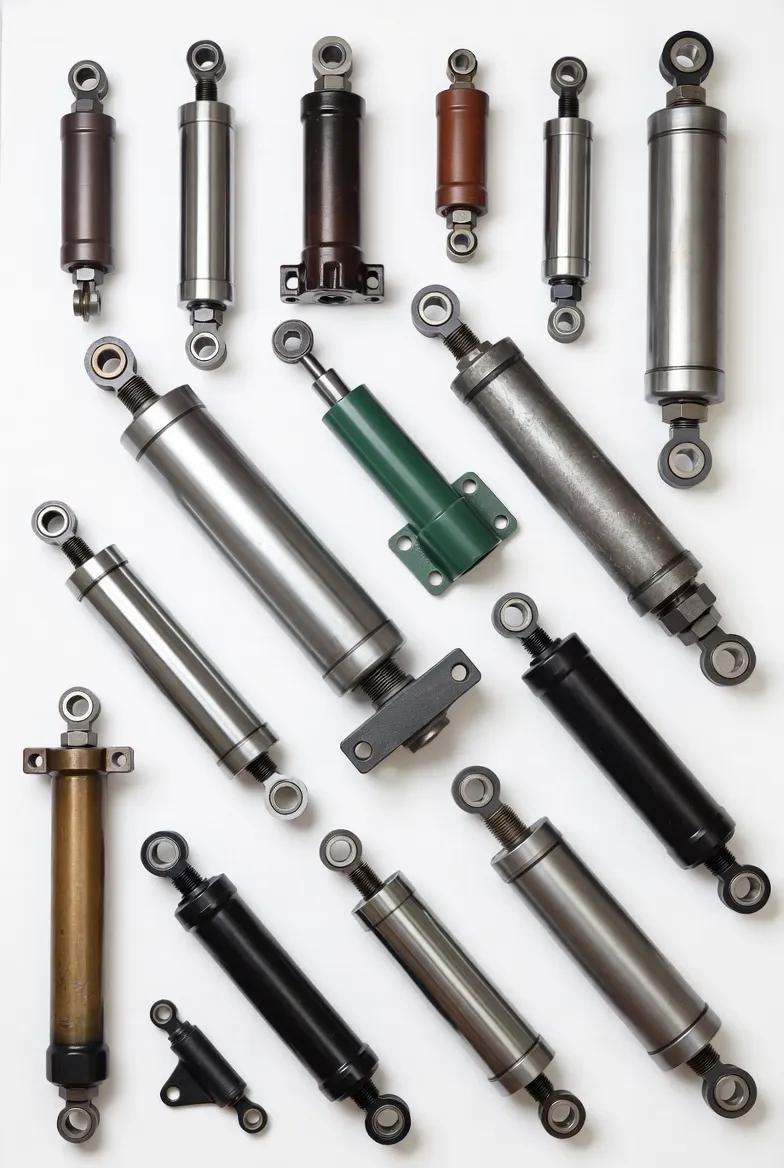
When selecting your log splitter actuator, you must pay critical attention to the mounting ends. Standard industrial tie-rod cylinders often use thin clevis mounts. These are entirely inadequate for heavy wood processing. The industry standard, absolute mandatory requirement for a robust machine is the Cross-Tube Mount (also known as a trunnion or welded tube mount).
The Superiority of Cross-Tube Mounts
A cross-tube mount consists of a heavy, thick walled steel cylinder welded horizontally across the base of the cylinder barrel and the tip of the piston rod. When mounted onto the machine utilizing heavy one inch or 1.125 inch hardened steel pins, this geometry creates an incredibly wide, highly stable pivot point. Wood never splits perfectly straight; it twists and torques violently. The wide bearing surface of a cross-tube mount absorbs these lateral shock loads flawlessly, preventing the twisting forces from bending the piston rod or shattering the internal head gland. A narrow clevis mount will instantly twist and tear under the same uneven loading.
Port Sizes and Fluid Velocity
Finally, ensure the fluid ports machined into the cylinder are adequately sized to handle the flow rate of your pump. If you push 16 GPM through a tiny 3/8 inch port, the fluid velocity will create massive restriction and severe thermal friction, instantly overheating the hydraulic oil and melting the internal seals. For high performance builds exceeding 11 GPM, specify a cylinder equipped with 1/2 inch NPT National Pipe Thread ports or size 8 ORB O-Ring Boss ports to ensure unrestricted fluid dynamics and cool operational temperatures.

Conclusion: Engineering the Ultimate Machine
Learning how to choose a hydraulic cylinder for a log splitter is the fundamental bedrock of building a safe, efficient, and highly productive piece of forestry equipment. By mastering the core physics of pressure versus area to achieve your target tonnage, optimizing the rod diameter to prevent structural buckling while accelerating return speeds, and mandating heavy duty cross tube mounts to survive violent torsional twisting, engineering professionals and dedicated fabricators can construct machinery that rivals top tier commercial units. Pairing your perfectly sized welded body actuator with a robust two stage pump and unrestricted fluid porting guarantees that your machine will slice through the most stubborn hardwoods with relentless, unyielding mechanical power for decades of reliable service.