
Advanced Fluid Power Fabrication
Behind the Scenes: The Complete Manufacturing Process of a Quality Hydraulic Cylinder
An authoritative engineering blueprint detailing metallurgical selection, precision CNC machining, automated orbital welding, advanced polymer sealing, and the rigorous hydrostatic testing protocols that define world-class fluid power manufacturing.

The Crucible of Kinetic Power: Engineering from Raw Steel
In the highly rigorous disciplines of commercial earthmoving, deep underground mining, automated manufacturing, and large scale agricultural harvesting, fluid power systems represent the absolute foundation of heavy mechanical force. Hydraulic linear actuators are the precise instruments that convert the immense hydrostatic pressure of synthetic fluid into perfectly controlled physical motion. However, long before a machine operator pulls a joystick to lift fifty tons of bedrock, an incredibly complex, highly orchestrated manufacturing symphony must take place. Understanding the complete manufacturing process of a quality hydraulic cylinder is essential for procurement managers, design engineers, and maintenance professionals who demand absolute reliability. To explore a vast array of components manufactured to these exact elite standards, visiting our premium hydraulic cylinders platform is a critical first step.
A world class fluid power actuator is not merely a collection of steel pipes and rubber gaskets hastily welded together. It is a highly calibrated pressure vessel designed to survive the most hostile thermodynamic and physical environments on the planet. The manufacturing journey transforms raw, unrefined steel billets into polished, micro-toleranced mechanisms capable of withstanding internal pressures exceeding five thousand pounds per square inch while simultaneously battling external abrasive contamination. A single microscopic flaw during the machining of the barrel, or a fractional deviation during the hard chrome plating of the rod, will result in catastrophic seal blowout and devastating equipment paralysis on the job site.
From an authoritative engineering perspective evaluated against strict international ISO manufacturing criteria, building a superior actuator requires a flawless sequence of metallurgical science, computer numerical control (CNC) precision, automated robotic fusion, and uncompromising quality assurance. This comprehensive technical guide will take you behind the scenes of a state of the art production facility. We will meticulously dissect every single phase of the fabrication process, from the initial steel yield strength analysis to the final hydrostatic burst testing, revealing exactly what separates a generic replacement part from a true engineering masterpiece.
Phase 1: Metallurgical Engineering and Material Selection
The structural survival of a custom fluid power actuator is entirely dependent on the quality of the raw materials utilized. The manufacturing process begins in the metallurgical laboratory, long before any steel is cut.
Evaluating Steel Yield Strength
The cylinder barrel and the piston rod require distinctly different metallurgical properties. The barrel must resist immense internal hydrostatic expansion forces, commonly utilizing ST52 or 1026 cold-drawn seamless carbon steel tubes. However, the piston rod acts as a slender column under extreme compressive stress. For heavy equipment like Excavator Hydraulic Cylinders, manufacturers deploy highly advanced 4140 chromoly alloy steel. This high-tensile material provides a yield strength exceeding 100,000 PSI, which is absolutely mandatory to prevent Euler column buckling during violent earthmoving operations.
Ultrasonic Defect Scanning
Before the raw steel billets are approved for production, they undergo rigorous non-destructive testing (NDT). Engineers utilize high-frequency ultrasonic scanners to probe deep into the atomic structure of the steel. They are searching for microscopic voids, slag inclusions, or internal stress fractures introduced during the steel mill’s forging process. If a raw tube contains even a microscopic fissure, it will violently rupture under peak operating pressure. Only metallurgically perfect steel is permitted to enter the machining floor.

Phase 2: Precision CNC Machining and Internal Honing
Once the raw materials are verified, the physical shaping begins. This phase is characterized by sub-millimeter tolerances. The relationship between the internal barrel diameter and the outer piston diameter is the most critical spatial geometry in the entire fluid power system.
Automated Lathe Profiling
Advanced multi-axis CNC lathes are deployed to profile the piston rod, cut the heavy-duty mounting threads, and carve out the intricate grooves required for the elastomeric seals. For highly specialized actuators, such as multi-stage Dump Truck Hydraulic Cylinders, the concentricity of these cuts must be absolute. Any deviation from a perfect centerline will result in immediate mechanical binding as the telescopic stages attempt to extend.
Skiving and Roller Burnishing (Honing)
The interior of the steel barrel requires a surface finish that is simultaneously frictionless yet capable of retaining a microscopic film of oil. Manufacturers utilize a specialized skiving and roller burnishing machine. This tooling rapidly cuts away surface imperfections and then aggressively rolls hardened steel bearings against the inner wall. This not only creates an incredibly precise internal diameter but also compresses the surface steel, increasing its hardness. The resulting finish displays a specific micro-hatch pattern, which perfectly lubricates the dynamic polyurethane seals without allowing high-pressure fluid bypass.

Phase 3: Surface Defense – Hard Chrome and Induction Hardening
The piston rod is thrust out of the protective barrel into highly abrasive, hostile environments. Its surface treatment is the primary defense against catastrophic structural destruction.
Electromagnetic Induction Hardening
Standard hard chrome is smooth but brittle. If a falling rock strikes a standard rod, the soft steel yields, and the chrome shatters, creating a jagged edge that immediately shreds the wiper seals. To prevent this, premium manufacturers pass the raw rod through a high-voltage electromagnetic induction coil. This process superheats the outer skin of the steel, followed by a rapid liquid quench. This hardens the outer case to 50-60 Rockwell C, creating an impenetrable anvil beneath the surface that bounces kinetic impacts away.
Electrochemical Chrome Plating
Once hardened, the rod is submerged in a toxic chromic acid bath. A massive electrical current causes chromium ions to bond molecularly with the steel. This builds a diamond-hard, low-friction layer that resists extreme environmental oxidation. For heavy equipment constantly exposed to corrosive fertilizers and deep mud, such as Agricultural Hydraulic Cylinders, manufacturers often apply double-layer or specialized nickel-chrome plating to ensure absolute immunity against chemical pitting.
Centerless Polishing
Following the plating process, the rod undergoes centerless grinding and polishing. The goal is to achieve an optimal surface roughness (Ra) typically between 0.1 and 0.2 micrometers. If the rod is too rough, it acts as a file against the rubber seals; if it is too smooth, it cannot carry the microscopic film of hydraulic oil necessary to lubricate the dynamic motion.
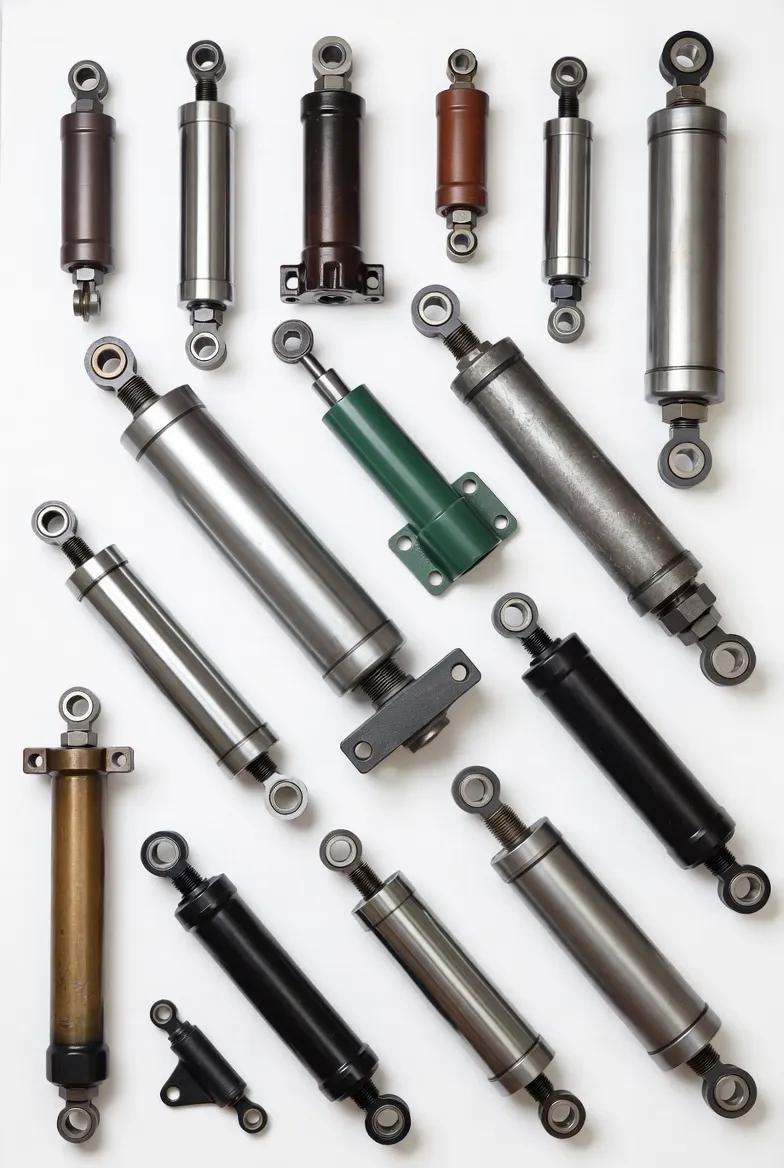
Phase 4 & 5: Robotic Welding and Clean-Room Assembly
With the individual components perfectly machined, the cylinder must be fused together into a monolithic pressure vessel and loaded with the critical polymeric sealing architecture.
- ✔️
Automated Orbital Welding: To connect the base cap and the trunnion mounts to the cylinder barrel, manufacturers deploy advanced robotic orbital welders or friction welding machines. These automated systems deliver a perfectly uniform, deep-penetration weld bead. Unlike manual stick welding, robots eliminate the possibility of microscopic slag inclusions or uneven heat distribution that could lead to explosive tensile rupture under peak hydrostatic loading.
- ✔️
Positive Pressure Clean-Room Assembly: The most frequent cause of premature cylinder failure is particulate contamination introduced during the assembly phase. World-class manufacturers assemble their actuators inside climate-controlled, positive-pressure clean rooms. Technicians meticulously install high-performance Polyurethane U-cups, PTFE glide rings, and extreme-heat Viton O-rings onto the piston and head gland. For precision logistics equipment like Forklift Hydraulic Cylinders, even a single grain of ambient silica dust trapped under a seal during assembly will ruin the exacting tolerances required for smooth mast elevation.


Phase 6: Quality Assurance and Hydrostatic Burst Testing
Before any manufactured cylinder is permitted to leave the facility, it must prove its capability to survive absolute extremity. A visual inspection is completely insufficient. The fully assembled actuator is mounted to a computerized hydraulic test bench. High-pressure synthetic fluid is pumped into the chambers, extending and retracting the rod to purge all atmospheric air and prevent the thermodynamic diesel effect. Once bled, the cylinder is subjected to a hydrostatic static load test, commonly pressurized to 1.5 times its maximum rated operating pressure. The computer monitors the system for ten minutes. If the pressure drops by even a fraction of a PSI, it indicates a microscopic internal seal bypass or a weeping weldment, and the cylinder is instantly rejected. For safety-critical machinery, such as Aerial Work Vehicle Hydraulic Cylinders designed to elevate human personnel, this flawless test validation is the ultimate guarantee of structural integrity and operational safety. By controlling every variable from raw steel selection to final pressure diagnostics, elite manufacturers create the relentless mechanical power that builds the modern world.