

? Introduction: The Powerhouse of Modern Construction Machinery
In the realm of modern heavy machinery, excavators are undoubtedly the absolute main force driving infrastructure development, mining extraction, and global urbanization. Beneath the massive steel framework of these machines, the true source of their astonishing lifting power and precise control capabilities lies in the component known as the mechanical muscle: the excavator boom cylinders. As the core executive elements of the hydraulic system, boom cylinders convert hydraulic energy into powerful mechanical energy, directly determining the operational efficiency, stability, and lifespan of the excavator.
This comprehensive guide delves into the extensive applications of excavator boom cylinders across various core industrial sectors. Whether you are an equipment procurement manager, a hydraulic engineer, or a heavy machinery operator, you will gain highly valuable industry insights from this thorough analysis.
Key Insight With the continuous upgrading of global infrastructure, the demand for high-performance, highly durable excavator boom cylinders is showing an exponential growth trend across all markets.
?️ Core Applications in Urban Construction and Civil Engineering
The development and renovation of urban spaces represent one of the most widespread scenarios for excavator applications. In this field, excavators not only need powerful digging forces but also require extremely high operational precision. The performance of the boom cylinders is directly related to the efficiency of building foundation excavation, trenching, and material loading. Urban construction environments often feature narrow spaces and complex underground pipeline networks, imposing incredibly stringent requirements on the micro-movement capabilities of the hydraulic cylinders.
- ▶ Foundation and Pipeline Excavation: When digging deep foundation pits, boom cylinders must withstand massive alternating loads over extended periods. High-quality cylinder barrel and piston rod surface treatment technologies can effectively resist the abrasion of mud and sand, ensuring stable output in harsh urban construction site environments.
- ▶ Building Demolition: For excavators equipped with hydraulic breakers or shears performing building demolition, the boom cylinders endure extremely high-frequency vibrations and impacts. This requires the hydraulic cylinders to have superior cushioning designs to absorb destructive shockwaves and protect the entire mechanical arm structure from structural fatigue.
- ▶ Municipal Road Maintenance: In auxiliary operations for road milling and asphalt laying, the response speed of the cylinders dictates the progress of construction. Advanced proportional valves combined with highly sensitive boom hydraulic cylinders enable operators to achieve millimeter-level precise control.
⚙️ Mining Operations: The Ultimate Test of Heavy Loads

If urban construction is a delicate surgical procedure, then mining extraction is undoubtedly a brutal test of endurance. In environments such as open-pit coal mines and metal mines, ultra-large excavators face severe challenges including high dust levels, extreme temperatures, and high-intensity continuous operations. In these scenarios, the application of boom cylinders becomes particularly critical and specialized.
To handle the immense weight of ore, the boom cylinders of mining excavators typically adopt ultra-large bore designs. The large dimensions bring not only an increase in thrust but also a massive test for the sealing systems and fluid dynamics. Under system pressures reaching hundreds of bars, any minor internal leakage will lead to significant energy loss and equipment downtime. Therefore, mining cylinders extensively use aerospace-grade high-strength alloy steel forgings, supplemented by deep-hole surface roller burnishing processes, to significantly enhance the fatigue strength and wear resistance of the cylinder inner walls.
Furthermore, rock debris in mining environments can easily damage exposed piston rods. The piston rods of high-end mining boom cylinders generally undergo high-frequency induction hardening, coupled with ultra-thick hard chrome plating. Some top-tier products even apply laser cladding or thermal sprayed ceramic technologies, providing them with impenetrable surface hardness. This extreme wear-resistant technology greatly extends the fault-free operational cycles of the equipment in harsh environments.
? Agriculture and Forestry: Customized Scenarios in Complex Terrains
With the development of specialized segments in the construction machinery market, an increasing number of specially modified excavators are being deployed in agricultural land reclamation and forestry logging. In forestry applications, excavators are usually equipped with harvester heads, requiring a series of complex actions such as gripping, sawing, and delimbing. This application demands that the boom cylinders possess not only immense power but also exceptionally high flexibility and coordination.

Forest terrains are rugged with steep slopes, causing the equipment center of gravity to shift constantly. Counterbalance valves and hose burst valves integrated into the boom cylinders play a protective role in these situations. If an unexpected hydraulic line rupture occurs, these safety valves can instantly lock the fluid path, preventing the boom from suddenly dropping and causing severe safety accidents. Simultaneously, addressing the brush-heavy nature of forest areas, robust protective armor is often added to the exterior of the cylinders to prevent branches from scratching the wiper seals and internal components.
In the agricultural sector, farmland water conservancy projects and the excavation of large irrigation canals equally rely on the power of hydraulic drives. Because agricultural excavators frequently operate in muddy wetlands, rust and corrosion prevention become focal points in boom cylinder design. Multi-layer anti-corrosion coating processes and the use of special stainless steel materials are widely applied in this niche sector, ensuring the machinery remains durable and reliable even in persistently damp environments.
♻️ Material Handling and Waste Recycling: High-Frequency Operations
In scrap steel recycling yards, port terminals, and large waste processing plants, material handlers featuring extended reach arms and multi-tine grapples are commonly utilized. The core demands here are high efficiency and high frequency. The equipment is required to perform gripping, slewing, and unloading actions continuously, up to twenty-four hours a day without interruption.
High-frequency extension and retraction movements cause the temperature of the hydraulic fluid inside the boom cylinders to rise rapidly. High temperatures will not only accelerate the degradation of the hydraulic oil but also cause permanent thermal deformation of polyurethane or rubber sealing components, thereby triggering severe oil leaks. Therefore, boom cylinders applied in material handling are designed with extremely low friction coefficients in their internal guide bushes and employ high-temperature-resistant Polytetrafluoroethylene composite seals. Additionally, some premium models adopt special flow channel designs to optimize the circulation path of the hydraulic oil, utilizing the fluid flow itself to carry away excess heat, achieving efficient thermal management.
? Core Technical Indicators and Material Science
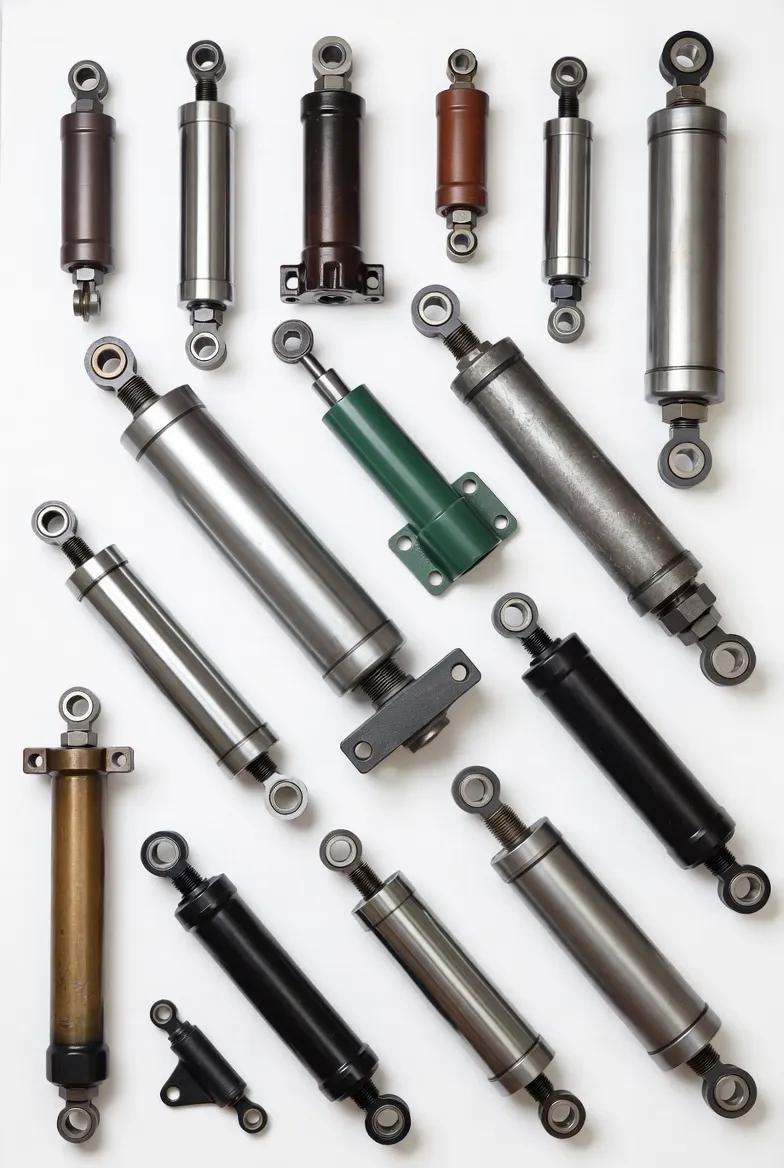
To truly understand the broad application areas of boom cylinders, we must dive deep into the core technologies that support these applications. The reliability of construction machinery depends largely on the combination of breakthroughs in fundamental material science and precision manufacturing engineering.
- Advanced Sealing Technology: Seals are the soul of the hydraulic cylinder. Modern boom cylinders often use five-piece sets or combined sealing structures. The primary seal handles high pressure to block hydraulic oil, the secondary seal manages residual oil films, and the wiper seal acts as a sentinel to keep external mud, sand, and moisture out. Top-tier seal suppliers utilize computational materials science to develop high-molecular polymers that maintain excellent elasticity even in extremely cold or hot environments.
- Piston Rod Surface Engineering: The piston rod constantly contacts the air and rubs against the guide sleeve during extension and retraction. Beyond traditional hard chrome plating, an increasing number of manufacturers are introducing Quench-Polish-Quench techniques and nitrocarburizing technologies. These methods not only improve surface hardness but also significantly enhance corrosion resistance, making them particularly suitable for construction operations in coastal high-salt-spray environments.
- Intelligent Cushioning Structures: When a boom cylinder reaches the end of its stroke, without a cushioning device, metal components would collide violently. Built-in variable cross-section cushion sleeves and cushion plunger designs force hydraulic oil to flow out through narrow gaps using throttling principles. This generates a damping force, allowing the massive boom to decelerate smoothly until it stops. This technology greatly extends the fatigue life of the mechanical structures.

? Daily Maintenance and Troubleshooting Guide
To ensure excavators deliver optimal performance across all application areas, establishing a strict boom cylinder maintenance schedule is crucial. Neglecting upkeep will not only lead to equipment downtime but also result in exorbitant repair costs. Below are maintenance strategies summarized based on the extensive experience of industry experts.
1. Contamination Control: The First Priority of Hydraulic Systems
Over seventy percent of hydraulic failures are caused by fluid contamination. Microscopic particulate matter entering the interior of the cylinder acts like sandpaper, scratching the cylinder barrel inner walls and seals, leading to internal leakage. Regularly replacing high-quality hydraulic fluid and filter elements to ensure system cleanliness meets ISO standards is the most effective method to prolong the life of excavator boom cylinders.
2. Troubleshooting Cavitation and Aeration
When operators hear abnormal hissing or cracking noises coming from the cylinders, it is usually due to air mixing into the hydraulic oil, causing cavitation. Air bubbles collapse instantly in high-pressure zones, generating localized extreme temperatures and pressure micro-jets capable of stripping away metal surfaces. In such cases, it is imperative to check the sealing of the suction lines and promptly bleed the air from the cylinders through the bleeder valves.
3. Handling Piston Rod Scratches
Before daily operations, the surface of the piston rod should be inspected for pits or scratches caused by flying rocks. Minor scratches can be gently polished with fine sandpaper along the circumferential direction to prevent their sharp edges from tearing the main seal ring. If the scratches are deep, professional localized electroplating repair or direct replacement of the piston rod is required.
? Future Trends: Smart and Digital Cylinders
With the deepening of Industry 4.0 concepts and the popularization of artificial intelligence technologies, excavator boom cylinders are experiencing a historic leap from traditional mechanical components to intelligent sensing terminals. The infusion of modern technology makes future construction machinery more efficient, autonomous, and energy-saving.

Integrated Displacement Sensors: In digitally controlled excavators, high-precision magnetostrictive displacement sensors are embedded within the boom cylinders. These sensors can read the exact position of the piston in real time and feed this information back to the central control system. This provides the core data support necessary for realizing semi-automatic or fully automatic grading operations and virtual electronic fencing to prevent the mechanical arm from touching overhead cables or underground pipelines.
Predictive Maintenance Integration: Utilizing temperature and miniature pressure sensors installed on the cylinders, the system can transmit real-time operational status to the cloud via the Internet of Things. AI algorithms, by analyzing subtle changes in oil pressure fluctuations and heat distribution characteristics, can issue early warnings before a seal completely fails. This transition from repair after failure to predictive replacement saves large mining enterprises and construction companies incalculable downtime costs.
Future excavator hydraulic systems will also focus more on energy conservation and environmental protection. The research and development of digital flow distribution technologies and energy-recovery boom cylinders are becoming new battlegrounds for major hydraulic corporations. Utilizing gravitational potential energy to drive motors for power generation or energy storage during the boom lowering process, and then feeding this back into a hybrid power system, will significantly reduce fuel consumption and comply with increasingly stringent global carbon emission regulations.
? Conclusion: Building a Reliable Future for Heavy Machinery
In summary, the excavator boom cylinder is by no means just a simple metal telescopic tube; it is a cutting-edge industrial product that integrates fluid mechanics, material science, precision machining, and electronic information technology. From the foundations of skyscrapers in bustling cities to the freezing, desolate mining regions, and from complex primary forests to high-speed waste recycling stations, boom cylinders support the infrastructure construction of modern human civilization with their outstanding reliability and powerful dynamic output.
When purchasing and evaluating excavator boom hydraulic cylinders, it is imperative to place the actual application scenarios as the primary consideration. Emphasize dust-proof sealing performance in dusty environments; stress high strength and fatigue life of materials in heavy-load mining areas; and focus on sensor integration and response accuracy in precision operation fields. Selecting a hydraulic brand with robust research and development capabilities, strict quality control systems, and a focus on credibility guarantees is fundamental to ensuring the long-term efficient operation of mechanical equipment.
Empowering Machinery, Driving the Future. Master core hydraulic technology to make every excavation precise and powerful!