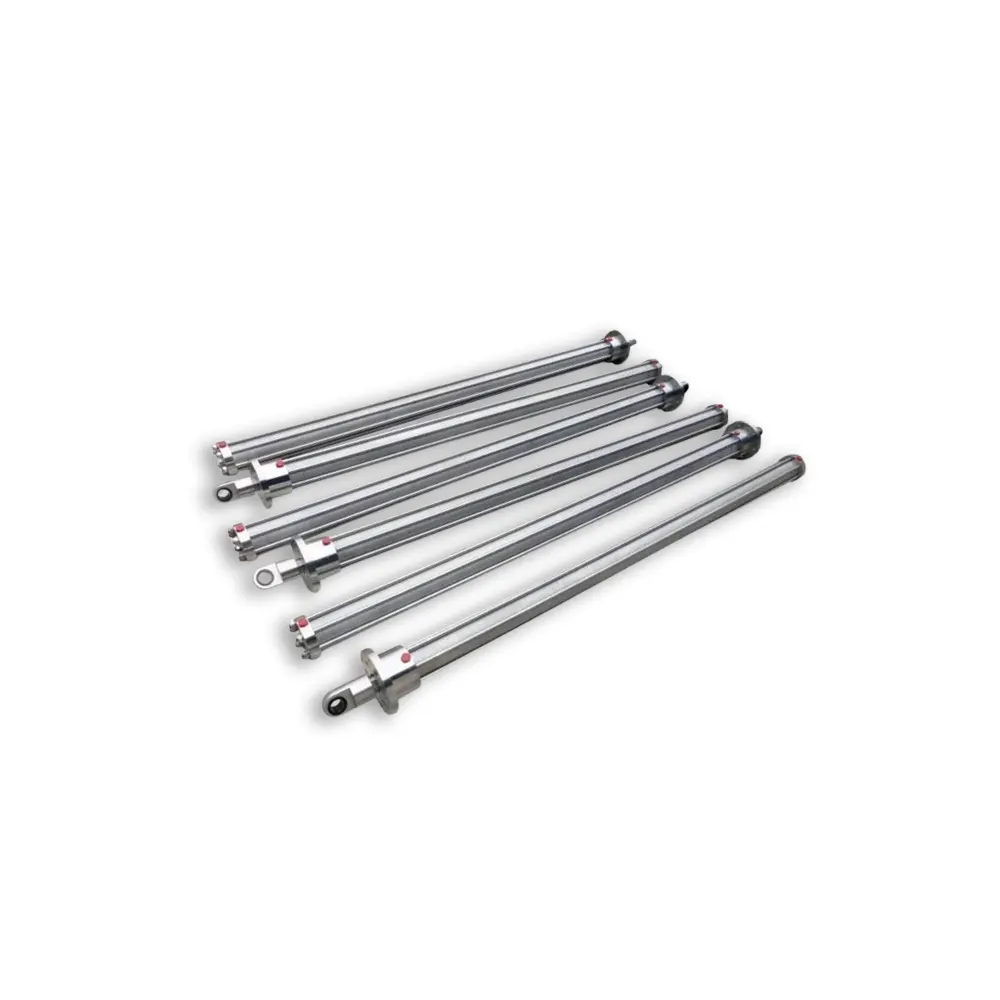
WASHDOWN STAINLESS STEEL HYDRAULIC CYLINDER
Washdown machinery puts hydraulic actuators near water jets, cleaning agents, product residues and hygienically sensitive surfaces. A stainless finish is a starting material choice, not a food-contact approval or substitute for cleanable equipment design.
Define the cylinder’s hygienic zone
Map the actuator relative to exposed food, packaged goods, guards and utility spaces. An assembly beneath a closed machine enclosure might have different requirements from a moving rod directly above open product. Consider whether oil could drip or spray into the process if a seal or hose fails. The position of the gland, ports and rear mounting bracket determines where residues may collect. The buyer must name the intended zone and any facility hygiene requirements rather than asking the supplier for an undefined food-grade cylinder.
Record chemical and thermal cleaning conditions
Cleaning-agent trade name, working concentration, water temperature, exposure time and rinse method are needed to assess materials accurately. Caustic wash, acidic cleaners and chlorine-based disinfectants produce different challenges, and exterior seals may see a different chemical mixture from internal hydraulic fluid. Tell the material and sealing suppliers how frequently each solution contacts the equipment. A statement that the surface is stainless cannot guarantee compatibility with any unspecified sanitation procedure. Change control must capture later changes in cleaning product or strength.

Locate crevices and uncleanable pockets
Rear clevises, shrouded welds, washers and port fittings may retain moisture or food residue even when the tube is easily wiped. Inspect the installed assembly from the operator’s cleaning position, not just the CAD front view. Drainability and physical access should be considered together: adding a shield can keep direct spray off a gland while creating a pocket beneath it. Hygienic design should minimize inaccessible overlap without undermining joint strength, bearing freedom or safe service access.
For hygienic machine layout, begin with the available corrosion-focused cylinder range.
Control gland and wiper exposure
A concentrated wash jet can strike a wiper directly and carry debris toward the moving rod. Document nozzle position, spray pressure practices and cylinder parking position during sanitation. Verify the rod surface, external seals and protective arrangement for the actual process. A generic seal photograph is not proof of chemical compatibility or washdown resistance. The supplier’s application review should distinguish the internal pressure seal from the outside wiper that confronts water, detergents and product residues.
Protect the processing area against hydraulic leakage
An oil leak is a contamination hazard even when a lubricant is formulated for incidental contact uses. Evaluate gravity paths from gland and hose connections and consider guarding, drip capture or relocation as appropriate. The design must still allow cleaning and early leak detection. Record fluid identity and any required facility-specific lubricant approval, but do not imply that the lubricant permits uncontrolled release. Maintenance instructions should require isolation and investigation when leakage appears, particularly when product is exposed.
Review all exposed metals and fasteners
Stainless tube material alone does not establish corrosion performance at pin joints, screws or port adapters. The buyer should request a component-level bill of materials and understand which surfaces are splashed repeatedly. Dissimilar-metal interfaces, thread crevices and damage from tool contact can become the weak point. A welded design may need appropriate finishing before final seal assembly. Requirements for surface smoothness or cleanable joints must be written into the drawing instead of assumed from an attractive product image.

Test cleaning access during commissioning
An installed cylinder may be difficult to inspect when the mechanism is fully retracted or when a guard blocks the gland. Use the machine maker’s safe lockout and load-support process before opening access. Review full-stroke clearances, hose routing and places where liquid collects after washing. A hydraulic functional test and a hygiene validation test address different questions. Agree which department owns cleaning verification and which documents the cylinder’s dimensional and pressure acceptance.
Ask for evidence tied to the actual equipment
The RFQ should state operating duty, material scope, cleaning chemistry, temperatures, rod finish and seal selection. If a hygienic design standard or certification is contractually required, identify the exact edition and scope. Request a dimensioned submittal, component materials, cleaning compatibility review and approved tests. A supplier’s general food-industry application picture is not evidence that this actuator has passed an inspection specific to the buyer’s food-handling line.
Create a hygienic risk map for the installed machine
Use the equipment layout to show open-product regions, splash paths, cleaning nozzles, guarding and drains. Mark the cylinder at both its retracted and extended positions. This can reveal a hose fitting above product or an inaccessible rear clevis that CAD renders do not emphasize. Evaluate whether a leaking gland could drip toward food, and whether external shields can be cleaned without creating new crevices. The facility’s hygienic design authority should approve the machine arrangement; a cylinder’s alloy designation is only one input to that decision.

Build a chemical compatibility schedule
Prepare a table of sanitation steps: pre-rinse, detergent, disinfectant, dwell period, final rinse and dry-down. For each step identify the actual product formulation, concentration, fluid temperature and spray direction. Then identify which seal or metal surface can contact that solution. The rod wiper may see repeated chemical cycling that the internal piston seal never encounters. If cleaning practices change after installation, the compatibility review should be reopened. A supplier cannot honestly guarantee resistance to an unspecified group of all cleaning chemicals.
Process machinery also uses several actuator constructions; see industrial actuator families.
Separate cleanability from visual finish
A polished body is not inherently easy to clean if weld pockets or covered joints retain product residues. Ask whether a worker can see and wash the underside of a port block, the interior of a clevis and the gap near the gland. A poorly directed wash jet may push contamination into a region that cannot drain. Consider mount orientation, smooth transitions, access panels and required disassembly methods. Material finish, geometry and cleaning verification form a combined system; none of them alone proves a sanitary outcome.
Use a contamination-path scenario
Imagine a cylinder above a belt conveying uncovered ingredients. The rod seal develops a slow leak while sanitation staff wash the mechanism each shift. Even if an appropriately designated lubricant is present, the oil can migrate downward toward product. The machine designer should consider moving the actuator, installing suitable containment, preventing leakage and adding inspection access. This is a layout and maintenance issue as well as a seal issue. Food-contact approval cannot be inferred merely because an actuator is stainless.

Specify commissioning and owner responsibilities
The hydraulic supplier should document the final cylinder materials, seals, finish and pressure/function checks. The machine builder should verify installation geometry, guards, hose routes and mechanical safety. The food facility should confirm cleaning methods and sanitary acceptance against its own requirements. These are separate signoffs, so the RFQ needs to name who supplies each document. If a third-party hygienic standard is requested, the purchase order must state the actual scope rather than claiming unspecified certification based on an industry application image.
Hygienic design worksheet
| Hygienic factor | Specified control |
|---|---|
| Product zone | Mark open-food and utility areas on layout |
| Wash process | Record actual chemical product and working dilution |
| External seal | Assess spray and cleaning contact |
| Mount access | Confirm reachable, cleanable recesses |
| Leak pathway | Review gravity paths to exposed product |
| Handover | Allocate machine, hygiene and hydraulic signoffs |
Five washdown design questions
Does stainless steel alone make an actuator hygienic?
No. Residue retention, leakage paths, seal selection and cleaning access matter. Compliance with any particular hygienic design program requires a relevant documented assessment, not a general material description.
Could washdown chemicals degrade an external rod wiper?
Yes, depending on compound, exposure and process conditions. Obtain specific cleaning formulations and evaluate them against the proposed elastomer and rod finish.
Should the cylinder be placed directly above exposed product?
The arrangement deserves a contamination and safety review. Designers often consider routing, guarding or relocation to control credible oil-release paths rather than relying only on a material label.
Does a compatible lubricant eliminate hygiene risk?
No. Any leak may contaminate equipment or product. Correct sealing, maintenance and appropriate machine layout remain essential.
What should cleaning staff validate during startup?
Inspect whether the cylinder and mount can be cleaned and drained as intended, whether guards remain effective, and whether hydraulic leakage can be detected promptly under the facility’s procedure.
Approve the cleaning environment as a system
A washdown specification becomes useful when the cleaning recipe, zone classification, component materials, seal compatibility and maintenance access are all documented. Keep any claimed hygiene approval tied to the exact assessed machine and certificate scope.
Share food-zone position, cleaning recipe and hydraulic specifications.