
Advanced Fluid Power Architecture
Hydraulic Cylinders in Excavators and Heavy Machinery: Engineering for Extreme Shock and Load
An authoritative engineering blueprint detailing kinetic shock absorption, metallurgical fatigue resistance, advanced hydrostatic sealing, and the structural science required to conquer the most brutal earthmoving environments.

The Absolute Limit of Mechanical Endurance
In the unforgiving arenas of commercial construction, deep subterranean mining, and large scale infrastructure development, machinery is subjected to physical punishment that defies standard engineering comprehension. The excavators, wheel loaders, and massive articulated haulers deployed in these sectors do not operate in sterile laboratories. They spend their operational lifespans tearing through solid granite, lifting immense payloads of abrasive aggregate, and battling extreme thermodynamic weather shifts. At the very heart of this relentless industrial warfare are hydraulic cylinders. These fluid power linear actuators act as the primary mechanical muscles of heavy machinery, translating highly pressurized synthetic fluid into the devastating kinetic force required to move the earth. For procurement professionals and design engineers seeking the highest global standards in fluid power fabrication, establishing a technical baseline at our premium hydraulic cylinders platform is an essential prerequisite.
Unlike standard factory actuators that perform predictable, smooth cycle loops, hydraulic cylinders in excavators and heavy machinery must be engineered for chaos. When an excavator bucket violently strikes a hidden slab of bedrock, the kinetic energy does not simply vanish. It sends a massive, instantaneous shockwave directly up the mechanical linkage and straight into the hydraulic cylinder. This impact causes the internal hydrostatic pressure to spike to astronomical levels in a fraction of a millisecond. If the cylinder is not explicitly designed to absorb, dissipate, and survive these extreme shock loads, the steel barrel will rupture, the piston rod will buckle, and the internal elastomeric seals will instantly shatter.
Evaluated against stringent international ISO fluid power safety and manufacturing directives, this comprehensive technical blueprint will systematically deconstruct the architecture of extreme duty actuators. We will explore the mathematical realities of shock load management, the metallurgical superiority required to prevent Euler column buckling, the intricate design of high pressure zero extrusion sealing matrices, and the kinematic mounting solutions that keep these massive machines operational. Understanding the science behind these components is the only way to guarantee absolute reliability in the field.
Managing Extreme Kinetic Shock: The Physics of Survival
The defining characteristic of an excavator hydraulic cylinder is its ability to survive unpredictable, violent impacts. This requires advanced internal cushioning and massive burst pressure tolerances.
Hydrostatic Pressure Spikes
During normal earthmoving operations, a system might operate at a continuous 4,000 PSI. However, when the machine strikes an immovable object, the kinetic momentum of the entire multi ton chassis is transferred into the trapped hydraulic fluid. This causes instantaneous pressure spikes that can exceed 10,000 PSI. To survive this, Excavator Hydraulic Cylinders are engineered with incredibly thick, high yield carbon steel barrels. The hoop stress calculations for these vessels include safety factors of 3:1 or 4:1, ensuring the barrel does not plastically deform or explode like a balloon under the immense surge.
Advanced End-of-Stroke Cushioning
In heavy machinery, the piston must never violently slam into the steel end caps at full speed. This metal on metal impact would rapidly tear the cylinder apart and send destructive vibrations through the operator cab. Fluid power engineers integrate highly specialized progressive cushioning spears into the piston assembly. As the cylinder reaches the final inches of its stroke, this spear enters a tightly machined cavity, restricting the exhaust fluid path. This restriction creates a massive localized backpressure that smoothly, hydraulically decelerates the massive payload before it bottoms out, preserving the structural integrity of the entire chassis.

Metallurgical Superiority: Forging Unbreakable Strength
The raw materials utilized in standard factory automation cylinders are entirely inadequate for heavy machinery. The environment demands specialized steel alloys and rigorous heat treatments to prevent catastrophic fatigue failures.
Induction Hardening the Chrome Rod
The piston rod is the most vulnerable component, as it constantly moves into the abrasive outdoor environment. A stray boulder or piece of rebar striking a standard rod will create a deep gouge, which acts like a razor blade to shred the internal seals upon retraction. To combat this, the rods of heavy duty cylinders undergo induction hardening. This high frequency electrical process superheats the outer layer of the 4140 chromoly steel, altering its crystalline structure to achieve extreme hardness while keeping the inner core ductile and flexible. The rod is then heavily chrome plated. This armor plating allows the rod to shrug off massive kinetic impacts without scratching, a vital necessity for Agricultural Hydraulic Cylinders working in dense, rocky terrain.
Preventing Euler Column Buckling
When a hydraulic cylinder extends under a massive load, the rod acts as a slender column subjected to immense compressive stress. If the rod diameter is not mathematically calculated correctly, the extreme force will cause the steel to bow outward and violently snap in half. This is known as Euler column buckling. Heavy machinery design mandates heavily oversized rod diameters and the use of ultra high yield strength steel to prevent this phenomenon. This is particularly critical in multi stage applications like Dump Truck Hydraulic Cylinders, where the actuator must lift dozens of tons of aggregate to extreme vertical heights without structural collapse.

Advanced Sealing and Extrusion Defense
The most robust steel housing is entirely useless if the microscopic polymer seals fail. In extreme duty equipment, the sealing architecture must actively resist extrusion and severe abrasive contamination.
Zero Extrusion Architecture
During massive shock spikes, the hydrostatic pressure actively tries to force the soft polyurethane seals into the microscopic clearance gaps between the piston and the barrel wall. If the seal extrudes into this gap, it is instantly sheared off, resulting in catastrophic fluid bypass. To prevent this, heavy machinery cylinders utilize highly rigid POM (Polyoxymethylene) or PTFE backup rings. These hard plastic rings sit behind the main seal, physically bridging the clearance gap and acting as an impenetrable wall that protects the elastomer from explosive extrusion.
Aggressive Excluder Technology
Earthmoving equipment operates in a continuous cloud of abrasive silica dust, mud, and water. As the rod extends, this slurry sticks to the oil film. If dragged back inside, it will destroy the pump. The outermost wiper seals on heavy equipment feature highly aggressive, double lip profiles designed to violently chisel hardened mud and ice off the rod. In highly sterile or safety critical environments, such as Aerial Work Vehicle Hydraulic Cylinders, these advanced excluders ensure the internal hydrostatic lock remains pure and uncompromised, preventing lethal platform drift.
Load Holding and Zero Drift
In logistics and heavy lifting, a cylinder must maintain its position even if a main hydraulic hose bursts. Excavator boom cylinders and Forklift Hydraulic Cylinders frequently integrate heavy duty counterbalance valves bolted directly to the steel barrel. These valves act as absolute hydrostatic locks, trapping the fluid inside the cylinder and permanently paralyzing the load in the event of a catastrophic system failure elsewhere on the machine.
Kinematic Mounting: Absorbing Structural Torsion
A machine chassis is not perfectly rigid. When an excavator tracks across uneven terrain and lifts a massive boulder, the entire steel frame twists and distorts. If the hydraulic cylinder is mounted rigidly to this twisting frame, it will experience devastating lateral side loading.
- ✔️
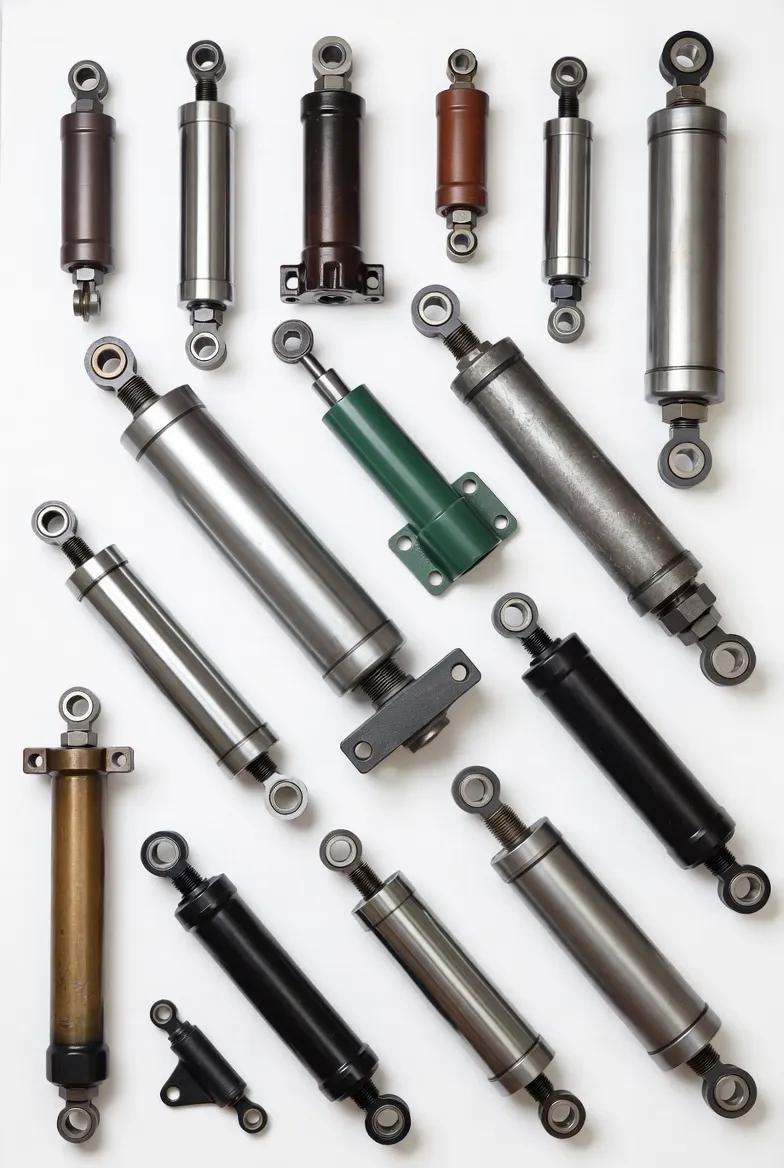
Spherical Bearing Integration: To prevent the cylinder rod from grinding aggressively against the internal head gland during chassis flex, engineers deploy advanced spherical bearings at the clevis mounts. These bearings allow the cylinder to freely pivot and articulate in multiple dimensions simultaneously. This kinematic freedom ensures that the immense pushing force remains perfectly axially aligned with the rod, completely neutralizing the destructive lateral shear forces.
- ✔️
Heavy-Duty Trunnion Mounts: For extremely long cylinders, standard end mounts are insufficient due to the massive bending moments generated in the center of the barrel. Heavy duty trunnion mounts are robotically welded near the center of gravity of the cylinder. This essentially halves the unsupported column length, vastly increasing the structural rigidity of the system and preventing the barrel from bowing under extreme load.


Conclusion: Architecting the Ultimate Kinetic Advantage
Engineering hydraulic cylinders for excavators and extreme duty heavy machinery is not a matter of simply scaling up standard components; it is a fundamental redesign aimed at total structural survivability. The environments these machines conquer are merciless. By meticulously calculating hydrostatic shock absorption thresholds, deploying induction hardened high yield metallurgical alloys, integrating rigid anti extrusion sealing matrices, and utilizing advanced kinematic spherical mounting solutions, fluid power engineers construct actuators that are virtually indestructible. These massive steel muscles are the absolute backbone of global infrastructure development. When your project demands unyielding kinetic force, failure is never an option. If your heavy equipment fleet requires custom engineered fluid power solutions designed to thrive in the most brutal environments on earth, our elite technical team stands ready to architect your ultimate mechanical advantage.