
Advanced Fluid Power Architecture
The Heart of Fluid Power: The Crucial Role of Hydraulic Cylinders in Industrial Machinery
An authoritative engineering blueprint detailing the fundamental hydrostatic principles, extreme kinetic load capabilities, automated precision architectures, and the absolute necessity of fluid power in modern industrial sectors.

The Unseen Muscle Driving Global Infrastructure
In the highly rigorous disciplines of commercial construction, advanced automated manufacturing, deep subterranean mining, and immense logistical operations, generating and controlling mechanical force is the absolute prerequisite for progress. While combustion engines and electric motors supply the primary rotational energy, transforming that energy into devastatingly powerful, perfectly controlled linear motion requires a specialized intermediary. This is where fluid power engineering assumes total command. The crucial role of hydraulic cylinders in industrial machinery cannot be overstated; they are the undisputed mechanical muscles that physically shape the modern world. To explore the absolute highest industry standards for precision engineered fluid power components, visiting our premium hydraulic cylinders platform provides an essential technical baseline.
A hydraulic cylinder is a triumph of metallurgical science and thermodynamic physics. It is a highly calibrated pressure vessel designed to execute a singular, profound task: converting the hydrostatic pressure of synthetic fluid into unstoppable linear kinetic energy. Without these actuators, modern industry would instantly grind to a halt. We would be unable to lift fifty ton steel girders into the sky, bore through solid granite beneath the earth, or stamp high tensile alloys into automotive chassis on a factory floor. The energy density provided by a hydraulic actuator remains completely unrivaled by any pneumatic or purely electrical alternative available in the engineering sector today.
From an authoritative engineering perspective evaluated against international manufacturing safety criteria, understanding the deployment and physics of these components is vital for any project architect or fleet maintenance director. This comprehensive technical blueprint will meticulously dissect the fundamental physics of hydrostatic force multiplication, explore the massive operational variations across different heavy industry sectors, analyze the specialized sealing architectures required for extreme environments, and demonstrate exactly why fluid power remains the absolute core of industrial progress.
The Physics of Force Multiplication
The supremacy of hydraulic cylinders in industrial applications is derived from a simple but profoundly powerful scientific principle regarding the behavior of confined liquids.
The Law of Incompressibility
Unlike gases, which compress when subjected to pressure, synthetic hydraulic oil is mathematically incompressible under standard operational constraints. When a hydraulic pump forces fluid into the sealed chamber of a cylinder barrel, the fluid acts exactly like a flexible, indestructible solid steel rod. It transfers one hundred percent of the input energy directly to the piston face without any spongy elasticity or energy absorption. This rigid transfer of kinetic energy allows the cylinder to not only push massive loads but to hold them perfectly suspended in mid air with absolute positional stability.
Extreme Force Density
The amount of force an actuator generates is calculated by multiplying the internal fluid pressure by the cross sectional surface area of the piston. Because modern industrial hydraulic systems routinely operate at pressures exceeding five thousand pounds per square inch, a cylinder with a relatively compact physical footprint can exert astronomical amounts of pushing or pulling power. This incredible force to size ratio is the definitive reason why massive Excavator Hydraulic Cylinders are the only viable technology for mobile earthmoving, as electric linear actuators capable of matching that force would be too massive to fit on the machine chassis.

Dominating Heavy Industry and Construction
The construction and logistics sectors are the most visible arenas where the crucial role of hydraulic cylinders is demonstrated daily. These environments demand actuators that are not only powerful but practically indestructible.
Managing Catastrophic Shock Loads
When a massive mechanical bucket slams into an immovable boulder beneath the earth, the kinetic shockwave travels instantly back through the machine linkage and directly into the actuator. Hydraulic cylinders are uniquely engineered to survive these violent impacts. The fluid medium itself acts as a dense shock absorber, while the induction hardened steel barrel and heavy duty trunnion mounts prevent the component from shattering. Without this inherent survivability, heavy construction would be impossible.
Telescopic Geometry for Logistics
In the logistics and materials transport sector, spatial efficiency is just as critical as raw power. A dump truck requires an actuator capable of lifting a massive cargo bed to a sixty degree angle, but that actuator must also collapse into a tiny footprint behind the cab for highway driving. The engineering solution is the multi stage telescopic cylinder. By nesting multiple steel sleeves inside one another, these specialized actuators, such as massive Dump Truck Hydraulic Cylinders, provide exceptional linear reach while maintaining strict highway legal dimensions.

Absolute Precision and Human Safety
While raw power is impressive, the ability to control that power down to the millimeter is what elevates fluid power engineering into the realm of advanced automation and critical life safety.
Micron-Level Kinematic Accuracy
In automated factory environments, cylinders are frequently paired with advanced electronic proportional valving and internal linear position sensors. This creates a closed loop feedback system where the machine computer knows the exact position of the cylinder rod at all times. This allows the actuator to accelerate rapidly, decelerate smoothly, and stop with micron level precision. This exact control architecture is what empowers Forklift Hydraulic Cylinders to carefully navigate fragile logistics cargo high into warehouse racking without sudden, damaging jerks.
Load Holding and Zero Drift
When human lives are suspended in the air, the fluid power system must be completely fail safe. Hydraulic cylinders achieve this by integrating heavy duty counterbalance manifolds directly into the steel barrel. These valves act as absolute hydrostatic locks. If a primary hydraulic hose bursts, the valve snaps shut, instantly trapping the oil inside the cylinder and permanently paralyzing the load. This prevents a lethal free fall scenario and is the absolute mandatory safety standard for Aerial Work Vehicle Hydraulic Cylinders.
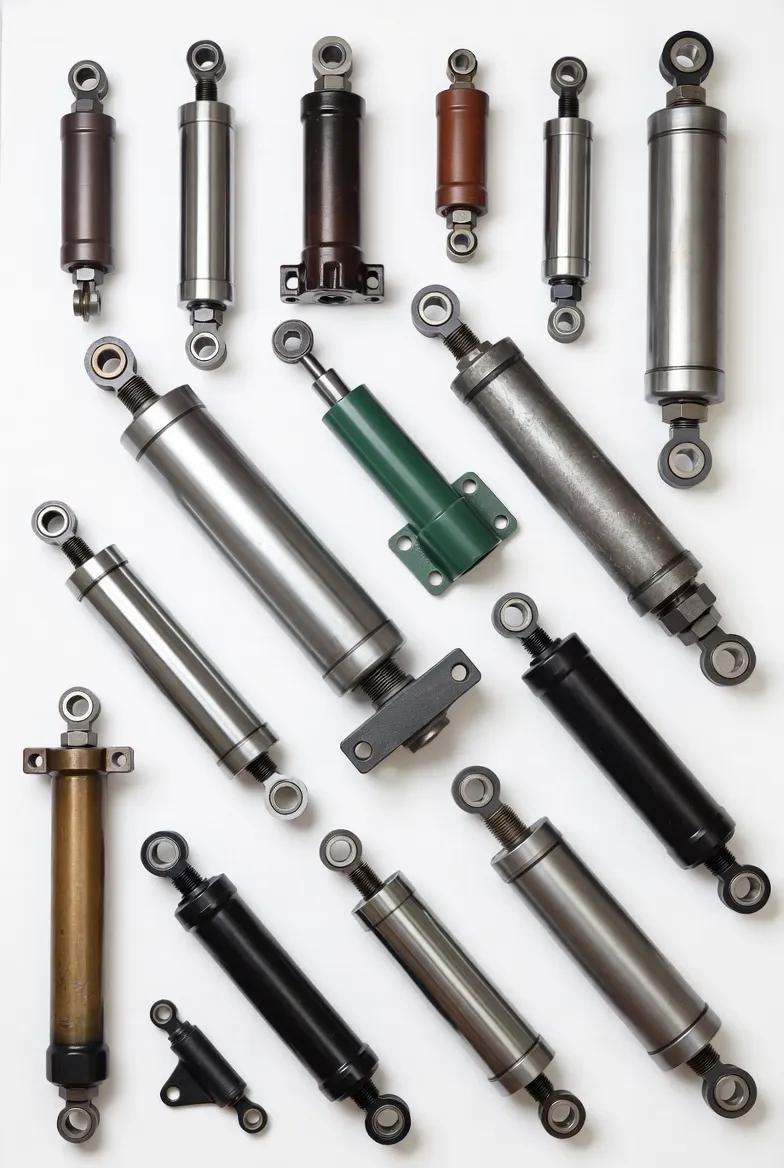
Surviving the Extremes: Metallurgical and Polymer Defense
Industrial machinery rarely operates in pristine, climate controlled environments. The actuators driving these machines must wage a continuous war against abrasive contamination, corrosive chemical attack, and severe thermodynamic fluctuations.
- ✔️
Defeating Abrasive Silica and Mud: When a piston rod extends into a muddy outdoor environment, it becomes coated in abrasive debris. As it retracts, this hardened mud attempts to penetrate the cylinder. Premium actuators are equipped with aggressive, dual lip metallic or polyurethane scraper seals designed to violently shear off this contamination before it can breach the pressure vessel.
- ✔️
Resisting Chemical Corrosion: Exposure to caustic fertilizers, road salt, or oceanic environments will rapidly rust standard steel components, leading to massive fluid hemorrhage. Modern fluid power engineering combats this by utilizing advanced multi part epoxy marine coatings for the barrel and induction hardened, heavily chrome plated rods. For machines constantly bathed in harsh chemicals, such as Agricultural Hydraulic Cylinders, these advanced metallurgical defenses are the only guarantee of long term survival.
- ✔️
Thermal Polymer Resilience: A machine might start on a freezing winter morning and operate continuously until the internal fluid temperature reaches scorching levels. Standard rubber seals would shatter in the cold and melt in the heat. Industrial cylinders utilize advanced Viton elastomers or highly plasticized polyurethane compounds capable of maintaining absolute hydrostatic sealing integrity across massive thermal spectrums.


Conclusion: Architecting the Backbone of Progress
The crucial role of hydraulic cylinders in industrial machinery is undeniable and irreplaceable. They are the unseen heart of fluid power, translating raw engine horsepower into the precise, devastatingly strong linear force required to construct our cities, harvest our food, and manufacture our goods. By leveraging the absolute rigidity of incompressible synthetic fluids, integrating advanced safety manifolds for zero drift precision, and deploying extreme metallurgical defenses against harsh environments, these actuators ensure that the world heaviest equipment operates with unerring reliability. As industrial automation continues to demand even greater power density and microscopic control, the reliance on advanced hydraulic engineering will only intensify. If your organization is designing revolutionary new machinery, upgrading a heavy equipment fleet, or requires highly customized fluid power components engineered to the absolute highest international standards, our elite technical team stands ready to architect your success.