
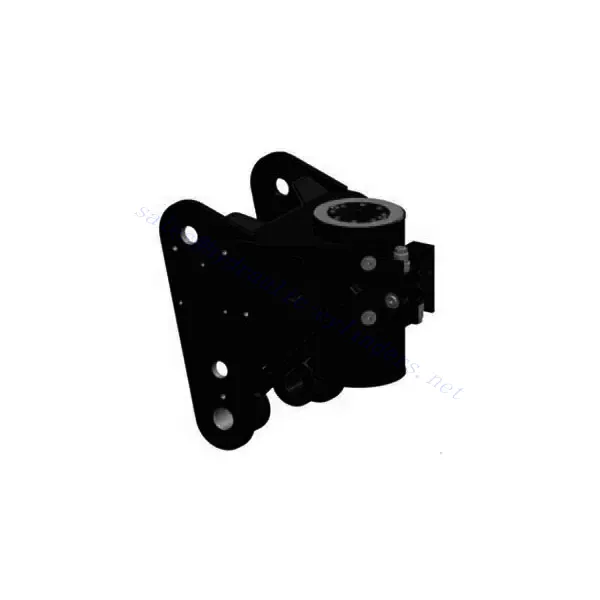
Drehantrieb für Hubarbeitsbühnen
Als einer der Hersteller, Lieferanten und Exporteure von mechanischen Produkten, bieten wir Hydraulikzylinder und viele andere Produkte an.
Bitte setzen Sie sich mit uns in Verbindung, um Einzelheiten zu erfahren.
Post:sales@hydraulic-cylinders.net
Hersteller, Lieferant und Exporteur von Hydraulikzylindern.
Drehantrieb für Hubarbeitsbühnen
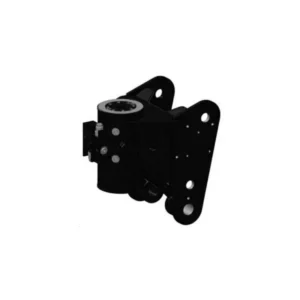
HBM series rotary actuator is a rotary actuator independently designed and developed for the arms control of articulated aerial work platforms. According to customer installation and performance requirements, the corresponding customized design can be realized to ensure the adaptability and flexibility of operation.
Based on the metric unit design, the unique seal and construction allow for a low coefficient of friction and high output torque. In addition, finite element analysis and durability testing contribute to the stability and reliability of the product. Compared with similar products on the market, the HBM series rotary actuator under the same product size, the output torque is increased by 10% ~ 20%, the cracking pressure is reduced by 50%, the operation is stable, the efficiency is higher, the cracking pressure is better, and finally ensure the safe, reliable and efficient work of the high-altitude working platform.
Aerial Work Platform Rotary Actuator Key Characteristics:
- Low Friction Coefficient:
- The critical component of the HBM series rotary actuator – the spiral spline for rotation and torque transmission,
features excellent precision, balanced stress distribution, and stable transmission. With the low-friction axial bearings and a unique sealing system design, the HBM series rotary actuator has a low friction coefficient during transmission.
- High Output Torque:
- Through continuous innovative research and validations, the HBM series rotary actuator is designed compactly to fully use the limited internal space and transmit high output torque via fluid pressure. Compared to similar products, the HBM series rotary actuator provides a 10% to 20% higher output torque under the same product size.
- Long Service Life:
- Comprehensive analysis and calculation on each size of the HBM rotary actuator are implemented with the assistance of FEA software during the design process. Besides, product optimization is continuously carried out to ensure that each product size can meet the long service life requirements.
- Except for regular factory tests, two dedicated rotary actuator endurance test benches are available for tests according to customer and application requirements, ensuring excellent durability and long service life.
Aerial Work Platform Rotary Actuator Parameter:
| Produktname | Drehantrieb für Hubarbeitsbühnen |
| Merkmale: | Realize platform and crank arm swing |
| Torque: | 500~5000N.m |
| Swing angle: | 0~360° |
| Druck: | 21MPa(standard working pressure) |
| Rotary Actuator Applications: | Hubarbeitsbühne |
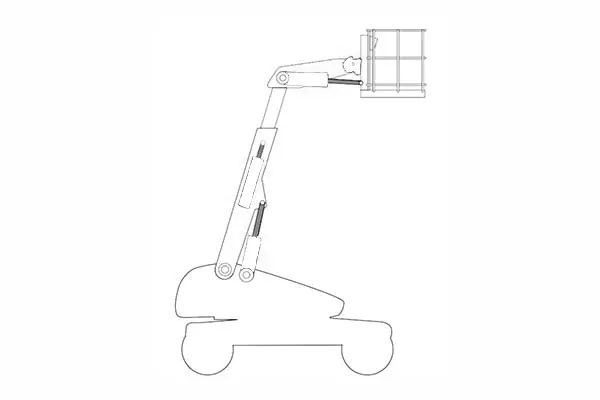
Identifikationsdiagramm für Hubarbeitsbühnen:
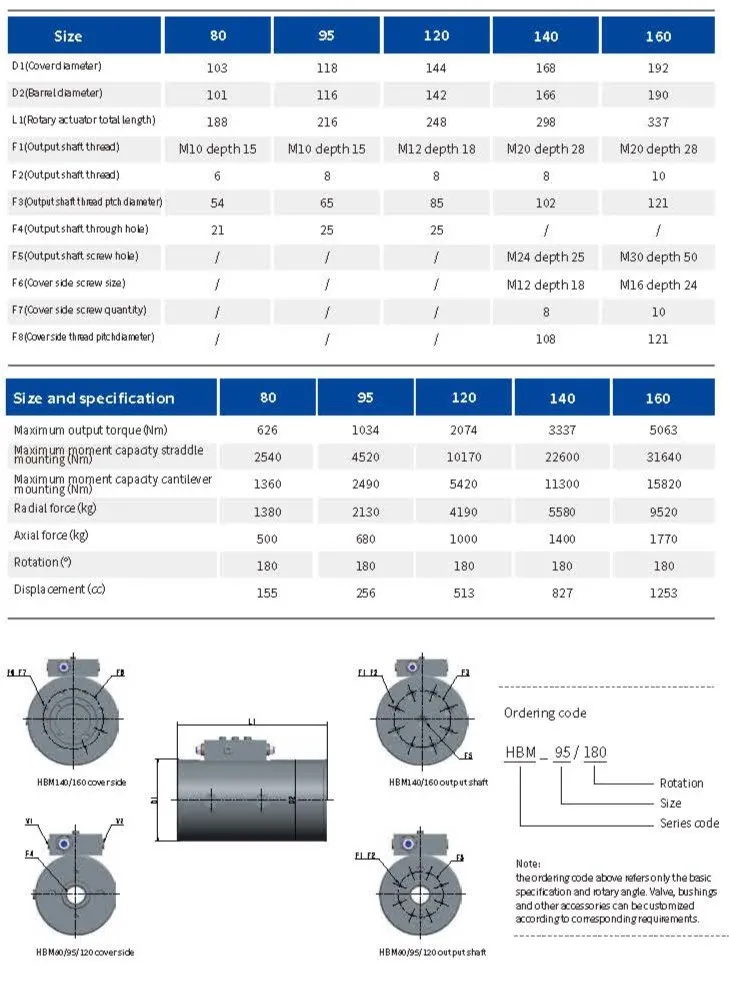
Aerial Work Platform Rotary Actuator Size And Specification:
Usage Method Of Aerial Work Platform Rotary Actuator:
- Actuator Installation:
- Follow the manufacturer’s instructions for proper installation of the aerial work platform rotary actuator.
- Ensure the actuator is securely mounted to the aerial work platform’s structure, providing a stable and reliable connection.
- Electrical and Hydraulic Connection:
- Connect the actuator to the electrical and hydraulic systems of the aerial work platform according to the provided guidelines.
- Ensure all connections are secure and properly sealed to prevent leaks or electrical malfunctions.
- Rotation Control:
- Utilize the control panel or interface provided to control the rotational movement of the aerial work platform.
- Follow the recommended operating procedures and safety guidelines for smooth and precise rotation.
- Sicherheitsaspekte:
- Machen Sie sich vor der Inbetriebnahme der Hubarbeitsbühne mit den Sicherheitsvorkehrungen und Notfallmaßnahmen vertraut.
- Ensure that all operators receive proper training on the safe operation of the platform and the aerial work platform rotary actuator.
Wie lässt man Luft aus einem Hydrauliksystem ab?
Bleeding air from a hydraulic system is a crucial maintenance procedure to ensure optimal performance and prevent spongy or inconsistent hydraulic operation. Here’s a step-by-step guide on how to bleed air from a hydraulic system:
- Blutungspunkte identifizieren:
- Locate the bleed points in the hydraulic system. These are typically found at high energies, such as on top of hydraulic cylinders, control valves, or pump reservoirs.
- Consult the hydraulic system’s manual or manufacturer’s guidelines to identify the specific bleed points for your system.
- Bereiten Sie das System vor:
- Turn off the power to the hydraulic system and relieve pressure by lowering or retracting hydraulic cylinders or releasing the pressure valve.
- Ensure you have the necessary tools and safety equipment to perform the bleeding process, including safety goggles and gloves.
- Position a Collection Container:
- Place a suitable container or drain pan beneath the bleed point to collect any hydraulic fluid that may be released during the bleeding process.
- This will help prevent spills and keep your work area clean.
- Öffnen Sie das Entlüftungsventil:
- Slowly and partially open the bleed valve at the designated bleed point using an appropriate wrench or tool.
- Be cautious not to fully remove the valve at this stage; instead, create a small opening to allow air and fluid to escape.
- Begin Bleeding:
- With the bleed valve partially open, activate the hydraulic system by turning it on or operating the relevant controls.
- Allow the hydraulic fluid to flow through the system, pushing out any trapped air bubbles. You will notice air and fluid escaping through the partially opened bleed valve.
- Monitor and Repeat:
- Monitor the fluid flow and observe any air bubbles escaping from the bleed valve.
- Once the fluid flow is consistent and free of air bubbles, close the bleed valve tightly to prevent any further air from entering the system.
- If air bubbles persist, repeat the bleeding process by partially opening the bleed valve again and allowing more fluid to flow through until the air is eliminated.
- Flüssigkeitsstände prüfen:
- After bleeding the air, check the hydraulic fluid level in the system’s reservoir or tank.
- Add additional fluid if necessary to maintain the recommended fluid level.
- Testen und Überprüfen:
- With the bleeding process completed and the hydraulic system reassembled, test the system’s operation to ensure smooth and consistent hydraulic performance.
- Verify that there are no unusual sounds or vibrations and that the system responds correctly to control inputs.
Fähigkeit und Kapazität der Fabrik:
(1) Montage
Wir verfügen über eine erstklassige, unabhängige Forschungs- und Entwicklungsmontageplattform. Die Hydraulikzylinder-Produktionswerkstatt verfügt über vier halbautomatische Montagelinien für Hubzylinder und eine automatische Montagelinie für Kippzylinder mit einer geplanten jährlichen Produktionskapazität von 1 Million Stück. Die Spezialzylinderwerkstatt ist mit verschiedenen Spezifikationen eines halbautomatischen Reinigungsmontagesystems mit einer geplanten jährlichen Produktionskapazität von 200.000 ausgestattet und mit renommierten CNC-Bearbeitungsgeräten, einem Bearbeitungszentrum, einer hochpräzisen Spezialausrüstung für die Zylinderverarbeitung, einer Roboterschweißmaschine, einer automatischen Reinigungsmaschine, einer automatischen Zylindermontagemaschine und einer automatischen Lackierproduktionslinie ausgestattet. Es sind mehr als 300 Sets (Sätze) an kritischer Ausrüstung vorhanden. Die optimale Zuweisung und effiziente Nutzung der Ausrüstungsressourcen gewährleistet die Genauigkeitsanforderungen der Produkte und erfüllt die hohen Qualitätsanforderungen der Produkte.


(2) Bearbeitungen
Die Bearbeitungswerkstatt ist mit einem maßgeschneiderten Schrägschienen-Drehzentrum, einem Bearbeitungszentrum, einer Hochgeschwindigkeits-Honmaschine, einem Schweißroboter und anderen zugehörigen Geräten ausgestattet, die die Bearbeitung von Zylinderrohren mit einem maximalen Innendurchmesser von 400 mm und einer maximalen Länge von 6 Metern ermöglichen.

(3) Schweißen

(4) Malerei und Beschichtung
Mit kleinen und mittleren Zylinder automatische Lackieranlagen auf Wasserbasis, zu erreichen automatische Roboter Be-und Entladen und automatische Spritzen, die Design-Kapazität von 4000 Stück pro Schicht;
Wir verfügen auch über eine halbautomatische Lackieranlage für große Zylinder, die von einer Energiekette angetrieben wird und eine Kapazität von 60 Kisten pro Schicht hat.


(5) Prüfung
Wir verfügen über erstklassige Prüfeinrichtungen und Prüfstände, um sicherzustellen, dass die Leistung des Zylinders den Anforderungen entspricht.

Wir sind einer der besten Hydraulikzylinderhersteller. Wir können umfassende Hydraulikzylinder anbieten. Wir bieten auch entsprechende landwirtschaftliche Getriebe. Wir haben unsere Produkte an Kunden weltweit exportiert und uns aufgrund unserer hervorragenden Produktqualität und unseres Kundendienstes einen guten Ruf erworben. Wir begrüßen Kunden im In- und Ausland, die uns kontaktieren, um Geschäfte zu verhandeln, Informationen auszutauschen und mit uns zusammenarbeiten!
Hydraulischer Zylinder Anwendung:

 DE
DE  EN
EN  PT
PT  ES
ES  FR
FR  IT
IT  AR
AR  ZH
ZH  RU
RU  KO
KO  KA
KA  BG
BG  CS
CS  DA
DA  EL
EL  ET
ET  FI
FI  HU
HU  ID
ID  LT
LT  LV
LV  NB
NB  NL
NL  PL
PL  RO
RO  SK
SK  SL
SL  SV
SV  TR
TR  UK
UK