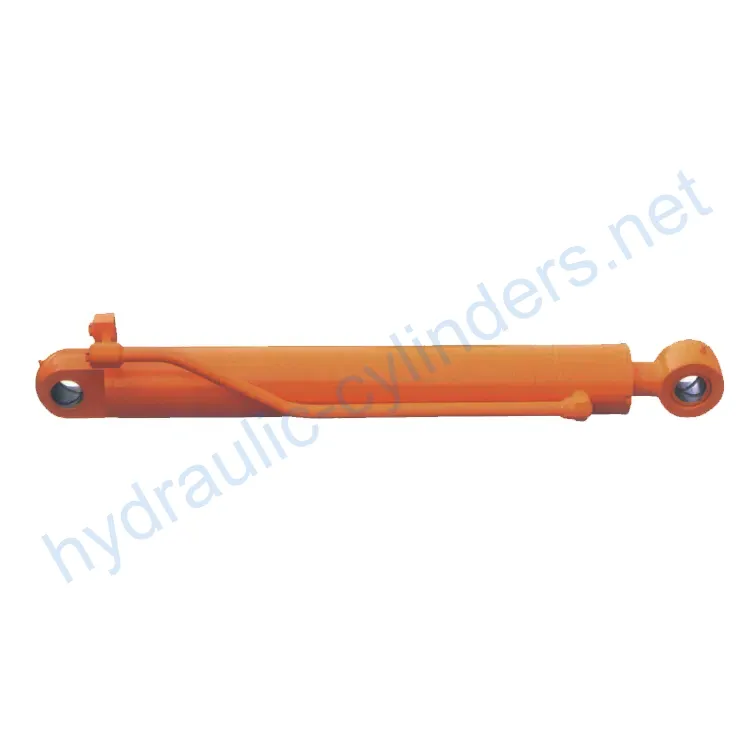
Cylindre de bras pour John Deere E230LC
En tant que fabricant, fournisseur et exportateur de produits mécaniques, nous proposons des vérins hydrauliques et de nombreux autres produits.
N'hésitez pas à nous contacter pour plus de détails.
Courrier :sales@hydraulic-cylinders.net
Fabricant fournisseur exportateur de vérins hydrauliques.
Introduction to Arm Cylinder For John Deere E230LC
The Arm Cylinder For John Deere E230LC is a specialized hydraulic cylinder designed to provide linear motion and power for various types of machinery, such as excavators, cranes, and robotic arms. The arm cylinder plays a crucial role in hydraulic systems, allowing for efficient movement and control of additional tools or attachments. These cylinders not only enable smooth motion but also withstand heavy loads, ensuring efficient operation and reliability of the machinery in various working conditions.
Définition et explication
The arm cylinder is a type of hydraulic cylinder specifically designed to provide linear motion and power to the arm of different types of machinery. It is essential in hydraulic systems for the effective movement and control of attached tools or accessories. These cylinders offer smooth motion and high load-bearing capacity, ensuring efficiency and reliability in various operational conditions. With their durability and functionality, arm cylinders are widely used in industries such as construction, manufacturing, agriculture, mining, logistics, and transportation.
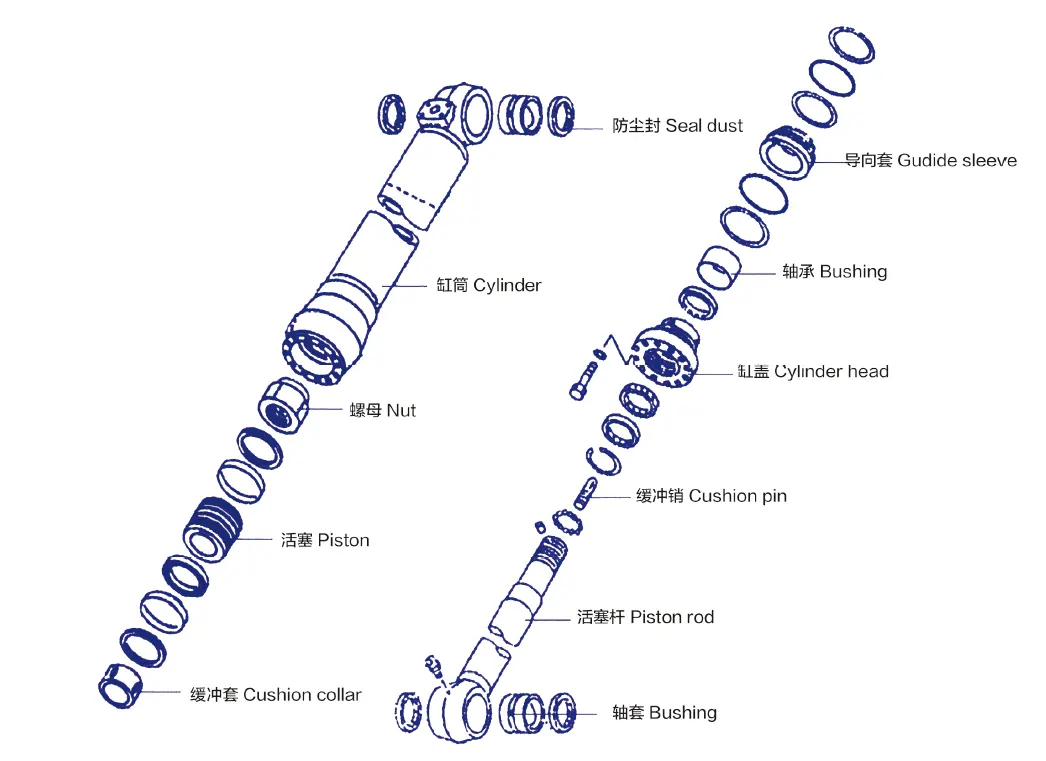
Features of Arm Cylinder For John Deere E230LC
1. Transmission à haut rendement
Le vérin du bras assure un mouvement linéaire et une force puissants, garantissant des performances élevées pour la machine.
2. Contrôle précis
The hydraulic system allows for precise motion control of the arm cylinder, resulting in flexible and accurate operation of attached tools.
3. Grande durabilité
The arm cylinder is constructed with high-strength materials, offering excellent wear resistance and corrosion resistance for prolonged use in harsh environments.
4. Adaptabilité polyvalente
These cylinders can be widely used in various machinery, such as excavators, cranes, and robotic arms, to meet different working requirements.
5. Entretien facile
The design of the arm cylinder considers easy maintenance and replacement, making regular inspection and upkeep more convenient and reducing equipment downtime.

Applications of Arm Cylinder For John Deere E230LC
The arm cylinder finds diverse applications in various industries:
1. Ingénierie de la construction
In excavators and cranes, the arm cylinder controls the movement of buckets or jibs for earthwork, material handling, and structural installation.
2. Industrie manufacturière
In automated production lines, the arm cylinder facilitates the motion of robotic arms, enabling processes such as assembly, welding, and material handling, leading to increased productivity and precision.
3. Machines agricoles
In agricultural equipment such as harvesters and planters, the arm cylinder controls the movement of operating arms, performing tasks such as planting, fertilizing, and harvesting.
4. Mining Operations
Dans les équipements miniers, le vérin de bras contrôle le mouvement des bras des machines d'extraction et de transport du minerai.
5. Logistique et transport
Dans les chariots élévateurs et les robots de manutention, le vérin du bras contrôle le levage et le mouvement des fourches, facilitant ainsi la manutention et l'empilage des matériaux.
Considérations de conception et critères de sélection
When considering the design and selection of the arm cylinder, several factors come into play:
1. Capacité de charge
The arm cylinder must be capable of withstanding the intended loads and forces in the application.
2. Scellement
Various sealing components, such as piston seals and rod seals, are used to ensure proper sealing and prevent leakage of hydraulic fluid.
3. Durabilité
Materials with high durability, wear resistance, and corrosion resistance are chosen for the construction of the arm cylinder to ensure long-term performance in demanding environments.
4. Sécurité
Safety features are incorporated into the design, such as pressure relief valves and emergency stop mechanisms, to prevent accidents and ensure operator safety.
5. Maintenabilité
The arm cylinder design considers ease of maintenance and repair, allowing for efficient servicing and minimizing downtime.

Étanchéité et lubrification du vérin de bras
The arm cylinder utilizes various seals, such as piston seals and rod seals, which are made of wear-resistant materials such as polyurethane and nitrile rubber. The cylinder body and threaded end surfaces are finely processed to enhance wear resistance. Regular lubrication with an appropriate amount of hydraulic oil is necessary to ensure smooth operation and longevity.
Inspection régulière et maintenance préventive
Pour garantir des performances et une longévité optimales, les mesures suivantes doivent être prises :
1. Inspection régulière
Periodic inspections should be conducted to check for any signs of wear, leaks, or damage to the arm cylinder or its components.
2. Preventive Maintenance
Appropriate preventive maintenance, such as cleaning, lubrication, and adjustment, should be carried out to prevent potential issues and ensure reliable operation.
Guide d'installation du produit
Une installation correcte du cylindre de bras est essentielle à son bon fonctionnement et à sa longévité. Suivez ces étapes :
1. Preparing for Installation
Gather all the necessary tools and equipment for installation, ensuring a clean and safe working environment.
2. Positioning the Cylinder
Position the arm cylinder in the correct location, aligning it with the mounting points on the machinery.
3. Connecting Hoses and Fittings
Connect the hydraulic hoses and fittings to the arm cylinder, ensuring secure and leak-free connections.
4. Securing the Cylinder
Securely fasten the arm cylinder to the machinery using the appropriate mounting hardware and torque specifications.

Considérations de sécurité et facteurs environnementaux
When using the arm cylinder, it is essential to prioritize safety measures. Keywords regarding safety precautions are of utmost importance to prevent accidents and ensure the well-being of operators.
Dépannage et problèmes courants
Despite their reliability, arm cylinders may encounter certain problems. Here are some common issues:
1. Fuite
Leakage can occur due to damaged seals or fittings. Inspect and replace any faulty components.
2. Abnormal Noise
If the arm cylinder produces unusual noise during operation, it may indicate worn-out components or inadequate lubrication. Check and rectify the issue accordingly.
3. Slow or Inconsistent Movement
Inadequate hydraulic pressure or damaged internal components can cause slow or inconsistent movement. Address the hydraulic system or inspect for damaged parts.
4. Cylinder Jamming
Jamming can occur due to misalignment or foreign objects obstructing the cylinder’s movement. Clear any obstructions and ensure proper alignment.
Conseils et solutions de dépannage
Pour un dépannage et une résolution de problèmes efficaces, tenez compte des conseils suivants :
1. Diagnosis
Thoroughly analyze the symptoms and perform a systematic diagnosis to identify the root cause of the issue.

 FR
FR  EN
EN  PT
PT  ES
ES  DE
DE  IT
IT  AR
AR  ZH
ZH  RU
RU  KO
KO  KA
KA  BG
BG  CS
CS  DA
DA  EL
EL  ET
ET  FI
FI  HU
HU  ID
ID  LT
LT  LV
LV  NB
NB  NL
NL  PL
PL  RO
RO  SK
SK  SL
SL  SV
SV  TR
TR  UK
UK