
Advanced Manufacturing Engineering
From Blueprint to Assembly: A Complete Look at Modern Hydraulic Cylinder Manufacturing and QA
An authoritative engineering blueprint detailing computer aided design, precision CNC machining, robotic orbital welding, and the rigorous quality assurance testing required to build world class fluid power linear actuators.

The Engineering Science Behind Unstoppable Force
In the highly rigorous disciplines of commercial earthmoving, advanced industrial automation, deep subterranean mining, and severe duty logistics, machinery relies entirely on the flawless execution of fluid power. Hydraulic cylinders act as the ultimate mechanical muscles, converting the immense hydrostatic pressure of synthetic fluids into perfectly controlled, unrelenting linear kinetic energy. However, generating thousands of pounds of force without catastrophic structural failure requires absolute manufacturing perfection. The journey from a raw steel billet to a fully functional high pressure actuator is a masterpiece of modern industrial fabrication. To explore the absolute highest industry standards for precision engineered components, visiting our premium hydraulic cylinders platform provides an essential technical baseline for procurement and design engineers.
Modern hydraulic cylinder manufacturing is no longer a traditional metalworking process; it is a highly integrated cyber physical production system. Every stage of fabrication involves microscopic tolerances, advanced metallurgical chemistry, and automated robotic precision. A single deviation in wall thickness calculation, a microscopic porosity in a weldment, or a contaminated assembly environment will instantly compromise the hydrostatic boundary, leading to dangerous fluid blowouts and massive operational downtime on the job site.
Evaluated against stringent international ISO fluid power fabrication and QA standards, this comprehensive technical blueprint will serve as your ultimate window into the factory floor. We will meticulously dissect the entire production lifecycle, exploring the mathematics of Finite Element Analysis during the design phase, the tribological perfection of CNC skiving, the metallurgical integrity of robotic orbital welding, and the non destructive QA testing protocols required to guarantee flawless operation in the field.
Phase 1: Digital Blueprinting and Finite Element Analysis
Before any steel is cut, the hydraulic cylinder must be mathematically proven in a virtual environment to ensure it can survive extreme hydrostatic and kinetic shock loads.
CAD Modeling and Fluid Dynamics
Design engineers utilize advanced Computer Aided Design software to map the exact internal geometry of the actuator. They calculate the precise bore dimensions to achieve the required pushing force and evaluate the annular rod area to determine retraction speeds. Flow simulations are run to ensure that hydraulic fluid can enter and exit the ports without causing turbulent cavitation. This phase is critical when designing multi stage Dump Truck Hydraulic Cylinders, where the volumetric flow between nested sleeves must be perfectly calibrated for smooth, uninterrupted lifting.
Finite Element Analysis (FEA)
Once the model is built, it undergoes intense mathematical stress testing known as Finite Element Analysis. The software simulates thousands of pounds of pressure pushing outward against the barrel wall to check for hoop stress failure. Concurrently, compressive loads are applied to the virtual piston rod to verify its resistance to Euler column buckling. If the software detects a potential weak point, the engineer increases the wall thickness or selects a higher yield chromoly steel alloy before approving the blueprint for the factory floor.

Phase 2: Precision Machining and Skiving
Transforming raw steel tubes and solid rods into high precision fluid power components requires state of the art CNC machining. The internal topography of the barrel must be microscopically flawless to prevent seal destruction.
Skiving and Roller Burnishing
Standard steel tubing has a rough, uneven interior. To prepare it for hydrostatic sealing, the barrel undergoes a skiving and roller burnishing process. A cutting head is driven rapidly through the tube, shaving off the rough interior surface to exact dimensional tolerances. Immediately following the cutter, hardened steel rollers compress the remaining microscopic peaks of the metal. This cold working process creates a glass like, mirror finish on the internal wall while simultaneously work hardening the surface. This flawless topography ensures that dynamic polyurethane seals can glide back and forth millions of times without suffering abrasive wear.
CNC Turning the Piston and Gland
The solid steel piston and the head gland are machined on highly advanced multi axis CNC lathes. The machine precisely cuts the deep grooves required to hold the complex array of elastomeric O rings, PTFE backup rings, and bronze filled wear bands. If these grooves are machined even a fraction of a millimeter too wide, the seals will extrude under extreme hydrostatic pressure, causing an instant blowout. The strict adherence to microscopic machining tolerances is why premium Agricultural Hydraulic Cylinders can survive the relentless shock loads of deep soil ripping without suffering internal fluid bypass.

Phase 3: Robotic Orbital Welding and Structural Fusion
Welded body hydraulic cylinders rely entirely on the integrity of their weldments. A weak weld is a ticking time bomb under high pressure.
Automated Orbital Welding
To connect the heavy cast steel base cap to the barrel, manufacturers employ automated robotic orbital welding cells. The cylinder rotates on a fixture while the robotic welding arm deposits a continuous, multi pass bead of high tensile filler metal. This automated process ensures deep metallurgical penetration and perfectly consistent heat distribution, eliminating the microscopic porosities and slag inclusions associated with manual welding. This creates an indestructible bond capable of handling extreme pressure spikes.
Securing Trunnions and Ports
In addition to the base cap, the heavy duty mounting trunnions and fluid ports are welded to the exterior of the barrel. For massive mobile equipment like Excavator Hydraulic Cylinders, these mounting points endure millions of violent shock impacts as the bucket crashes into bedrock. The welds must possess immense shear strength. After welding, the entire assembly undergoes stress relieving heat treatment to normalize the crystalline structure of the steel, preventing premature fatigue cracking in the field.
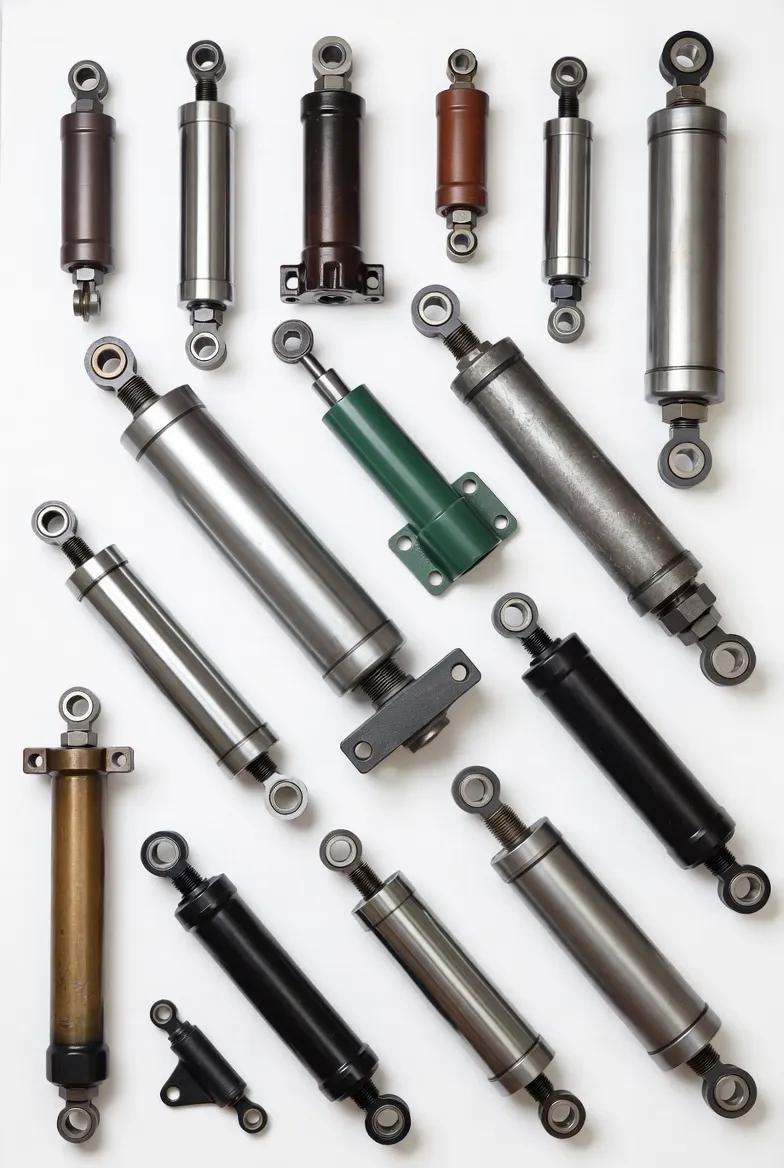
Phase 4: Plating and Cleanroom Assembly
With the steel components machined and welded, the final stages of manufacturing focus on environmental protection and pristine mechanical integration.
- ✔️
Induction Hardening and Chrome Plating: The piston rod is the only dynamic part exposed to the outside world. To survive flying rocks and corrosive environments, the carbon steel rod is passed through high frequency induction coils, hardening its outer surface. It is then submerged in a massive electrochemical bath where a thick layer of hard hexavalent chromium is plated onto the steel. This provides incredible rust immunity and an ultra low friction surface that glides smoothly past the head gland seals.
- ✔️
Cleanroom Assembly Protocols: The actual assembly of the cylinder must occur in a climate controlled, positive pressure cleanroom environment. A single piece of metallic swarf or silica dust trapped inside the barrel during assembly will instantly score the seals upon the first stroke. Technicians meticulously lubricate the premium polyurethane seals, install the wear bands, torque the piston nut to exact mathematical specifications using hydraulic wrenches, and carefully insert the rod assembly into the barrel without nicking the delicate elastomers. This extreme cleanliness is mandated for life safety applications like Aerial Work Vehicle Hydraulic Cylinders, where absolute reliability is paramount.

Phase 5: The Ultimate Proving Ground — Quality Assurance
A fully assembled hydraulic cylinder is never shipped blindly. It must be subjected to a battery of violent diagnostic tests to prove its hydrostatic capability before it is released to the field.
Hydrostatic Proof and Drift Testing
Every cylinder is mounted to a specialized testing manifold. High pressure fluid is pumped into the cylinder, intentionally pressurizing it to 1.5 times its maximum rated operating pressure. The cylinder is deadheaded, and highly sensitive digital sensors monitor for any pressure decay. If the pressure drops even a fraction of a PSI, it means fluid is invisibly bypassing the internal piston seal, which would cause dangerous load drift in the field. This absolute verification of zero bypass is critical for safety.
Non-Destructive Testing (NDT)
For the critical robotic welds, QA inspectors deploy Ultrasonic Testing (UT) or Magnetic Particle Inspection (MPI). These advanced Non Destructive Testing methods scan deep beneath the surface of the steel to detect any hidden porosities, slag inclusions, or microscopic fatigue cracks that could lead to a catastrophic blowout under heavy cyclic loading. Only cylinders that pass both hydrostatic and NDT protocols receive their serial number and final protective paint coating.

Conclusion: The Architecture of Absolute Reliability
The modern manufacturing of a hydraulic cylinder is a flawless synergy of advanced computer science, heavy industrial metallurgy, and rigorous quality assurance. From the initial finite element stress calculations that dictate the barrel thickness, to the high precision CNC skiving that creates a mirror smooth path for the polymers, and the brutal hydrostatic proof tests that verify the final assembly, every single stage is meticulously designed to eliminate the possibility of mechanical failure. When you procure a fluid power actuator built to these exacting global standards, you are not simply buying a part; you are securing the kinetic reliability, efficiency, and safety of your entire heavy machinery fleet. Whether outfitting autonomous Forklift Hydraulic Cylinders or massive earthmoving equipment, demanding manufacturing transparency is your ultimate safeguard. If your organization requires custom fluid power solutions engineered and fabricated to the absolute highest echelons of industrial quality, our premier technical team stands ready to deliver.