
Advanced Fluid Power Kinematics
Servo vs. Standard Hydraulic Cylinders: The Secret to Sub-Micron Precision Control
An authoritative engineering blueprint detailing closed-loop feedback systems, hydrostatic bearing friction reduction, linear position transducers, and the ultimate architecture required to achieve flawless positional accuracy in automated machinery.

The Evolution from Brute Force to Absolute Precision
In the expansive realm of fluid power engineering, hydraulic actuators have long been revered as the undisputed champions of brute force. The fundamental physics of utilizing incompressible synthetic fluids to transmit immense hydrostatic pressure allows a relatively compact steel cylinder to effortlessly lift, crush, or move hundreds of tons of material. For decades, this raw mechanical power was the sole engineering objective. However, modern Industry 4.0 automation, advanced aerospace testing, and highly sophisticated manufacturing processes now demand something far more complex than simple kinetic force. They demand absolute, unwavering positional precision. The machine must not only push a fifty ton payload, but it must stop that payload exactly at a microscopic coordinate, holding it with sub-micron accuracy without a fraction of a millimeter of drift. This intense engineering paradox is exactly where the profound divide between standard fluid power actuators and servo hydraulic cylinders originates. To explore the absolute highest industry standards for precision engineered components, visiting our premium hydraulic cylinders platform is a mandatory first step for serious procurement professionals.
A standard fluid power actuator operates in an open-loop configuration. The operator or basic computer shifts a directional control valve, fluid enters the barrel, and the piston moves until it hits a mechanical stop or the valve is closed. It is an effective “bang-bang” control system. Conversely, a servo hydraulic cylinder is a highly intelligent, closed-loop cyber-physical system. It merges the immense power density of traditional hydraulics with the exacting, software driven precision of electric servo motors. The cylinder is in constant, millisecond communication with a central processing unit, continuously verifying its exact physical position, velocity, and force output, and making instantaneous micro adjustments to correct any kinematic deviations.
From an authoritative engineering perspective evaluated against international ISO manufacturing criteria, designing and specifying a servo system requires a complete paradigm shift. The internal mechanical tolerances, the elastomeric seal compounds, and the control valve architectures are entirely different from standard equipment. This comprehensive technical masterclass will meticulously dissect the structural anatomy of servo hydraulic cylinders, explore the devastating effects of stick-slip friction, analyze the integration of linear position sensors, and provide the definitive decision matrix for when your machinery must transition from standard force to sub-micron precision control.
The Structural Limitations of Standard Actuators
To appreciate the genius of servo architecture, one must first understand exactly why standard hydraulic cylinders fail when tasked with high-precision, low-velocity movements.
The Stick-Slip Phenomenon (Stiction)
Standard cylinders utilize heavy-duty polyurethane or nitrile rubber seals that squeeze tightly against the steel barrel to prevent high-pressure fluid bypass. This tight squeeze creates immense static friction. When the cylinder is commanded to move slowly, the fluid pressure must build up high enough to overcome this static friction. Once the seal breaks free, it suddenly transitions to lower dynamic friction, causing the piston to violently jerk forward. The pressure drops, the seal grabs again, and the cycle repeats. This jerky, stuttering movement is called “stick-slip” or stiction. While perfectly acceptable for heavy earthmoving equipment like Dump Truck Hydraulic Cylinders, stick-slip makes sub-micron positioning mathematically impossible.
Open-Loop Blindness
A standard cylinder is “blind.” It has no internal mechanism to communicate its exact physical position back to the machine controller. If a heavy payload causes the fluid to compress slightly, or if internal leakage across a worn directional valve allows the piston to drift backward by a fraction of an inch, the machine’s computer remains completely unaware of the error. In precision applications, this lack of feedback leads to compounding dimensional errors, resulting in ruined manufacturing batches or failed robotic operations.

The Anatomy of a Servo Hydraulic Cylinder
To completely eradicate stick-slip friction and establish flawless closed-loop communication, fluid power engineers redesign the cylinder from the ground up, utilizing advanced metallurgical and polymer sciences.
Frictionless Sealing Architectures
The heavy rubber U-cups found in agricultural equipment are completely banned in servo cylinder design. Instead, servo actuators utilize specialized low-friction step seals made from PTFE (Polytetrafluoroethylene, commonly known as Teflon) infused with bronze or carbon. These advanced polymer composite rings slide against the micro-honed steel barrel with practically zero static friction. In the absolute highest-end aerospace testing simulators, engineers completely remove physical seals, utilizing Hydrostatic Bearings where a microscopic, continuous film of highly pressurized fluid floats the piston rod so it never touches the steel housing. This complete elimination of tribological friction allows the cylinder to respond instantly to commands without any mechanical hesitation.
Linear Position Transducers (LVDT / Magnetostrictive)
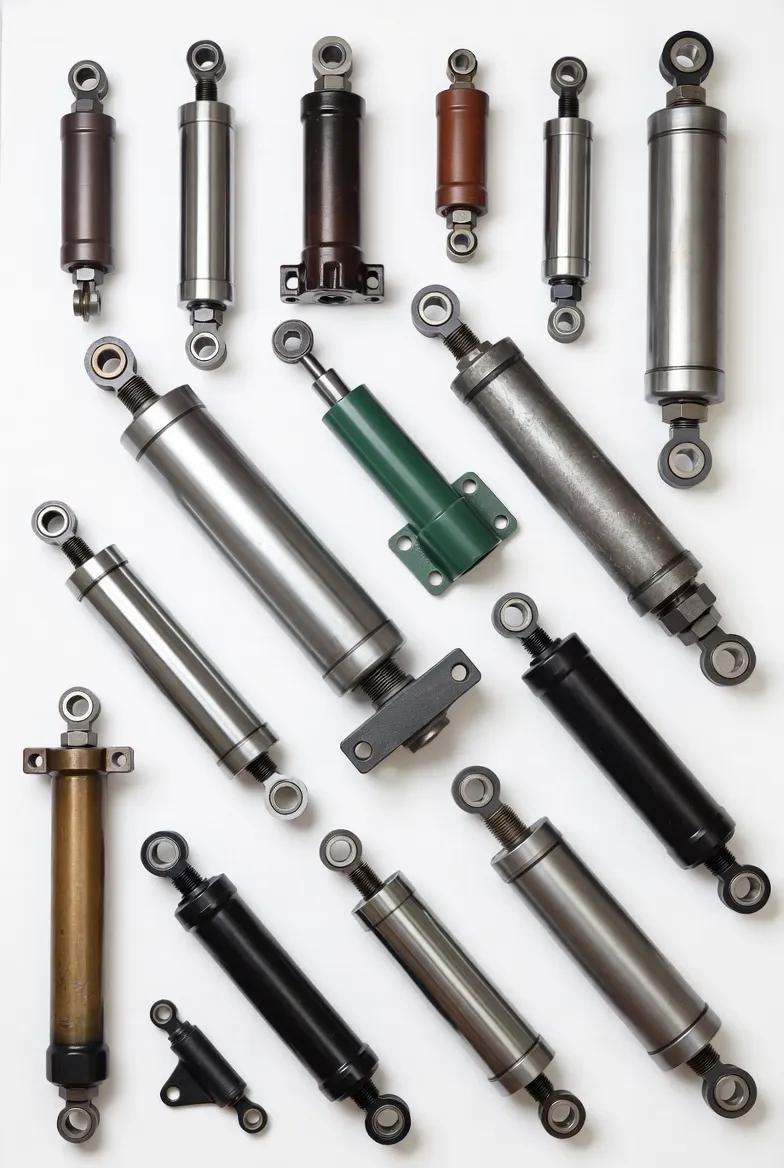
The defining characteristic of a servo cylinder is its internal vision. The piston rod is gun-drilled hollow, and a highly sensitive linear position sensor is inserted directly into the core of the actuator. Magnetostrictive sensors utilize a magnetic ring attached to the piston that travels over a waveguide wire, sending high-frequency torsional strain pulses back to the sensor head. This allows the cylinder to report its exact position, down to a fraction of a micron, thousands of times per second. If the payload attempts to drift by even one ten-thousandth of an inch, the sensor instantly detects the error and commands the hydraulic valves to correct it. This technology is vital for complex machinery like Forklift Hydraulic Cylinders that are upgraded for autonomous, driverless warehouse navigation.
The Brains of the Operation: High-Frequency Servo Valves
A highly precise cylinder is useless without an equally precise fluid delivery mechanism. Standard directional control valves are far too crude to operate a closed-loop system.
Voice Coil Actuation
Instead of using basic electrical solenoids to smash a heavy spool back and forth, true servo valves utilize advanced voice coil technology—similar to the mechanisms found in high-end audio speakers. These voice coils use electromagnetic fields to shift the internal valve spool with infinite variability and zero mechanical friction. This allows the valve to throttle the hydraulic fluid flow in microscopic increments, reacting to computer commands in less than a millisecond.
The PID Control Loop
The servo valve, the cylinder sensor, and the machine’s central computer form a Proportional-Integral-Derivative (PID) control loop. The computer sets a “target position.” The sensor reports the “actual position.” The computer calculates the “error” between the two and commands the servo valve to release the exact, mathematically perfect volume of high-pressure fluid required to correct the error instantly. This continuous feedback loop happens thousands of times every second, creating motion that appears perfectly smooth and rigid to the human eye.
Extreme Fluid Purity Mandates
Because servo valves rely on microscopic internal clearances to achieve sub-micron control, they are notoriously sensitive to contamination. A single grain of silica dust that would easily pass through a standard Agricultural Hydraulic Cylinder will instantly jam a servo valve, causing total system paralysis. Deploying servo systems requires absolute dedication to ISO cleanliness standards, utilizing high-pressure, three-micron absolute kidney-loop filtration systems continuously.

Where Brute Force Meets Absolute Precision: Core Applications
Servo hydraulic cylinders represent a significant capital investment. They are deployed exclusively in environments where standard actuators would fail to meet the exacting geometric and temporal tolerances required by the process.
- ✔️
Aerospace Structural Testing: When evaluating the fatigue limits of a commercial airliner wing, engineers use arrays of servo cylinders to apply highly complex, rapidly fluctuating kinetic loads to the aluminum structure. The cylinders must replicate the exact aerodynamic vibrations of flight, requiring flawless, high-frequency synchronization that only a closed-loop system can deliver.
- ✔️
Plastic Injection Molding: Pushing molten polymer into a complex steel mold requires immense pressure followed by an instantaneous, perfectly timed stop. If the cylinder pushes a fraction of a millimeter too far, it will flash the mold, ruining the part. Servo hydraulics provide the massive clamping force required while guaranteeing the sub-micron stopping accuracy necessary for high-yield precision manufacturing.
- ✔️
Advanced Safety Elevation: While standard Aerial Work Vehicle Hydraulic Cylinders rely on mechanical counterbalance valves, next-generation autonomous platforms are beginning to integrate servo-proportional systems to ensure the human payload is elevated and suspended with zero mechanical shuddering, regardless of wind resistance or chassis movement.


Conclusion: Architecting the Future of Fluid Power
The leap from standard hydraulic cylinders to servo-controlled systems represents the pinnacle of modern fluid power engineering. By systematically eliminating destructive stick-slip friction through advanced PTFE polymers and hydrostatic bearings, integrating highly sensitive magnetostrictive linear position sensors, and throttling the fluid with lightning-fast voice coil servo valves, engineers can achieve a level of kinematic perfection previously thought impossible. These closed-loop systems take the raw, uncompromising lifting capacity of a massive Excavator Hydraulic Cylinder and refine it with the surgical precision of a microscopic scalpel. As global industries push toward total automation, the integration of intelligent, software-driven fluid power will become the absolute standard. If your manufacturing facility is struggling with dimensional inaccuracies, unpredictable cycle times, or requires a massive upgrade to sub-micron positional control, our elite engineering team stands ready to architect your custom fluid power solution.