
Fluid Power Engineering Foundations
Hydraulic Cylinder Basics: 10 Core Terms Every Novice Engineer Must Know
An authoritative and comprehensive technical blueprint detailing the critical nomenclature, physical components, hydrostatic principles, and the foundational engineering vocabulary required to architect modern fluid power systems.

Decoding the Lexicon of Mechanical Force
Entering the highly specialized discipline of fluid power engineering requires more than a rudimentary understanding of mechanical physics. It demands absolute fluency in the exact terminology that governs the design, deployment, and diagnostic troubleshooting of linear actuators. In the realms of commercial earthmoving, advanced industrial automation, deep subterranean mining, and high-yield agriculture, hydraulic cylinders are the undisputed instruments of kinetic power. They convert the intense hydrostatic pressure of synthetic fluid into perfectly controlled linear movement. However, for a novice engineer tasked with specifying or repairing these massive steel pressure vessels, the specialized vocabulary can appear overwhelming. Misunderstanding a single term on a technical specification sheet can result in catastrophic equipment failure, ruptured seals, or structurally buckled machinery. To establish a baseline of elite engineering standards, visiting our premium hydraulic cylinders platform provides a critical point of reference for modern component architecture.
The fluid power industry relies on a rigid, highly standardized nomenclature defined by organizations such as ISO and the National Fluid Power Association. When a senior designer references the annular area, the gland extrusion gap, or the Euler column limit, there is zero margin for interpretation. Every term represents a specific mathematical calculation or a physical metallurgical component that dictates the survival or destruction of the machine. The difference between an actuator that performs flawlessly for decades and one that detonates under peak hydrostatic load is entirely dependent on the engineer’s mastery of these foundational concepts.
This comprehensive technical masterclass is engineered specifically to eliminate the learning curve for professionals entering the fluid power sector. We will meticulously dissect the top ten core terms that define hydraulic cylinder architecture. By exploring the exact physics behind bore dimensions, the thermodynamic limits of elastomeric seals, the critical dynamics of rod displacement, and the structural variations of mounting mechanics, this guide will empower you to converse, design, and troubleshoot with the authority of a seasoned fluid power veteran.
The Mathematical Foundation: Geometry of the Actuator
1. Bore (Internal Diameter)
The “Bore” is the single most important mathematical dimension in fluid power. It refers to the internal diameter of the cylinder barrel. The bore diameter dictates the total cross-sectional surface area of the internal piston. According to Pascal’s Law, the physical pushing force generated by a cylinder is calculated by multiplying the internal fluid pressure by this exact piston area. Therefore, if you require more lifting force but cannot increase the system pressure, you must specify a cylinder with a larger bore. A massive internal bore is the defining characteristic of heavy-duty equipment like Excavator Hydraulic Cylinders, empowering them to tear through solid bedrock with hundreds of tons of linear thrust.
2. Stroke (Linear Displacement)
The “Stroke” defines the total physical distance that the piston rod can travel from its fully retracted resting state to its absolute maximum extended position. While the bore dictates the force, the stroke dictates the reach. Specifying the exact stroke length is crucial for machine kinematics; if the stroke is too short, the machine will not complete its intended motion arc. If the stroke is too long, the cylinder may collide with external machine framework, causing severe structural damage. Applications requiring extreme stroke lengths often utilize multi-stage telescopic architectures, such as those found in Dump Truck Hydraulic Cylinders, to achieve massive elevation from a compact chassis footprint.

The Anatomy of the Actuator: Structural Components
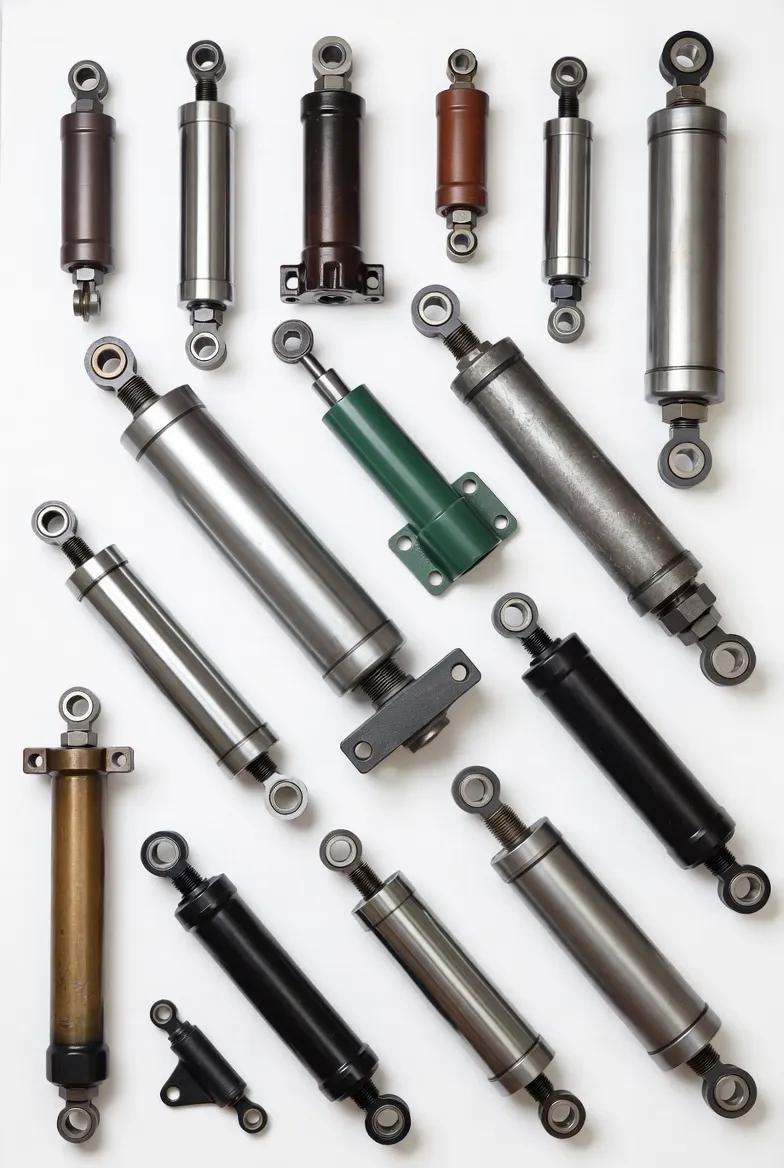
A hydraulic cylinder is not a singular block of steel. It is a highly complex assembly of precision-machined metallurgical components, each designed to perform a highly specific function under immense thermodynamic stress.
3. Piston Rod
The piston rod is the physical connection between the internal hydrostatic power and the external payload. It is the only component that repeatedly transitions between the internal oil bath and the harsh external environment. Rods are typically forged from high-yield 4140 chromoly steel to resist Euler column buckling, and are subsequently induction-hardened and electrochemically plated with hard chrome. This creates a diamond-hard, frictionless surface that defends against abrasive silica, caustic chemicals, and kinetic impacts. In outdoor environments, the survival of the rod is paramount, a design philosophy heavily emphasized in Agricultural Hydraulic Cylinders that face constant mud and fertilizer exposure.
4. Gland (Head Cap)
The “Gland,” often referred to as the cylinder head, is the precision-machined steel block that seals the end of the barrel where the rod extends. It is the most complex stationary component of the cylinder. The gland houses the primary high-pressure rod seals, the external environmental wiper seals, and the internal brass or composite wear bands that mechanically guide the rod and absorb lateral side-loading. If the gland is improperly torqued or suffers from structural fatigue, high-pressure fluid will instantly blow out, paralyzing the machine. It is the ultimate hydrostatic boundary.

Architectural Configurations: How the Cylinder Moves
Not all cylinders are designed to push and pull with equal capability. The internal porting architecture defines exactly how the actuator utilizes fluid power.
5. Single-Acting vs. Double-Acting
A Single-Acting cylinder features only one hydraulic port. Fluid enters to push the piston out, but the system relies entirely on gravity or an internal mechanical spring to force the oil back out and retract the rod. A Double-Acting cylinder features two ports—one at the blind end and one at the rod end. This allows high-pressure fluid to be directed to either side of the piston, creating immense, powered force in both extension and retraction directions. Double-acting architecture is mandatory for complex kinematic operations requiring precision push-pull control.
6. Operating Pressure (PSI / Bar)
Operating Pressure denotes the maximum continuous internal hydrostatic force the cylinder is engineered to withstand without suffering plastic deformation or seal failure. Industrial systems commonly run at 3,000 PSI, while extreme mobile machinery can push beyond 5,000 PSI. Exceeding the specified operating pressure will cause the steel barrel to balloon outward, instantly extruding the polyurethane seals and destroying the actuator. Safe fluid power design always incorporates pressure relief valves calibrated slightly above this operating limit to prevent explosive over-pressurization.
Advanced Kinematics: Controlling the Fluid
Understanding force is vital, but managing the velocity and the impact of the fluid is what separates a crude machine from a masterfully engineered robotic system.
- ✔️
7. Internal Cushions: When a heavy payload reaches the end of the stroke, its kinetic momentum will violently slam the piston into the steel end caps. To prevent this destructive impact, cylinders are often equipped with internal cushions. These are integrated needle-valve shock absorbers that intentionally trap and restrict exhaust fluid in the final inches of travel. This generates a massive, localized hydrostatic backpressure that smoothly and safely decelerates the payload before metal-on-metal contact occurs.
- ✔️
8. Annular Area: This is a crucial calculation for predicting cylinder speed. In a double-acting cylinder, the extension speed relies on the full bore area. However, during retraction, the solid steel rod takes up physical space inside the barrel. The “Annular Area” is the total bore area minus the cross-sectional area of the rod. Because this area is smaller, it requires less fluid to fill the chamber. Consequently, for a given pump flow rate, a cylinder will always retract significantly faster than it extends. This differential volume calculation is vital for synchronizing fast-paced logistics equipment like Forklift Hydraulic Cylinders.

System Integration and Structural Integrity
9. Mounting Styles (Clevis, Trunnion, Flange)
The mounting style dictates how the extreme force is anchored to the machine chassis. Flange mounts are rigid and ideal for straight-line stationary industrial presses. However, for mobile equipment featuring swinging booms, rigid mounts would instantly break. Clevis and Trunnion mounts act as pivots, allowing the entire cylinder body to swing in a radial arc alongside the moving payload. This pivoting action completely isolates the fragile internal seals from destructive lateral side-loading. For critical elevation safety, such as Aerial Work Vehicle Hydraulic Cylinders, perfectly aligned pivot mounts are mandatory.
10. Elastomeric Seals
Seals are the microscopic polymer boundaries that contain the immense hydrostatic pressure. Modern cylinders utilize high-performance Polyurethane or Viton materials to create U-cups, O-rings, and Wiper seals. If system pressure spikes beyond the seal’s structural limit, the rubber will literally extrude into the clearance gap between the steel parts and shred to pieces. Furthermore, extreme thermodynamic heat can bake the seals, rendering them brittle and useless. The entire operational life of the actuator depends on the chemical and physical survival of these elastomeric components.

Conclusion: Mastering the Language of Power
Fluency in the ten core terms of hydraulic cylinder architecture is not merely an academic exercise; it is the absolute foundation of successful fluid power engineering. By understanding the mathematical relationship between bore and operating pressure, the kinematic realities of stroke and annular volume, and the structural limits of piston rods and elastomeric seals, novice engineers transform into capable, authoritative designers. This specialized vocabulary bridges the gap between theoretical calculations on a blueprint and the brutal, unrelenting reality of heavy machinery operating in the field. When you speak the language of fluid power with precision, you guarantee that your equipment will perform with absolute safety, maximum efficiency, and decades of unstoppable reliability. If you are ready to apply these concepts to your next massive mechanical project, or if you require advanced guidance on specifying the perfect actuator, our elite technical support team is standing by to engineer your success.